




The palace dominates from above, more than one hundred meters high, the coastal part of Vasto, like a monolith in square-cut light stone. Located behind the Cathedral and at the border of the two areas of the old city, that of Roman foundation and that which grew during the Middle Ages, the palace was founded by the condottiero and lord of Vasto, Giacomo Caldora, perhaps in the twenties of the fifteenth century. Little remains of the original appearance, except the structural layout with the large central courtyard, and some traces in the external masonry fabric, two of which are the double window and the remains of the Durazzo-style portal, which testify to the elegance of the architectural and decorative apparatus. After the lordship passed to the Guevara, who perhaps completed the construction, especially in the part facing the sea, in 1496 the domain came into the hands of the D’Avalos, who made it, for three centuries, not only a residence, but also the seat of the city magistracies. The most severe event was the Turkish invasion of 1566, which, taking advantage of the absence of Marquis Francesco Ferdinando, residing in Palermo after being appointed Viceroy of Sicily, plundered Vasto and damaged the palace. His wife, Isabella Gonzaga, daughter of the Duke of Mantua, after the death of her husband, from 1573, began consolidation and reconstruction work, which did not end before the beginning of the following century. However, the golden century of the palace was the eighteenth century: the new lords of the Lante della Rovere family enriched the apartments and established a small but lively court there. With the French invasion, the residence began its decline and during the nineteenth century several rooms were demolished or assigned to various uses. From the 1970s onward, Palazzo D’Avalos began a gradual recovery process. Today it houses the city’s art and archaeology collections. The art gallery is located in the eastern and southern wings of the first floor of the palace and hosts works by Donnini, Moccioli, Michetti, Brill, and Palizzi.
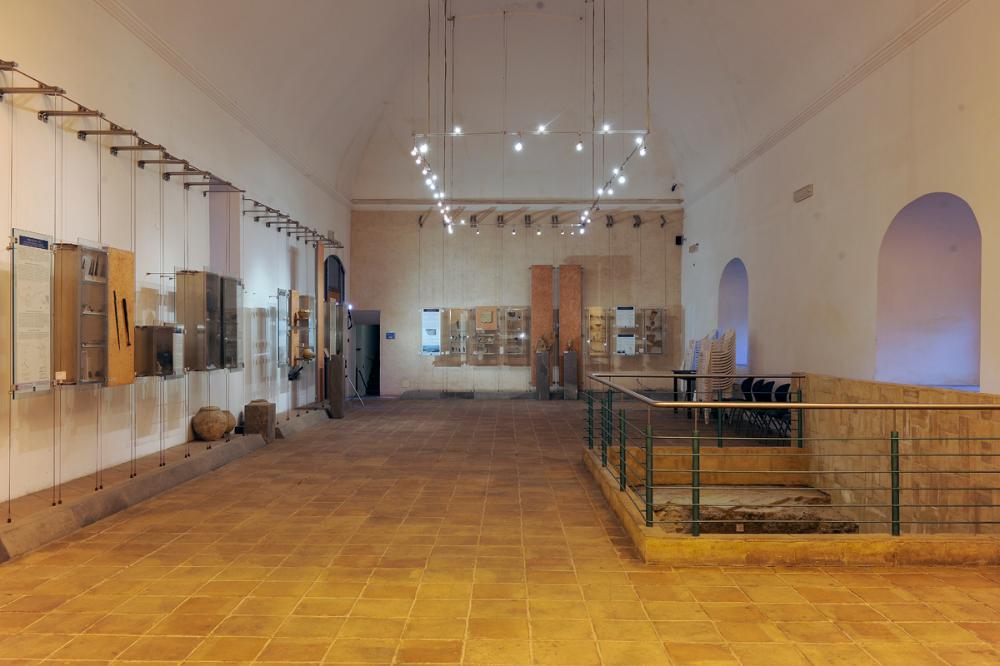
The archaeological collection, divided into five rooms, includes finds from the Iron Age to the early Middle Ages that testify to the development of the Frentan area and the city of Histonium (ancient Vasto).
In the first room are exhibited artifacts from the 10th century to the 1st century BC: burial items from the Tratturo and Villalfonsina necropolises, votive terracottas from the sanctuaries of Villalfonsina and Punta Penna, a collection of small bronzes and numismatics.
The second room is dedicated to the development of the city of Histonium in the early imperial age (1st century BC): portraits of the Julio-Claudian gens, sarcophagi, and amphorae are on display.
The third room concerns the expansion of Histonium in the full imperial age (1st-2nd century AD): there are remains from the amphitheater, aqueducts, cisterns, and a mosaic thermal complex; also exhibited are oil lamps, stamped bricks, and a finely crafted bust of a woman.
In the fourth room are the burial items from the most important city necropolises: the area of Largo Barbacane, the town hall palace, the Castello Caldoresco.
In the last room there are evidences of late antiquity and the Early Middle Ages: inscriptions, coins, and a ciborium from a 7th-century church in Vasto.
Information about Palazzo d’Avalos – Civic Museums
Piazza Lucio Valerio Pudente, 1
66054 Vasto (Chieti)
0873367773
[email protected]
https://www.museipalazzodavalos.it
January – June 10 Saturday, Sunday and holidays 10:30 AM – 12:30 PM, 4 PM – 7 PM June 16 – August 31 every day 10:30 AM – 12:30 PM, 6 PM – 12 AM September 1-30 every day 10:30 AM – 12:30 PM, 6 PM – 10 PM October 1 – December 12 Saturday, Sunday and holidays 10:30 AM – 12:30 PM.
€ 3.00
Source: MIBACT


