


Wicklow teaches. Following the example of Ireland’s most “flowering” county, which for years, between May and August, hosts an internationally renowned floral festival, other regions are highlighting the history, nature, and characteristics of their own green jewels.
In the West, great relevance is being found by the Ireland West Garden Trail, a virtual route that unfolds between the counties of Galway, Mayo, and Roscommon, painted with blooms of rhododendrons, azaleas, camellias, heather, and botanical varieties that here find favor in a climate tempered by the Gulf Stream. Included are towering palms with an exotic appearance!
In the heart of Connemara, a true “veteran” in the sector is the garden of Ballynahinch Castle Hotel created two centuries ago between the river course and the Twelve Bens hills. Complementing two illustrious hotels is also the “secret garden” of Cashel House Hotel with its precious collections of ancient and modern roses, lilacs, magnolias, azaleas grown in a sort of nursery where, in 1919, Jack O’Mara inserted the most diverse and curious species from all corners of the world; and the informal garden of the Zetland Country House Hotel, overlooking the sea.
Celtic symbols and artistic installations instead for the Brigit’s Garden (Roscahill), a representation of the life cycle according to Celtic culture, designed by Mary Reynolds, where a non-profit association organizes educational programs for adults and children.
Literary reminiscences instead at Coole Park (Gort), property of Lady Gregory, playwright and co-founder of the Abbey Theatre, where stands the “tree of autographs,” with the engravings of the initials of writers – among whom Yeats, Synge, Beckett – who visited the residence every summer; the Kylemore Abbey & Victorian Walled Garden created by Mitchell Henry in 1867 and considered one of the most interesting Victorian gardens on the island.
At Portumna, on the banks of Lough Derg, among the flowering geometries of Portumna Castle, lie espaliers of fruit plants, lavender bushes, and the aromatic herbs of a garden created in the 17th century, recently restored; while at Letterfrack, on the ocean shores, Rosleague Manor opens romantic paths among groves and flowering shrubs.
Finally at Roscahill, the park of Ross Castle, on the shores of the homonymous lake, reveals an extraordinary variety of tall plants.
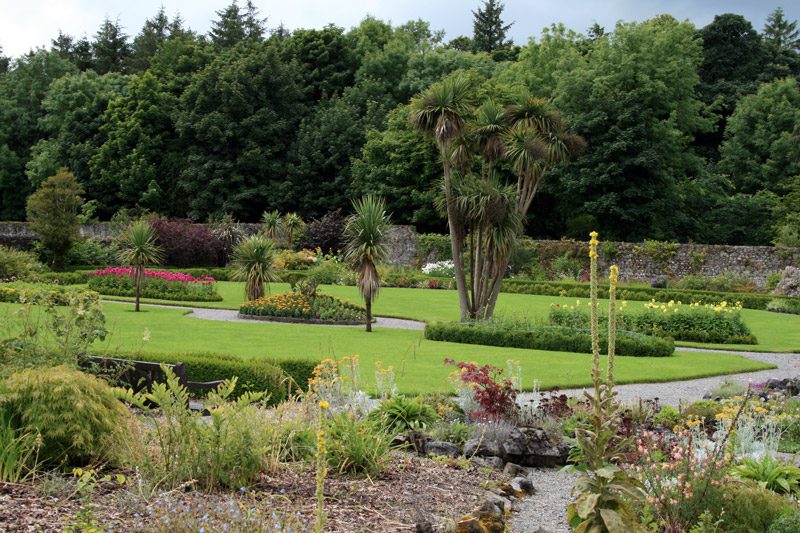
In Mayo, near Ballina, the Enniscoe House & Garden, next to the handicrafts and agricultural tools of the Mayo North Heritage Centre, presents the original 18th-century layout divided in the mid-19th century into an ornamental garden and a kitchen garden area.
Clear Victorian style for the green area that, in Castlebar, surrounds Turlough Park in a play of terraces, flowerbeds, and water mirrors around a very particular greenhouse. The scenic green space of Westport House in Westport, built in 1685 and considered one of the most significant historic residences on the island and now also a usual location for exclusive weddings, dates back instead to the early 20th century. Only two, but very valuable, are the floral wonders of Roscommon county.
At the gates of the capital, Castlecoote House and Gardens is a Palladian residence, built on the ruins of a 16th-century castle and immersed in a centuries-old park among fragments of flower carpets, an apple orchard, a bridge, and three medieval towers.
A true record at Strokestown, the Strokestown Park around the homonymous 18th-century manor now used as the Famine Museum, restored and refurnished with the furnishings. Besides the rose garden, collections of wildflowers and ferns, its peculiar feature lies in the green border that outlines it. The longest in the British Isles, included in the Guinness World Records.