


Calcata is a small village in the province of Viterbo in Lazio, a few kilometers from Rome. In the 1930s, fears of collapses in the cliffs forced the inhabitants to abandon the ancient center and rebuild the houses downstream. Calcata village was destined for demolition, but was saved by a special law, enacted during the fascist era, for the reconstruction of earthquake-affected centers in Sicily and Calabria. During the fascist period (1927) Calcata was transferred from the province of Rome to that of Viterbo. Calcata Rome is a short distance away, about 50 kilometers north of the capital.
It is called the village of artists. And indeed, when you cross the entrance of Calcata, north of Rome and in the province of Viterbo, you immediately get the feeling of being in a unique place. Here cars are forbidden and the village, suspended on a cliff, a trademark of the Tuscia region of Lazio, is said to be visited also for the positive energy it emanates.
The true attraction of Calcata is the positive energy it emanates, which has made this ancient village a place of harmony and balance for those who have had the sensitivity to perceive it.
What to see in Calcata
1 The village of Calcata Viterbo: a magical place where artists live
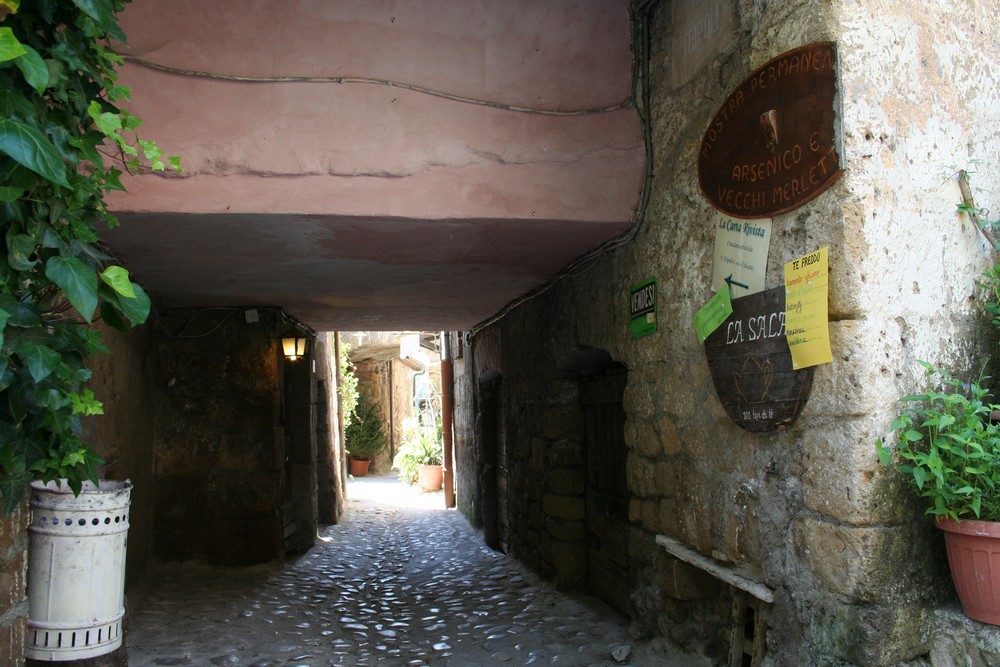
The village of Old Calcata later became a destination for artists and intellectuals, attracted by the magical atmosphere of the place, who made the ancient buildings their own, transforming the town into a bohemian village. The medieval village of Calcata is accessible through the “big gate,” an opening in the walls of the ancient castle that leads us into the town center, where houses and caves dug into the tuff overlap, among steep staircases, balconies with colorful flowers, narrow alleys, and streets paved with large river cobblestones. Some houses, most of which were formerly used as stables and barns, date back to the 1200s. Today they host shops and very colorful artisan workshops. In Piazza Vittorio Emanuele II stands the Baronial Palace of the Anguillara, the family that ruled the fief until the 19th century and the church of the Holy Name of Jesus.
The Baronial Palace of Calcata was formerly used as the primary school, medical clinic, and post office. Currently, the palace is owned by the Treja Valley Park and is used for civil marriage ceremonies, events, exhibitions, and conferences.

2 Calcata village and the secret door
From the cliff, a steep precipice over the valley, hides the “secret door” an invisible path that allowed during the war, to descend to the valley for supplies without being seen. The Treja valley, a destination for picnics and nature trails, was the setting in the mid-60s of Italian western films, such as the series of Franco Franchi and Ciccio Ingrassia, some films by Bud Spencer and Terence Hill, some scenes from Pasolini’s Decameron. The center of Calcata was instead part of the set of the film “Amici miei” with Ugo Tognazzi. However, the true attraction of the place seems to be the positive energy emitted, which has made this ancient village a place of harmony and balance for those who had the sensitivity to feel it. Around Calcata, it is also possible to get in touch with the Opera Bosco Museum of Art in Nature. It is an outdoor contemporary art itinerary over two hectares of forest in the gorge of the Treja Valley.

3 Church of the Most Holy Name of Jesus
The Church of the Most Holy Name of Jesus, in Calcata, is a place of worship from the fourteenth century. Completely renovated in the eighteenth century, it is located in the old village settlement. Inside the church, it is possible to admire frescoes and objects dating back to the sixteenth century.
4 The inhabitants of Calcata
According to a recent census, Calcata is inhabited by about 90 people, one third of whom are Romanian.
5 Calcata where to eat
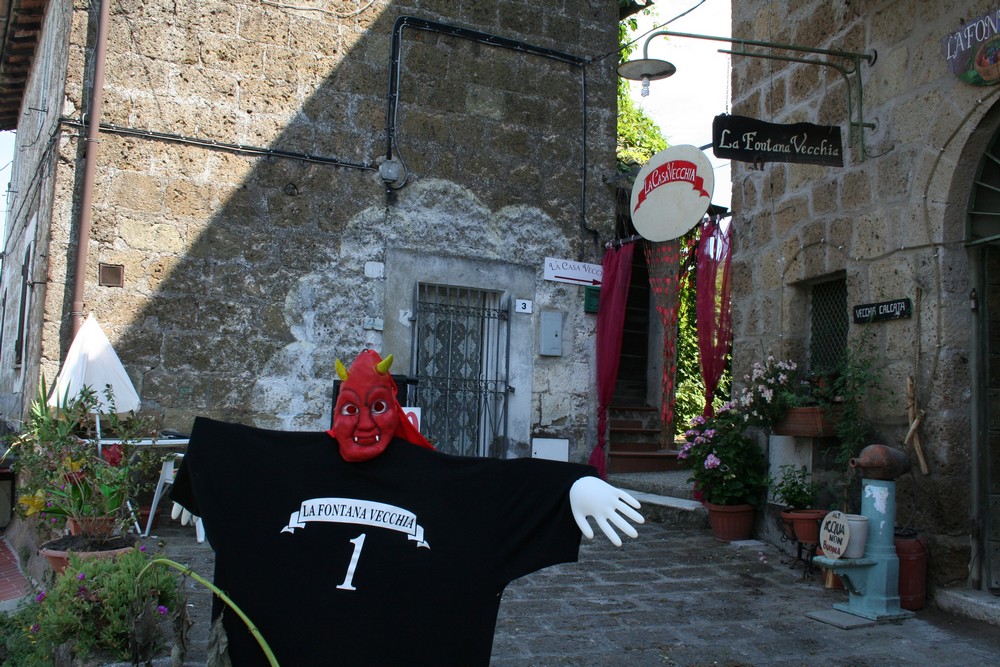
In Calcata there are several restaurants where you can eat dishes of local and national cuisine. in Via degli Americani, at number 7, there is “Trattozero“, a restaurant with typical local cuisine. In Via Garibaldi 9, instead, there is “Il Graal“. This place also offers typical cuisine. At “Ristorante Opera“, in Via della Pietà 2, national cuisine is offered. Prices are average, Il Graal slightly more expensive while the cheapest is Trattozero.
6 Calcata where to sleep
In the surroundings of the medieval village of Calcata there are several nice accommodations to consider. From holiday homes, to farm stays to B&B and hotels. There is something for everyone. It is not difficult to find accommodation in Calcata.



 è un antico borgo medioevale non molto distante da Roma. Il borgo accoglie artisti, hippie e distribuisce una forte energia positiva.)