

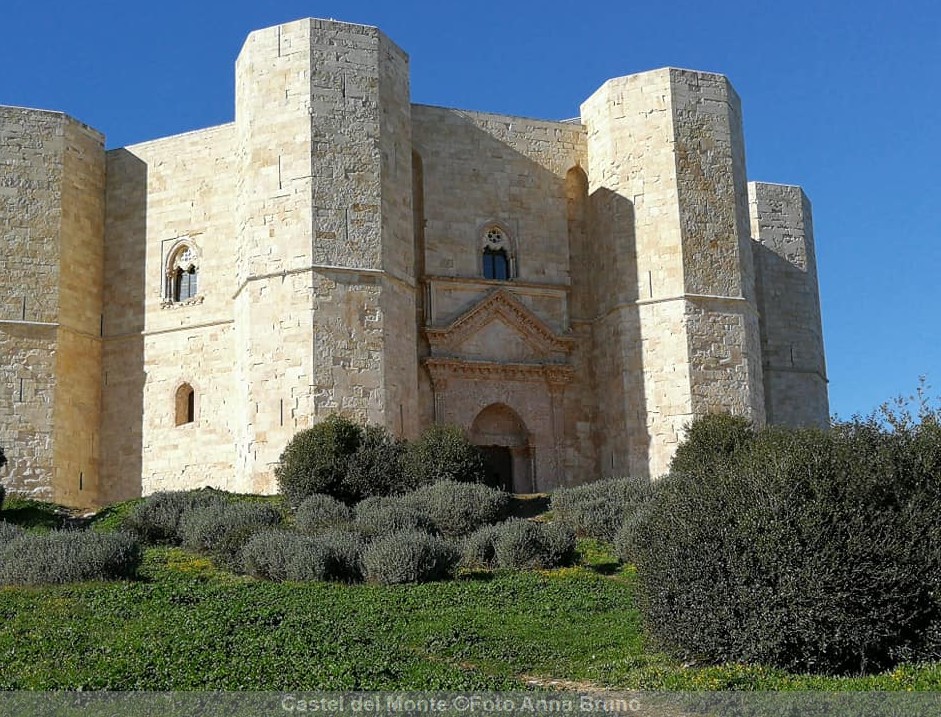


Castel del Monte is located in the countryside of Andria, in Apulia. On each of the eight corners, it has eight towers of the same shape in the local limestone curtain walls, marked by a string course; eight single-arched windows open on the lower floor, seven double-arched and one single triple-arched window, facing Andria, on the upper floor.
The courtyard of Castel del Monte, octagonal in shape, is characterized, like the entire building, by the chromatic contrast resulting from the use of coral breccia, limestone, and marbles; there were once ancient sculptures as well, of which only the slab depicting the Cavalier Procession and a fragment of an anthropomorphic figure remain.
Corresponding to the upper floor, three French doors open, beneath which there are some protruding elements and some holes, perhaps intended to support a wooden balcony useful for making the rooms independent from each other, all interconnected by a circular path, except for the first and eighth, separated by a wall in which a large oculus opens at the top, probably used for communication.
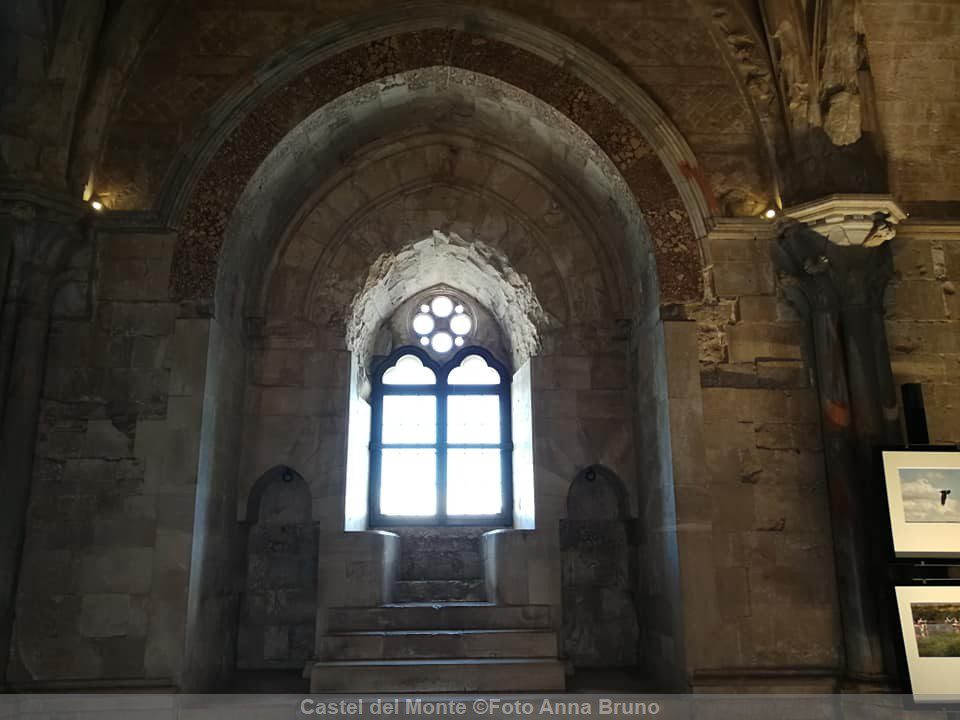
The sixteen rooms, eight for each floor, have a trapezoidal shape and have been covered with an ingenious solution. The space is actually divided into a central square bay covered with a ribbed groin vault, (with semi-columns in coral breccia on the ground floor and trilobed marble pillars on the upper one), while the remaining triangular spaces are covered by pointed barrel vaults.
The keystones of the groin vaults are different from each other, decorated with anthropomorphic, zoomorphic, and phytomorphic elements.
The connection between the two floors takes place through three spiral staircases inserted into as many towers.
Some of these towers house cisterns for collecting rainwater, partly also channeled towards the cistern excavated in the rock below the central courtyard.
In other towers, however, the bathrooms are located, equipped with latrine and washbasin, each flanked by a small room, probably used as a changing room or perhaps intended to house bathing tubs, since body care was much practiced by Frederick II and his court, according to a custom typical of that Arab world so loved by the sovereign.
The sculptural furnishings, although heavily depleted, are of great interest as they provide significant testimony of the original decorative apparatus, once also characterized by the wide chromatic range of materials
used: mosaic tesserae, glazed tiles, glass pastes, and mural paintings, traces of which were seen by some local writers and historians between the late 18th and early 19th centuries, who described them in their works.
Currently still present are the two anthropomorphic corbels in the Falconer’s Tower, the telamons supporting the umbrella vault of one of the stair towers, and a fragment of the floor mosaic in the eighth room on the ground floor. In the Provincial Art Gallery of Bari, two important sculptural fragments, depicting a Head and a headless Bust, found during the lengthy restorations, which, however, have not yielded any trace of the octagonal basin placed in the center of the courtyard, mentioned by some scholars of the last century, are temporarily deposited.