

For the peasant civilization, nature was Chaos, which had to be continuously ordered by a divine hand, through the work of the Saints and the Madonna. Figures who helped to overcome hardships, poverty, despair, and the loneliness of the most remote villages.
Out of devotion, the Lucanians have built, on the mountains, among the woods, small churches, which they called Sanctuaries. There are 82 of them, scattered in the most inaccessible places of the region, not far from a Community. Buildings mostly dedicated to the Madonna, which nurture a faith deeply rooted in culture, habits, and traditions. A living presence, that no one questions.
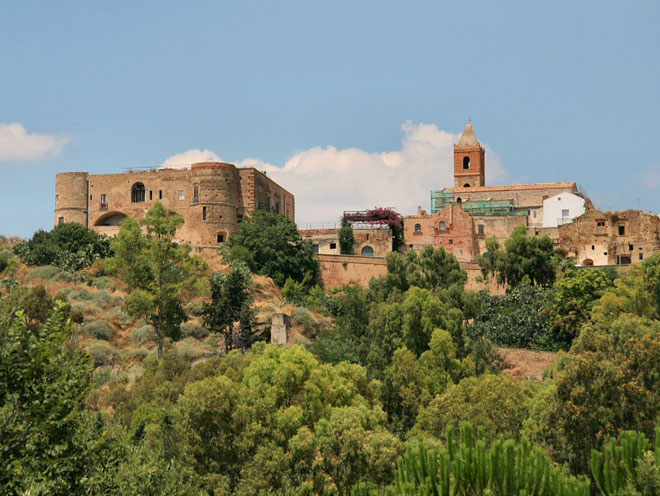
In Calvello on the second Sunday of May, the village is abuzz. It is a date awaited all year: the day when the Madonna is accompanied to the Saraceno Mountain Sanctuary.
The devotion is total. A human chain climbs up a steep and slippery road. A rough path through the woods, to reach a rock spur, at the foot of Monte Volturino, at 1,320 meters high, to the “Country Sanctuary”, the Virgin’s summer residence. A small white church, with bare walls, overlooking the entire valley between Monte di Viggiano and Caperrino. It was built by the Benedictines, founders of Calvello, not far from an ancient Lombard military outpost, later Saracen, from which the locality takes its name. “Queen of Monte Saraceno, pray for us!” This is the invocation that the faithful, having come all the way up here, address to the Virgin, portrayed in a small effigy, with an intense expression. The statue, which is solemnly carried to the small Sanctuary, is not the original, but a reconstruction of the wooden simulacrum, of Byzantine craftsmanship, of the Madonna “de Plano”, destroyed, along with the parish church, by the earthquake of 1857.
What could be recovered was rebuilt by a Neapolitan artist, who bound the pieces with papier-mâché. It is enclosed in the “Caggia”, the urn-symbol of so much devotion. Made of very hard and heavy wood, it was hand-carved by local artisans. Surely, it reproduces one of older craftsmanship. The Caggia is the most immediate visual element; it is, for the people of Calvello, the very image of the Madonna, their wealth, their pride, the familiar and usual way of identifying, since childhood, the Marian symbol. It is the safe place, to which reference is made with deep faith, for about a millennium.
The Statue of the Madonna of Monte Saraceno was crowned on September 9, 1947. An event that mobilized thousands of pilgrims from all over the region. The devoted Lucanians collected two kilograms of gold to cast the crowns that would adorn the heads of the Mother and Child. Two enchanting diadems set with precious stones. Twice, in 1952 and 1981, the crowns were stolen by sacrilegious hands. Twice the people of Calvello managed to restore to the statue the symbol of royalty that belongs to it. On the day of the procession to Monte Saraceno, a religious rite is renewed, accompanied by the festival, folklore, and the tradition of “being together”, in the name of a common belief. On the eve of this journey, the traditional “focanoi”, bonfires symbolizing renewal, purification, and an ideal obstacle to the passage of the Madonna’s statue, are lit in the village.
There is a competition to carry the Caggia on the shoulder and, in the past, it was customary to pretend, once arrived at the river “Terra”, an obstacle to continuing.
There is a legend of a Hermit who would have lived in a small cave right next to the Sanctuary. Beliefs, traditions, rituals that tell the culture of a people. The same culture that still gives emotions to those who return to Calvello from distant places, from acquired homelands, which can never replace the tastes, smells, and atmospheres of the place where they were born.
The rite is repeated on September 8 and 9: days on which the procession follows the reverse route: from Monte Saraceno to the Parish Church; when the Caggia returns to the village to stay there all winter. Again a joyful and orderly chain; another stop along the way at the Sanctuary of the Most Powerful: ancient patron chapel, dating back to the 17th century. Here people refresh themselves during the walk and pray, at one thousand meters high, in the enchantment and serenity of a place with unspoiled nature. The feast continues, and it is a festival of colors, sounds, and rites, in the name of a renewed, rediscovered identity.