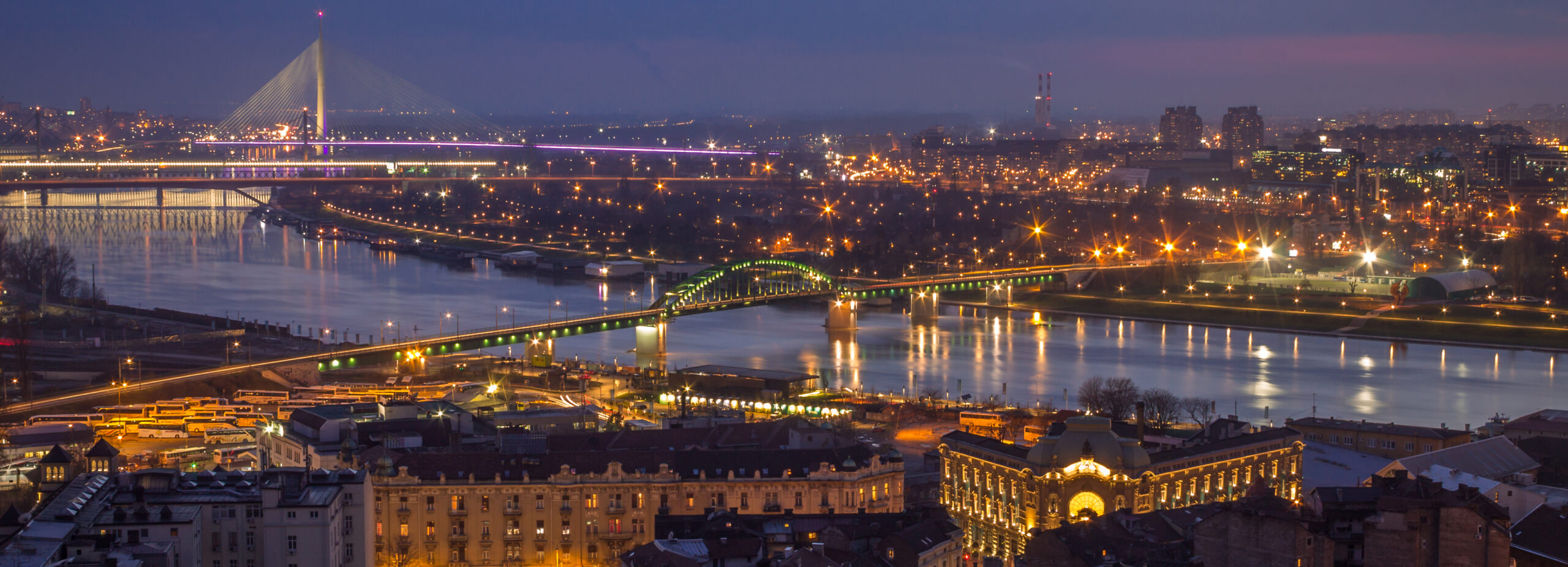


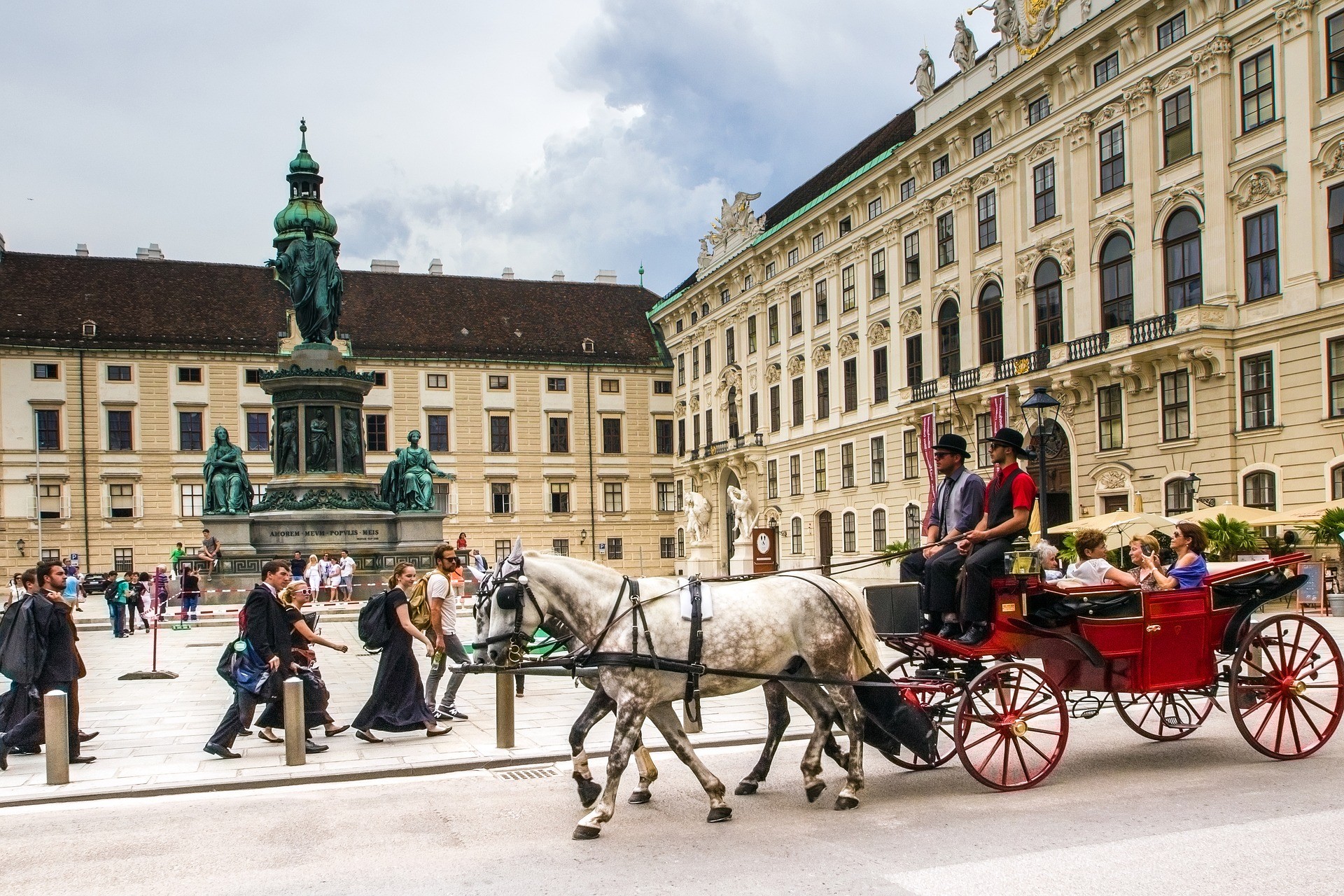

Vienna, the capital of Austria, reflects on the Danube and, with its one million six hundred thousand inhabitants, boasts a heritage of history, art, architecture, customs, and curiosities that makes more than one visit highly recommended.
- Things to Do and See in Vienna
- 1 Vienna What to See in 1 Minute
- 2 Vienna must-see places
- 3 St. Stephen’s Cathedral
- 4 Ringstrasse
- 5 Opera House
- 6 Imperial Palace and Museums Quartier
- 7 Famous Characters of Vienna
- 8 Vienna at Christmas: the markets
- 9 Prater Park
- 10 Sacher torte
- 11 Surroundings of Vienna
- 12 How to get around Vienna
- 13 Where to have fun in Vienna
- 14 Where to shop in Vienna
- 15 What to Eat in Vienna
- 16 Where to sleep in Vienna
Vienna is today a cosmopolitan and international city: the constant expansion eastwards of the European Union’s borders is an event that plays in its favor, carving out an ever more strategic role.
In the shadow of its majestic imperial palaces, a rich world of creativity and innovation has developed, ranging from artistic avant-gardes to ethnic and high-level cuisine.
Things to Do and See in Vienna
Vienna, the capital of Austria, presents itself with a stern appearance and majestic architecture. The things to do and see in Vienna are numerous because the Austrian capital is the stronghold of a past that is today evolving increasingly thanks to the lively cultural and intellectual life. Let’s see what to see and what to do in the grand capital of Austria.
1 Vienna What to See in 1 Minute
For an overview of Vienna, it is best to start from the historic center enclosed within the large tree-lined ring called the Ring. To see are the St. Stephen’s Cathedral, the Hofburg, residence of the Habsburgs, with the imperial apartments and a remarkable treasury of gold and silver, the Spanish Riding School, the Kapuzinerkirche with the Habsburg tombs, the State Opera, the Albertina Museum, the Graben and other streets and squares full of charm and history. Beyond the Ring are the new MuseumQuartier, the Belvedere Palaces with their art treasures, the Church of St. Charles, the Secession Building, the Prater with its Ferris wheel, the Schönbrunn Palace with its beautiful park. At a dance pace, to the notes of a Viennese waltz, you head at the end of this beautiful tour of Vienna towards metro pavilions designed by Otto Wagner, in Karlsplatz.

2 Vienna must-see places
- To immerse yourself in the city’s atmosphere, it is advisable to head immediately to one of the traditional Viennese cafés, perhaps in the streets of Altstadt, famous for the elegance and the sought-after social life of the establishments.
- Here is the Opera House, here is the Museum of Fine Arts, here rise the Towers of the Pagans in front of the magnificent St. Stephen’s Cathedral.
- The emblem of the Habsburgs cannot be missed in this area, that is the Imperial Palace (Hofburg), which over the years has become the Kunsthistorisches Museum, one of the most valuable museums for fine arts, and among the 10 largest museum complexes in the world. For those who love modern art, the doors are open to the MUMOK, as well as to the Leopold Museum.
- Very beautiful to see are the Lipizzaner horses performing inside the stables of the Spanish Riding School.

3 St. Stephen’s Cathedral
La St. Stephen’s Cathedral in Vienna is the largest of its kind in all of Austria. Built in Gothic style between the 12th and 13th centuries, the cathedral is considered a true attraction for visitors to Vienna. The South Tower is visitable and stands 137 meters tall. The North Tower features a Renaissance-style spire that complements the pre-existing Gothic structure. Inside the St. Stephen’s Cathedral is the tomb of Frederick III, made of red marble.

4 Ringstrasse
Die Altstadt (Città Vecchia) wird vom Ringstrasse begrenzt. Es handelt sich um einen Perimeter, der den mittelalterlichen Stadtkern vom restlichen Teil trennt, der sich in den folgenden Jahrhunderten entwickelt hat.

5 Opera House
The Vienna Opera House, located in the old part of the city, has seen giants of classical music such as Mozart, Beethoven, Brahms perform. Vienna, moreover, like the rest of Austria, has given birth to illustrious figures of fame not only nationally.

6 Imperial Palace and Museums Quartier
The Vienna Imperial Palace was an important place during the Austro-Hungarian period. After the First World War, it was transformed into the seat of the Museums Quartier which includes several cultural places and is considered one of the largest cultural spaces in the world. Other points of interest not to be missed:
- Spanish Riding School that collects the history of horses. It is also possible to attend the training sessions (morning) and visit the stables;
- Kunsthistorisches Museum which houses extensive collections of the Habsburgs;
- MUMOK Museum of Modern Art where you can find Pop Art, Warhol, George Brecht, and many other artists representative of modern and contemporary art;
- Leopold Museum holds the largest collection of Egon Schiele in the world;
- Schloss Schonbrunn, Baroque-style palace and UNESCO heritage site;
- Sigmund Freud Museum, the house where the psychoanalyst lived that collects objects, documents, and photographs.

7 Famous Characters of Vienna
Vienna has been the cradle of famous figures who have made the city’s art, science, and culture shine worldwide: here the air was filled with notes by Beethoven, Mozart, Schubert, Mahler, Brahms, and many others; here Sigmund Freud theorized (whose house, transformed into a museum, can be visited); here Gustav Klimt painted: The Kiss, a famous canvas, is exhibited in the Austrian Belvedere Gallery, as well as the work Judith I. Still on the theme of painting, Vienna also saw the growth of Egon Schiele and many, many other intellectuals and prominent figures.

8 Vienna at Christmas: the markets
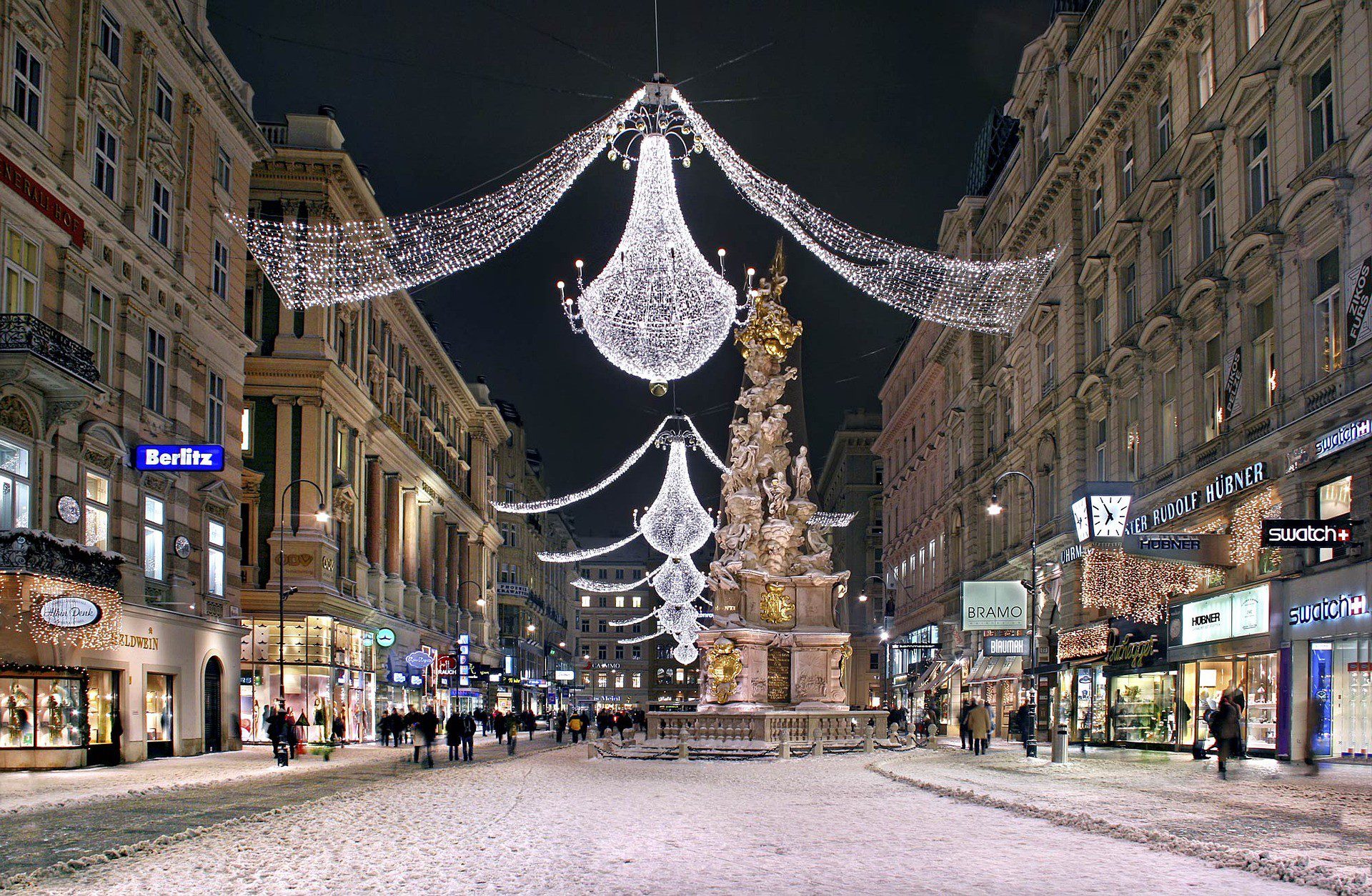
The Vienna Christmas Market most famous is the one at Rathausplatz, the square in front of the town hall, which displays a huge Advent wreath (a full 12 meters in diameter), animated by stalls full of toys, carousels, little trains, and with the trees of the beautiful park sprinkled with lights. But not to be missed are also the market at Freyung square, whose origins date back to 1772, also known as the Old Viennese Christ Child Market, where the stalls offer refined pieces of craftsmanship, glass decorations, ceramic objects, and traditional nativity scenes. And the splendid one hosted in the honor courtyard of the Schonbrunn Palace, former summer residence of the Habsburgs.
9 Prater Park
At this point, you can take a trip across the Danube to the Prater Park, which features old and traditional rides. The Ferris wheel is very famous, built with wooden cabins from which you can admire the city from a spectacular view from above.

10 Sacher torte
After wandering through imposing palaces and works of art, the day in Vienna can only end with a slice of Sacher torte, perhaps right in the café of the Hotel Sacher Vienna, a temple of Austrian pastry where the Sacher recipe is still jealously guarded today, despite imitations and attempts to emulate its appearance and taste.

11 Surroundings of Vienna
In the surroundings, tourist attraction centers also include the Donau-Auen National Park on the border with Slovakia, the elegant spa town of Baden with its Biedermeier-style houses, and the Klosterneuburg Abbey, one of the most important in Austria, which houses the precious Verdun Altar. These destinations are also suitable for those who prefer to visit Austria by camper.

12 How to get around Vienna
Vienna can be easily explored on foot but it will be fun to take one of the trams or metro trains, characterized by the Art Nouveau style. Two of these trams, number 1 and number 2, allow you to admire one of the clear symbols of Habsburg power: the Ring (Ringstrasse or Der Wiener Ring), a boulevard that circles the old city, within which are the main attractions of Vienna. Using the Vienna Pass is recommended. It allows you to take advantage of a series of discounts. The Vienna City Card is valid for 24, 48, or 72 hours. You can then travel for free on Vienna public transport or on the HOP ON HOP OFF buses of Big Bus Tours and benefit from over 210 discounts, from museums to Heuriger, starting from 17 euros.

13 Where to have fun in Vienna
The Austrian capital hosts countless events, places to have fun. For example, during the carnival weeks alone, there are more than 200 balls and neighborhood parties ready to entertain visitors, among which one of the most evocative is the one organized at Karl-Marx-Hof (Town Hall). Tasty and unusual dishes, extravagant fashion, and young art have made the area surrounding the Karmelitermarkt market one of the liveliest in Vienna.

14 Where to shop in Vienna
In larger centers, pubs, breweries, irresistible ice cream shops and pastry shops, shopping malls represent a constant attraction for tourists looking not only for monuments and museums, but also for tasty attractions and some good bargains. In Vienna, you also go to Loden, Tostmann, and Lanz.

15 What to Eat in Vienna
In Vienna you certainly cannot miss the Wiener Schnitzel (equivalent to our Milanese cutlet), the Backhendl (breaded and fried chicken), and the Sacher Torte. Often and mistakenly identified with Viennese cuisine, the Austrian cuisine is an enviable palette of its many regional tables. Here are some tips on what to eat in Austria.

16 Where to sleep in Vienna
The accommodations in Vienna are in line with the standards of European capitals. In the more chic areas, star hotels have a not too low cost. However, there are hotels, always in the area adjacent to the train station, at a good price. As well as offers from extra-hotel accommodations: B&B, holiday homes, guesthouses. You just need to choose wisely and get advice.