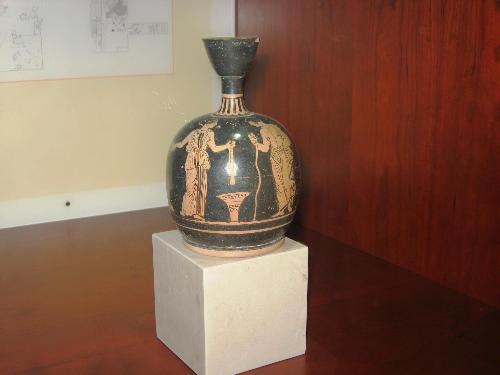
We present to you Ugento and its splendid shores, on the Ionian side, a concentration of very white beaches, postcard-perfect sea, history, folklore, and culture. And one of the most popular holiday destinations on the Salento peninsula.
Ugento, a town in the Salento hinterland, is a jewel that encloses unparalleled architectural and artistic beauties, as well as enjoying a strategic position for possible movements within the territory. Perfect as a tourist destination, it embraces a stretch of coast that also includes the shores of Torre San Giovanni, Torre Mozza, Lido Marini.
Among the peculiarities of the place are the reclamation basins, connected to each other by special channels that allow an orderly collection of waters, regulating their flow to the sea; basins that, being on the main migration routes of particular birds, have become the perfect habitat for various species that stop in this area to feed and reproduce.
Known for its monuments and points of interest, Ugento is a town of uncertain origins, difficult to date. What is known is that findings of archaeological artifacts such as imposing menhirs, megalithic monuments where religious rites were performed, as well as dolmens, funerary monuments destroyed over time, suggest very, very ancient origins.
The city reached its greatest splendor around the nineteenth century B.C., a period when the influence of the Messapian civilization was reflected on Ugento, making it a city-state equipped with its own army and mint.
Evidence of the Messapian settlement includes the powerful walls, some of whose sections are still visible and which are believed to have been part of several towers extending along the entire length.
Today Ugento has a well-maintained historic center, rich in history and traditions, but also dotted with religious and artistic monuments of great value. One of these is undoubtedly the Cathedral of Santa Maria Assunta, built at the beginning of the 18th century, with a neoclassical-style facade and a single nave with a Latin cross plan. Among the peculiarities of the church is the presbytery, with a choir entirely made of olive wood.
Another noteworthy place is the Castle of the Princes d’Amore: repeatedly renovated over the years and damaged following the occupation of the city by the barbarians around the mid-1500s, the castle underwent a radical transformation thanks to the settlement of the Princes d’Amore toward the end of the 1600s, who, with various restoration interventions, made the residence majestic and splendid, stripping it of the strictly military features that characterized it. Among the beauties that can be admired inside the manor are the paintings and decorations that adorn the large rooms, with mythological-themed cycles.
The former Franciscan convent of S. Maria della Pietà has housed the new Civic Archaeological Museum for six years now, a large space spread over two floors that hosts and preserves artifacts retracing the city’s history. The ground floor, in the area that previously housed the refectory, offers visitors the sight of a large model reconstructing the history of Ugento, while in the cloister there is one of the most interesting finds, the Tomb of the Athlete. This, dating back to the end of the 6th century B.C., was discovered in 1970 and consists of a base, covering slabs, and enclosure slabs, with a painted decoration of bands.
Furthermore, on the road connecting Casarano to Ugento, there is a place of unique beauty, the Chapel of the Madonna of Constantinople, dating back to the early 1600s. A single barrel-vaulted room welcomes visitors who are completely captivated by a system of frescoes that fill and illuminate it, despite the tangible signs of time having faded the colors. The Madonna of Constantinople is depicted on the wall above the altar, surrounded by full-figure saints. A truly suggestive place worth stopping by even for just a minute.
The strong historical and artistic significance of the many monuments present in the city led to the creation of a true network, which gave rise to a museum system that is functional and efficient, comprising the New Archaeological Museum, the Archaeological Collection “Adolfo Colosso,” the Crypt of the Crucifix, the Church of the Madonna of Constantinople, the Castle of the Princes d’Amore, and Palazzo Rovito.
Ugento, therefore, ancient Messapian center, cradle of art, civilization, and culture, is recognized by the Apulia Region as an important hub and tourist reception point, due to all the beauties embracing architecture, environment, and art, which it still preserves today with commitment, care, and consistency.
More information can be found at https://www.comune.ugento.le.it
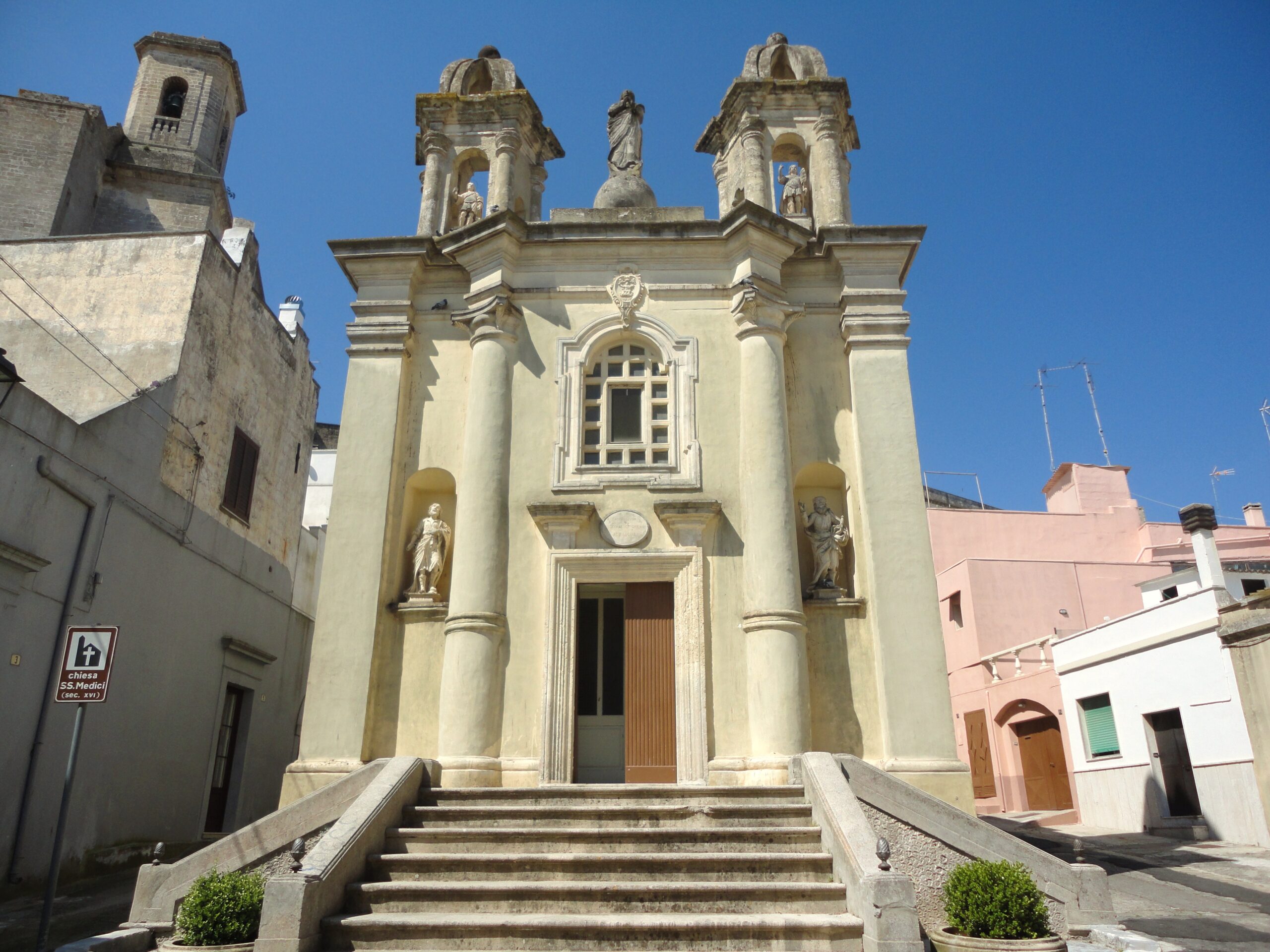
Torre San Giovanni
Torre San Giovanni is the shore closest to Ugento (actually it is a real hamlet of the city), and since ancient times it has represented an important hub due to the port, consolidating the well-being and development of the town over the years.
The symbol that distinguishes it is a coastal tower, today turned lighthouse, impossible not to notice because of a characteristic black and white checkered pattern that gives it a style totally different from the various other coastal towers scattered along the Salento coasts.
In summer Torre San Giovanni becomes the living and beating heart of tourism, welcoming thousands of visitors every year, who find themselves experiencing it intensely both day and night, with a series of activities, events, and festivals that offer an immersion into the habits and traditions of the south.
The pride of the place is the seafront: spacious, well kept, very popular, and perfect to enjoy the cool evening breeze or to sip a coffee by the sea in one of the many small bars. If you are passionate about photography, the seafront offers sunsets that become true shows of nature, with intense and vibrant color variations, so much so that they remain imprinted forever.
The coast of Torre San Giovanni seems made to satisfy the most demanding tourists and those with varied tastes, as it offers the convenience and accessibility of sandy beaches, but also the wilder beauty of rocks, ideal for diving and snorkeling lovers.
To stay here it is advisable to book by choosing among the most advantageous offers and preferred accommodations: bed and breakfasts, villages, campsites, and private houses are all comfortable and valid resources to rely on, you just have to decide what kind of holiday you want. More information can be found at https://www.nelsalento.com/torre-san-giovanni.html
Torre Mozza
Immediately after the small port of Torre San Giovanni begins a stretch of sandy dunes that border a stretch of sea protected by pinewoods that seem to almost wrap and cradle it. The sea here has colors, scents, and clarity worthy of the most popular exotic destinations, with vibrant shades of blue that excite.
Torre Mozza is located a little further south of Torre San Giovanni and takes its name from an old sixteenth-century coastal watchtower around which the entire inhabited center has developed over the years. The erosion of the sea combined with various collapses at different times has given it an almost unique shape, as if it were literally cut off on the side, making it very similar to a sandcastle missing its top, abandoned on the shore by some child.
The beach surrounding and characterizing Torre Mozza is splendid, without too much beating about the bush: very white sand, typical vegetation of sandy and brackish environments, and above all, ample free space make it one of the most popular beaches during the summer months.
Moving further ahead, it is also possible to enjoy the comforts offered by various equipped beaches, but generally those who choose Torre Mozza do so to enjoy the beach freely without schedules, carrying a towel on their shoulder and lots of sunscreen. In the evening, the shore sheds the crowds that almost seem to bother it during the day to gather in moments of tranquility and relaxation, among outdoor dinners, aperitifs, or barbecues.
Booking holiday homes or hotels nearby can be a very valid solution for those who love convivial moments, evenings under the starry sky, without necessarily the stress of having to do something. Alternatively, it is possible to choose the shore as a base, then move to nearby locations if you are looking for nightlife. More info at https://www.marinediugento.it/#torremozza
Lido Marini
The third shore of Ugento is Lido Marini, a location extending south towards the shores of Salve in the direction of Santa Maria di Leuca. Part of Lido Marini belongs to the municipality of Salve, and it is the ideal destination for a holiday of pure sun, sea, food, and relaxation.
The fact that it developed later than the other two shores, with works that brought it back to the spotlight among holidaymakers, makes it a very quiet shore, equipped with essential services and a myriad of private villas lining the streets.
Its sandy, low, and easy shoreline is especially suitable for easy access for those not very familiar with water or for families with children. Among the things to highlight for anyone deciding to book a holiday here is that there is no possibility to withdraw money at ATMs, but you need to move to nearby shores for this. This does not detract in any way from the beauty of the place, which seems like a snapshot worthy of any travel agency catalog, and it is certainly possible to choose it as a base then move around Salento by car.
More information at https://www.Lido-Marini.com