

Nel 1821, on commission from Duchess Maria Luigia, Nicola Bettoli began the construction of the New Ducal Theatre in the area of the Convent of St. Alexander. The theatre was completed in 1828 and inaugurated on May 16, 1829, with the opera Zaira composed for the occasion by Vincenzo Bellini.
The theatre, later named Regio, still represents a significant example of the numerous and imposing public works carried out by the Duchess. It arose in the heart of the city, structured in a central body and two lateral wings connected to the Ducal Palace and the Church of St. Alexander, thus becoming a reference and gathering place in the life of the city itself, according to G.B. Niccolosi, for whom “no less than scenic shows the theatrical architecture should adapt to times and customs” (G. B. Niccolosi, 1829, p. 10). The neoclassical facade features a portico with Ionic columns topped by two bands. In the first are five pedimented windows placed corresponding to the intercolumns below, in the second a large thermal window flanked by two elegant flying Fame images, bas-reliefs by Tommaso Bandinelli, as well as the decoration with lyre and masks that shapes the pediment crowning the building. The two lateral bodies are set back and resolved in only two orders.
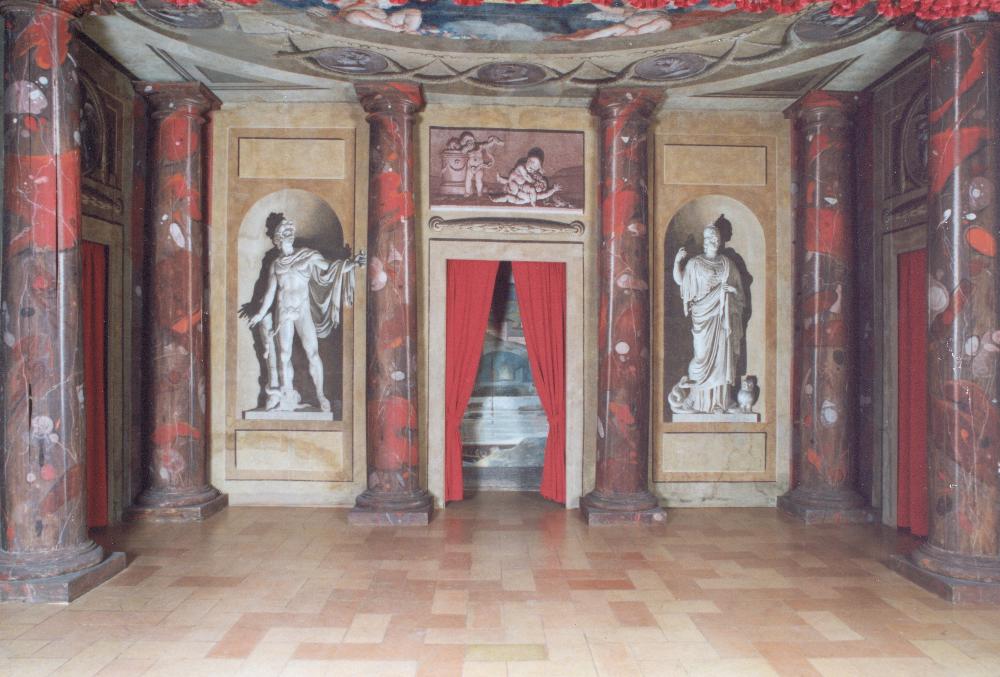
The square vestibule of the theatre has a coffered ceiling supported by Ionic columns and leads to the horseshoe-shaped stalls with four tiers of boxes, equipped with their respective dressing rooms, and a gallery. The stage is vast and well equipped, particularly elegant is the small hall covered by a vault painted by G. B. Azzi, who depicted Harmony with bacchantes and cupids, accompanied by the stuccoes and ornaments of P. Piazza, G. Smit, G. Gelati, T. Bandini, and C. Rusca. On the walls are the false bas-reliefs of mythological subjects by S. Campana. Originally, the hall had a refined neoclassical decoration, as documented by Toschi’s engravings. Each tier of boxes had different stucco decorations: at the bottom were aligned military trophies, then the story of Psyche, medallions with portraits of poets, garlands of flowers and fruits. The proscenium boxes were more richly decorated with images of Fame supporting acanthus trophies and portraits of illustrious men; on the arch stage a light clock was placed between the attributes of Phoebus and Minerva.
The transformation of the hall began, by order of Charles III of Bourbon, in 1853; architects Luigi Montecchi and Luigi Bettoli and the set designer Girolamo Magnani, appointed that same year as painter and director of the theatre, worked on it.
The neoclassical ornaments of the hall were replaced with richer and more sumptuous ones, and in the ceiling, already painted by Giovan Battista Borghesi, who had depicted the protagonists of the ancient and modern scene flying against a starry sky background, a purple band and a frieze with gilded frames were inserted. The beautiful curtain by Giovan Battista Borghesi, still existing, depicting the triumph of Pallas, remained intact. After electrification, introduced in 1907, and the creation of the mystical gulf in 1926, the theatre hasn’t undergone substantial modifications until 1983, the year in which the necessary restoration and conservation work started, carried out “with the theatre open,” that is, without interruption of the activity, throughout the nineties.
The overall project, developed by the Municipal Technical Office, realized, in successive phases, the structural strengthening of the walls of the vaults and coverings; the renovation of the ancient hall of the set designers and the flying tower spaces; the restoration of the boxes, balconies, foyer, and smokers’ room. Other interventions concerned the recovery of spaces for artists and crew, as well as the upgrading of safety systems.