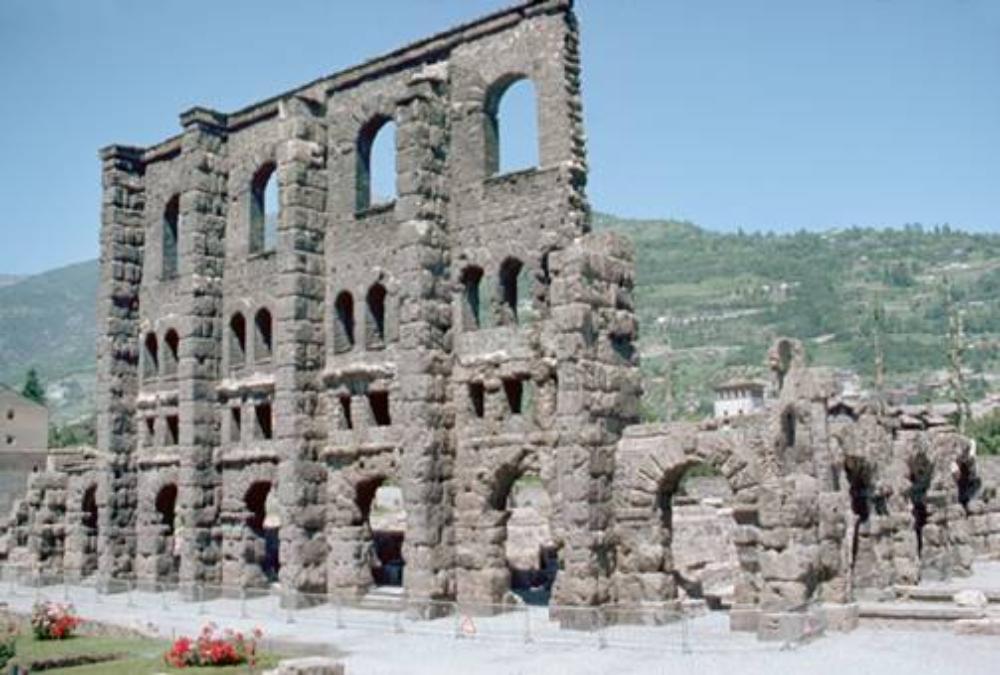

The only facade currently visible is the southern one, as high as 22 meters, characterized by a series of buttresses and arches and lightened by three stacked orders of windows of various shapes and sizes.
The semicircular steps that housed the spectators (cavea), the orchestra (whose radius is 10 meters), and the stage wall (now reduced to the foundations only) are also clearly identifiable; the stage wall once rose with its rich front adorned with columns, marbles, and statues.
It is estimated that the Theater could hold three or four thousand spectators. Some scholars believe that the theater was equipped with a fixed roof.
With the fall of the empire, up until the 18th century, every memory of the building’s original function was lost and its remains were not recognized as such until very late: during the Middle Ages, numerous constructions were added against it, demolished during modern recovery and restoration works.
In 1864, some trial excavations brought to light a series of walls, while in the 1920s the monument was first arranged, demolishing the small houses around it. The complete excavation took place however between 1933 and 1941, when important restoration and integration works were carried out.
Recent studies on the masonry have allowed the hypothesis that the structures currently visible were not all born in the first phase (1st century BC), but are the result of successive modifications made still in ancient times.
Visiting info:
March 1 – September 30: 9:00 AM – 7:00 PM
October 1 – 31: 9:00 AM – 6:30 PM
November 1 – January 31: 9:00 AM – 5:00 PM
February 1 – 28: 9:00 AM – 6:30 PM
Last admission 30 minutes before closing time.
Open every day, except December 25 and January 1
Difficulty of access for disabled people (gravel flooring).
Information about the Roman Theater of Aosta
Via Du Baillage
11100 Aosta (Valle d’Aosta/Vallée d’Aoste)
0165 275904
[email protected]
https://www.google.it/#q=TEATRO%20ROMANO%20aosta
free
Source: MIBACT