


Bomarzo, Park of Monsters: the history
We are in Bomarzo, in the heart of Etruscan territory. From the small town perched on the hill, you can oversee the entire green valley crossed by the bends of the Tiber river. In the 15th century, the Orsini princes established their residence here and around the mid-16th century, one of them, the scholar and brave man of war Vicino Orsini, wanted to create at the foot of the hill a grand and unique monumental park. To shape the sculptures, the Prince used the stone abundantly found in the area: a light gray tuff, with a characteristic black speckling similar to peppercorns: the “peperino”.
The volcanic origin of this material evidently matched well with what the eccentric Prince had in mind: the creation of gigantic and fantastic statues, carved directly into the large blocks of “peperino” scattered across the land. Why Prince Orsini wanted to create that complex “scenic machine” is unknown; perhaps the work was part of the broad phenomenon that was a hallmark of the 16th century, the Kunst- und Wunderkammer, when the collection and collecting of rarities, curiosities, singular and extravagant items spread throughout the princely courts of half Europe, as a symbol of vanitas. The Park of Monsters, however, was a special Wunderkammer, because it was outdoors and immersed in greenery, and this was quite unique.
Whatever the reason for its establishment, today the Park of Monsters in Bomarzo is certainly one of the most fascinating places in central Italy: a true “Sacred Grove” of the Baroque period. An open-air art gallery, with sculptures created by unknown artists. Indeed, many legends are told about who contributed to the creation of the mysterious and unusual park. It seems that its eccentric creator, Prince Orsini, during a battle near Vienna captured Turkish prisoners, brought them to Bomarzo, and here ordered them to carve the statues. This could explain the clumsy and craft-like execution of the works; the sculptures are indeed not very refined, but surely the figures of these monstrous animals and these fantastic and grotesque giants neither fail to captivate adults nor to intimidate children.
A truly unique character, this Vicino Orsini who was able to blend together various symbols and many allegorical figures, producing an elegant mélange of cultures and different eras. Bears in medieval symbolism represented the conversion of pagans to Catholicism, and the goddess Fortuna was, according to Horace, the lady of the sea; although in the Renaissance Fortuna was the goddess revived from Antiquity who unpredictably distributed her favors. The monsters, were typical elements of Greek mythology and Jewish apocalyptic literature, while dragons, in Christian culture, were the representation of Satan. Surely, this grand monumental complex, which perhaps is the symbol of an instinctive human defense against the unknown, is one of the most bizarre and fantastic works of the Italian 16th century.

Bomarzo, Park of the Monsters: the gardens
The feeling you get in the gardens of the Park of the Monsters of Bomarzo is one of “bold caution,” perhaps it is the name that unconsciously intimidates us. At the entrance we are welcomed by two stone Sphinxes that seem to guard a huge Hercules intent on dismembering Cacus, the Roman god son of Vulcan who spits fire and is giant-sized; a slight shiver runs down our spine but we prefer to attribute it to the coolness of the beautiful gardens, and we continue to venture into the park with greater curiosity.
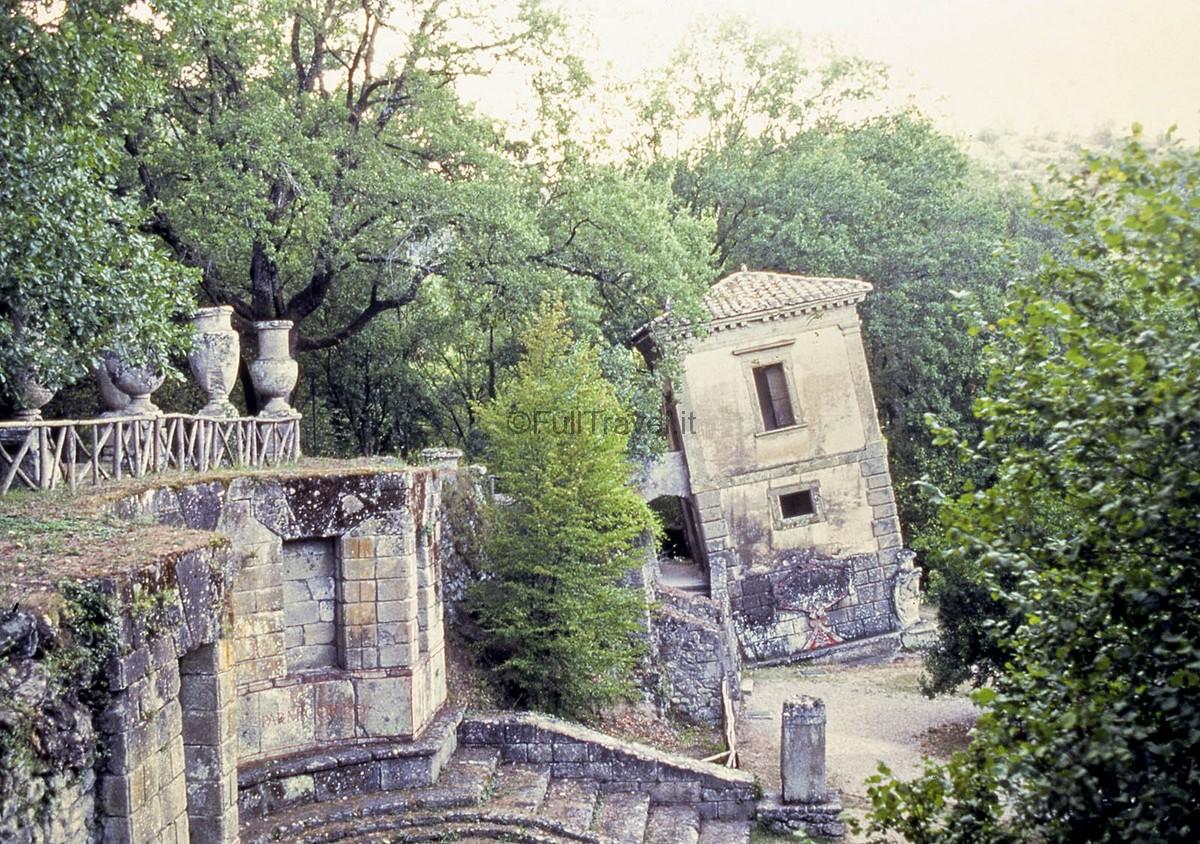
Oblique fountains and heads of infernal Monsters, a gigantic Turtle topped by the statue of Fortune, a Dragon attacked by lions and dogs, a Mask with the features of an ogre with its mouth wide open with a stone table and chairs inside. In front of all these figures our imagination runs wild, and we establish that Prince Orsini must have been a really special type. We still encounter sea Monsters emerging from the rocks, winged Mermaids and Lions, an Elephant that with its trunk seems to crush a warrior, a Tilting House that seems to sink into its own foundations. We enter the house and our head spins, we have the sensation of losing balance and everything becomes unstable. We run out of that enigmatic structure and continue to the Schist, the large square with a lookout. The furnishing of the square consists of enormous vases, decorative pine cones and acorns, and at the end, almost to conclude the area, there is a series of heraldic Bears holding a rose: it is the coat of arms of the Orsini princes. As we walk we see inscriptions and verses carved on the rocks almost everywhere, accompanying us along the paths, as if to remind us that the place was designed to give space to reflection and meditation.
At the end of the long route of the Park of the Monsters of Bomarzo, at the highest part of this “enchanted garden” which develops along a terrace itinerary, there is a small domed Temple: some claim that Prince Vicino Orsini had it erected in memory of his wife Giulia Farnese, who died prematurely. We finally leave the Park of the Monsters and it is as if we awaken from a dream; the pleasant feeling that remains is that of having contributed to the amusement of a character who for 5 centuries has played with all his guests.