

The Mausoleum of Emperor Hadrian is one of the most significant monuments of ancient Rome. Originally built as an imperial tomb, it was later transformed into a fortress, then a papal residence, then a prison, and finally into its current role as a museum.
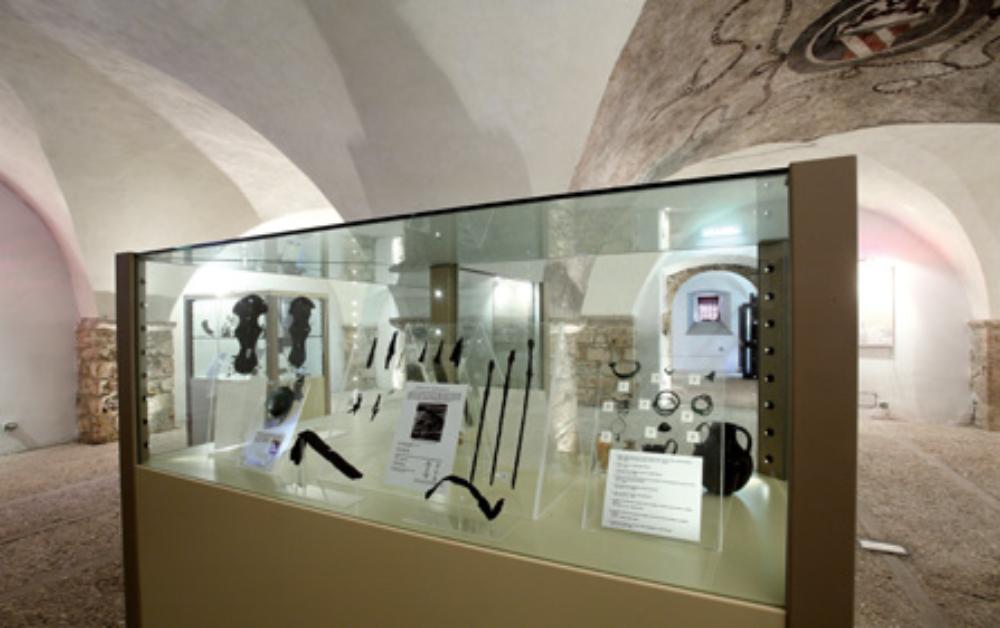
The National Museum of Castel Sant’Angelo has been enriched since September 1, 2012, with an additional exhibition space of great interest dedicated to the history of Castel Sant’Angelo. In the rooms of Alexander VI, recently restored and an integral part of a project of renovation and enhancement of the museum, the exhibition unfolds through a series of engravings, prints, paintings, and reconstructive drawings, to illustrate the many, diverse, often misunderstood historical phases which, over its millennial history, have modified, conditioned, and changed the monument.
Divided into four sections, the history of Castel Sant’Angelo is illustrated by period prints, scenic views, and interesting ideal reconstructions of the monument, as imagined by the creativity of Renaissance artists and architects, from its construction until the nineteenth century, in a journey that highlights its intense and continuous use.
Built as the mausoleum of Emperor Publius Aelius Traianus Hadrianus (76-138 AD) and dynastic tomb for the Antonine family, with Emperor Aurelian first and with Honorius later, the imposing mass was included in the city walls of Rome and transformed into a kind of fortress for the city’s defense. Because of these prerogatives, it acquired the title of castellum from then on, to which, in the early medieval period, was added that of sancti Angeli, from the legend of the vision of Archangel Michael sheathing his sword, to mark the end of the plague.
Its proximity to St. Peter’s, its strategic position controlling the northern entrances to the city, and its closed and imposing mass have made Castel Sant’Angelo the center of political interests, inseparably linking its fate to that of the Church since, in 1367, Pope Urban V demanded the keys of the Castle as a condition for the return of the Curia to Rome.
Since then, numerous architectural interventions and new constructions have been carried out, aimed, on the one hand, at updating the building to renewed defensive needs, with the construction of bastions and the pentagonal wall, and on the other hand at making it increasingly comfortable and suitable to the aspirations of the Curia, assuming under Paul III Farnese (1534-1549) the appearance of a real princely residence.
Up to more recent times, when the castle was used exclusively as a political prison, called by the name Forte Sant’Angelo, and finally when in 1925 it was transformed into a National Museum. Its charm remains unchanged, as does its ability to impress the collective imagination of the city of Rome, with the “Girandola,” an event renewed every year on June 29, during the festival of the city’s patrons, the theme to which the fourth and last section is dedicated.