

On the top of a sunny hill, overlooking the Tiber valley, the Clitunno and the Topino; surrounded by the Martani Mountains and the Subasio (the mountain of Assisi), Montefalco is a small nest not of eagles, but of falcons, as recalled by the emblem atop the Town Hall, which pays tribute not only to the splendid panoramic position, but also to its history.
In the Middle Ages, the town was one of the bases of Emperor Frederick II of Swabia, who hunted here with falcons. And from the Middle Ages, much remains in Montefalco: the circular walls interspersed with towers; the narrow and intriguing alleys; houses and small palaces leaning against each other, the ancient quarters, the artisanal weaving shops. Entering through the merloned gate of S.Agostino, you proceed along the main street, Corso Mameli, on which stand the 13th-century Church of the Augustinians, with inside imposing trusses and precious frescoes from the 1300s and 1400s, and a dense array of houses and noble palaces, which emanate the warm tones of the local stone (called San Terenziano), with which they were built.
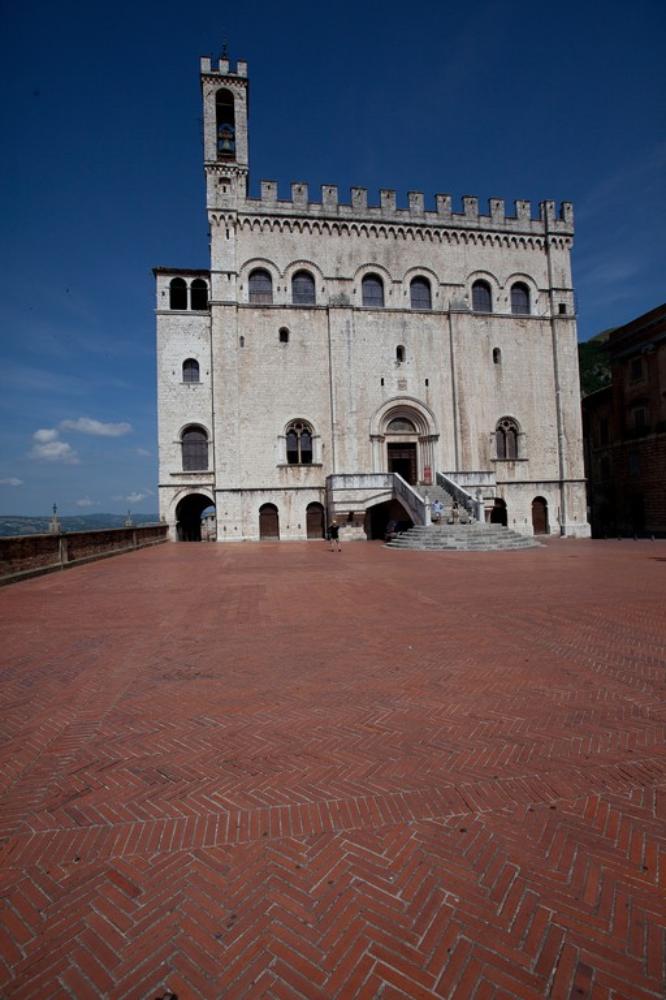
In a few minutes, you reach the large, airy circular Town Square, dominated by the gigantic mass of the Town Hall (1270 A.D.), refined by a 15th-century loggia and adorned with a tower with a panoramic terrace, from where the gaze spans 360 degrees, capturing, in succession, Spoleto, Trevi, Foligno, Spello, Assisi and Perugia.
The daily hustle and bustle culminates in the square, helped by charming enotecas and small restaurants (we are in the land of the prized Sagrantino), shops of typical products and traditional crafts. But Montefalco’s pride blooms just a few dozen meters away, on Ringhiera dell’Umbria street: the 14th-century Church-Museum of S.Francesco, in the apse of which, Benozzo Gozzoli frescoed, in 1452, twelve touching scenes of the Saint’s life, giving rise to the most important Franciscan pictorial cycle after that of Giotto in Assisi and marking a fundamental step in the transition from late Gothic painting to that of the early Renaissance. Among the many treasures, the church also houses a 16th-century painting by Perugino and, in the undergrounds, the ancient Franciscan cellars, opened to the public in 2006: the stone vats for pressing Sagrantino and the space for the presses can be clearly recognized. A Municipal Statute of 1692 referred to them as the largest in Montefalco.