

Every year, in mid-October, in Riva di Tures, in South Tyrol, one of the most beautiful and well-attended transhumance festivals of the Alpine arc is organized, which becomes not only a moment of thanksgiving for the good progress of the summer grazing, but also an opportunity to get to know an intact valley, full of good and genuine things, produced and sold by the farmers themselves in their small shops and colorful markets.
At noon, the first cowbells can be heard and immediately after the cows appear, one behind the other in a single file, with udders swollen with milk and the group of farmers in costume accompanying them. Although they have been marching for hours and the road descending from the high pastures is rough, it is not hard to read contentment and satisfaction on their faces. The summer went smoothly, there were no losses among the livestock, and now that the cold is beginning to bite, it is time to return to the valley to celebrate and shelter the cattle in the stables. For this reason, every year, in mid-October, in Riva di Tures, a quiet and picturesque village in the Tures-Aurina valleys, in South Tyrol, a magnificent Transhumance Festival is held, featuring not only cows, breeders, and costumed performers, but also the public, who crowd in large numbers along the parade route from the early hours of the morning and fill the food stands set up on the square below the village. The opening of the cortege is set for 1 p.m., just enough time to dress the queen (the most beautiful cow with the best “bearing”) and lead her to the starting ribbons. Hans Mairhofer, a local breeder, gathers the livestock in the meadow behind the church and, helped by his wife Annemari, places on the head of his Sabine, a splendid queen with a light coat of almost ten years, a sumptuous diadem made of ribbons, sequins, beads, colorful feathers, writings, and symbolic motifs. To those who approach curiously, he kindly offers a small glass of schnapps and the indispensable topfnudeln, the traditional soft fried dumplings. Sabine is almost ready; only the white and red ribbon is missing, which Hans slides under her belly and ties into a beautiful bow on her back, to let everyone know that the grazing went well and to thank good fortune.
At 1 p.m., the start signal comes from the powerful whip crack of the Goaslschnella, the alpine whipcrackers group from Terento. Surrounded by two wings of the crowd, cows and farmers triumphantly descend into the village and, between one group and another, the performance of the costumed actors takes place, who, transported on carts, evoke traditional scenes of rural life: grandmothers spinning wool, shepherd boys cuddling lambs and kids, housewives doing laundry in old tubs, men carving wood, and elderly people smoking pipes in their warm rooms. A nostalgic high-altitude memory that warms the atmosphere and energizes everyone, locals and tourists alike. After the parade, the livestock is allowed to rest in the meadows around the stands, and the breeders indulge in a well-deserved refreshment with local specialties: gerstesuppe (barley soup), speck, sausages and smoked sausages, the indispensable graukase (grey cheese, symbol of the valleys), tirtlan (fritters filled with ricotta and spinach), kirschtakrapfen, huge fried doughnuts; there are also those who prepare melchamus, a typical dish of alpen living, made with flour, milk, and butter. Under the large tent, a pleasant musical relay takes place: the Tyrolean orchestra, which started mid-morning, gives way to the members of the Campo Tures Band, who, in their impeccable red, white, and black costume, play traditional tunes and accompany the event to its final moments. The festival in Riva is, of course, not the only transhumance festival in the district; between September and the end of October, others are held in S.Giacomo, Villa Ottone, Molini di Tures, S.Pietro, Rio Bianco.
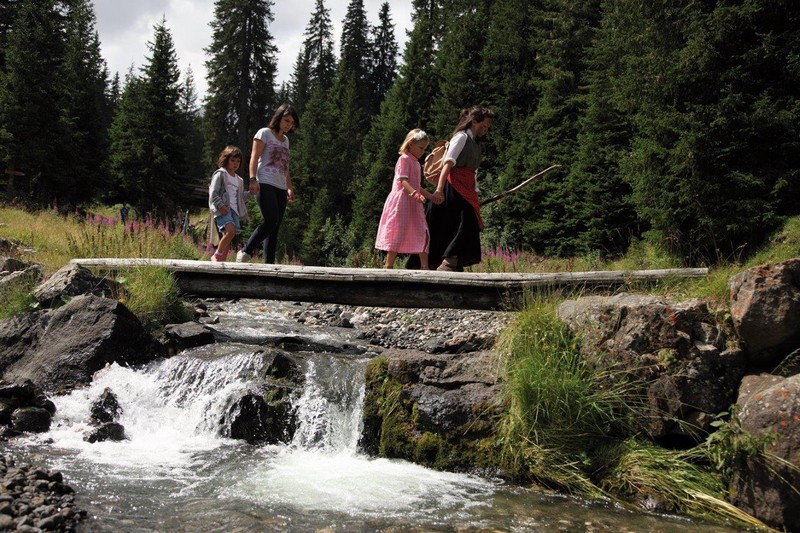
Thanking the heavens for the good progress of grazing is a ritual as ancient as it is indestructible and is also an occasion to exalt the customs of the farmers, who, particularly in recent years, have taken on an increasingly active role in promoting their valleys. Among the many attractive initiatives, it is worth mentioning the typical markets and shops set up at farms and farmsteads. Small spaces, but full of good, curious, and sometimes rare things, managed by the producers themselves and guaranteed for quality and genuineness for the consumer. <>. Descending from Riva, the panoramic road winds through some of the most beautiful corners of the Vedrette di Ries Natural Park, stirred by peaks, woods, and spectacular waterfalls. In nearby Caminata, nestles the warm little shop with workshop of Helene Brusa, a lady with open and friendly manners, who, with the wool of her white alpine breed sheep, makes beautiful sweaters, cardigans, scarves, hats, rugs, and quilts, proudly showing her old machines and the entire processing procedure. Continuing towards Campo Tures, the valley reveals its wider and neater profile, an orderly geometry of fields and clearings announcing that the main town is only a few kilometers away. Right on the road stands the Lahnerhof, the farm of the Fruch family, from whose wood-fired oven an irresistible aroma of freshly baked rye bread emanates. Welcoming visitors and the curious is Martina Fruch, who, besides organic cereals, potatoes, vegetables, and fruits, also offers her delicious jams, fruit syrups, and preserved plums. At the entrance to the village, there is also the Peintenhof, the Moser family farm, where Peter, one of the sons, raises Pinzgau oxen, cows of various breeds, such as the prized Sprinzen from Pusteria, calves, and pigs, which he butchers himself and sells the meat directly, helped by his wife Angelica and sister Hildegard. Also excellent are the sausages and the speck smoked and aged in the traditional way.
Campo Tures, located in the center of an ancient alluvial plain, is a village with a relaxing atmosphere, pleasant Gothic architecture, and shops full of good and curious things. Although little frequented by mass tourism, it boasts monuments of great importance, such as the powerful medieval stone castle overlooking the settlement, or the fifteenth-century parish church, which houses a valuable museum of sacred art. Among the weekly events, there is the Farmers’ Market, where special local products can be found: the Oberhollenzer family from the Hochgruber farm in Selva dei Molini offers, for example, dried pasta with pig’s blood, which, once cooked, is fried in butter with chives and accompanied by a sprinkle of very aged grey cheese. Also excellent are apple cider vinegar, spreadable cheeses, blueberry and elderberry syrups, and tirtlan filled with potatoes, spinach, sauerkraut, or ricotta. From the Wiesemann farm come organic fruits and vegetables, tasty poppy seed pastries, linden flowers for infusions, hay garlands, dried flower centerpieces, and much more. Meanwhile, Peter Feichter, an eclectic farmer from Lutago, makes colorful slippers in warm felt in front of passersby. This valley concentrates a notable and varied cheese production; every year, in February, Campo Tures hosts a crowded and prestigious Cheese Festival, showcasing various specialties, many produced in nearby farms. One of these is the Knollhof, in nearby Lappago, where Hilde Niederkofler offers natural yogurt, butter, sour ricotta, and Graukase, the typical grey cheese with low-fat dough, obtained through a natural coagulation process and traditionally consumed with oil, vinegar, and fresh sliced onions.
In Selva dei Molini, a hamlet of Campo Tures framed by woods and watched over by the daring peaks of the southern side of the Zillertal Alps, the Steiner family from the Eggermairhof farm produces the Steiner Zwerg, a soft and tasty cheese, ready to eat after four weeks, and a range of fresh small cheeses flavored with hay, nettle, garden herbs, pepper, and walnuts. From the valley floor, one can head to the western side of the district, called the Aurina Valley, which opens up views of intriguing beauty. Between the villages of Lutago and San Giovanni, on a small sunny slope, rises the ancient farm of the Leiter family, the Getzlechenhof, surrounded by an acre of land on which Mrs. Dora and her husband Franz cultivate herbs and medicinal plants.
Dora has become a profound expert on the virtues of mallow, calendula, lemon balm, mint, and also the damask rose, from whose petals highly fragrant oils and essences are derived. She cultivates them with love and organic methods, harvests them by hand when the moon advises, dries them in the dedicated workshop, and packs them in attractive packages that she sells in the little shop. A final stop at the farmers’ shops is reserved for Predoi, almost at the end of the valley, a village known since antiquity for its copper mines, which monopolized life there until the end of the 19th century. Facing the road is the Wassererhof of the Innerbickler family, where Mrs. Paula has been making beautiful bobbin lace for over forty years, an ancient traditional craft that saved many families from poverty when the mine closed, and prepares fragrant syrups and jams with fruit from the estate, as well as an unusual yet excellent dandelion honey, obtained by boiling the flowers in a little water and filtering the mixture.
SHOPPING
1 Lahnerhof – Fam.Fruh Caminata 26, Campo Tures (Bz), tel. 0474.678229
2 Helene’s wool processing Caminata 2, Campo Tures (Bz), tel. 0474.679581
3 Peintenhof- Fam. Moser Parrocchia 25, Campo Tures (Bz), tel. 347.5410134, the butcher shop is only open on Saturdays.
4 Farmers’ Market every Thursday, from 3 p.m. to 6 p.m., at the Tubris Center in Campo Tures (Bz), information at the local tourist office tel. 0474.678076.
5 Eggermairhof – Fam.Steiner Selva dei Molini (Bz), tel. 0474.653205
6 Knollhof- Hilde Niederkofler Lappago/Selva dei Molini (Bz), tel. 0474.685003
7 Getzlechenhof – Fam. Leiter San Giovanni in Valle Aurina (Bz), tel. 0474.671205
8 Wassererhof-Fam. Innerbichler Predoi (Bz), tel. 0474.654235
GETTING THERE
BY PLANE The nearest airport is Bolzano, about 100 km away.
BY TRAIN The most convenient train station is Brunico, from where buses depart for the valley (hourly service).
BY CAR The Tures-Aurina Valleys can be reached via the Brenner motorway A22. At the Bressanone exit, take the Val Pusteria road and shortly before Brunico, follow the signs for Brunico West and the subsequent signs for Tures-Aurina Valleys or Falzes.
BY CAMPER Near the natural swimming pool of Campo Tures, tel. 0474.678257 there is a parking area equipped with services.