

Starting from the need to provide more historical keys to understanding the Fort, the great tourist-cultural hub of the Autonomous Region of Aosta Valley, it became necessary to expand – over time and space – the knowledge of the nineteenth-century fortress in the long history of fortification systems through a reading of the Alps as a boundary, obstacle, natural barrier, mobile frontier, inhabited and experienced territory and political border line, crossed and traversed, defended and fortified.
To the ambitious museographic project that already includes the Museum of the Alps, the thematic routes The Alps for Kids and the Prisons alongside spaces dedicated to temporary exhibitions of international scope, the Fort adds a unique and valuable piece.
Located in the Ferdinando Work, situated on the first level of the fortified rock of Bard, the museum extends over an area of more than two thousand square meters.
The new fascinating historical route is divided into three sections: the “Museum of the Fort and Fortifications”, “The Fortified Alps (1871-1946)” and “The Alps, a frontier?”.
The first part, the “Museum of the Fort and Fortifications”, set up in the Upper Ferdinando Work, presents a series of historical settings accompanied by models, films and authentic weapons, with a narrative path that highlights the evolution of fortresses in the Western Alps through the progression of weapons and military strategies, materials and construction techniques, starting from the Roman era up to the new architectural and ballistic solutions of the twentieth century. The visit allows for rapid learning: thanks to the cinematic re-proposal of famous movie clips containing war scenes (The Crusades – Kingdom of Heaven, Ridley Scott, 2005; Masada, Boris Sagal, 1981; The Profession of Arms, Ermanno Olmi, 2001; Alatriste, the fate of a warrior, Augustin Diaz Yanks, 2006; The Last Valley, James Clavell, 1971; Revolution, Hugh Hudson, 1985; The Last of the Mohicans, Michael Mann, 1992; Glory. Men of Glory, Edward Zwick, 1989, Cold Mountain, Anthony Minghella, 2003) and narrative paths, historical and contemporary cartography and scenographies recreated with weapons and scale reconstructions of fortress wall sections, the viewer is projected into the era relevant to each single room on a journey in which they are the protagonist.
The second part of the museum, “The Fortified Alps (1871-1946)”, located in the rooms of the Lower Ferdinando Work, is dedicated to the transformations that occurred between the end of the 19th and the 20th century, and places the Fort of Bard within the system of nineteenth-century fortresses. Inside it presents scale models and scenographic reconstructions, aimed at highlighting not only the characteristics considered most representative of fortifications in the Alpine arc, but also trying to make the Alps themselves protagonists, a theater of technological evolution that took them to become “Italy’s frontier.” A narrative on the evolution of fortresses through the progression of weapons, the changing materials and construction techniques, the gradual thickening of walls, the placement of Forts in increasingly dominant locations, the evolution of strategic methodologies and architectural solutions, all constantly related to the offensive capabilities of the enemy. The theme of the militarized mountain is touched upon in the sections dedicated to the First and Second World Wars and the Resistance, always focusing on the evocative impact entrusted to a multimedia approach.
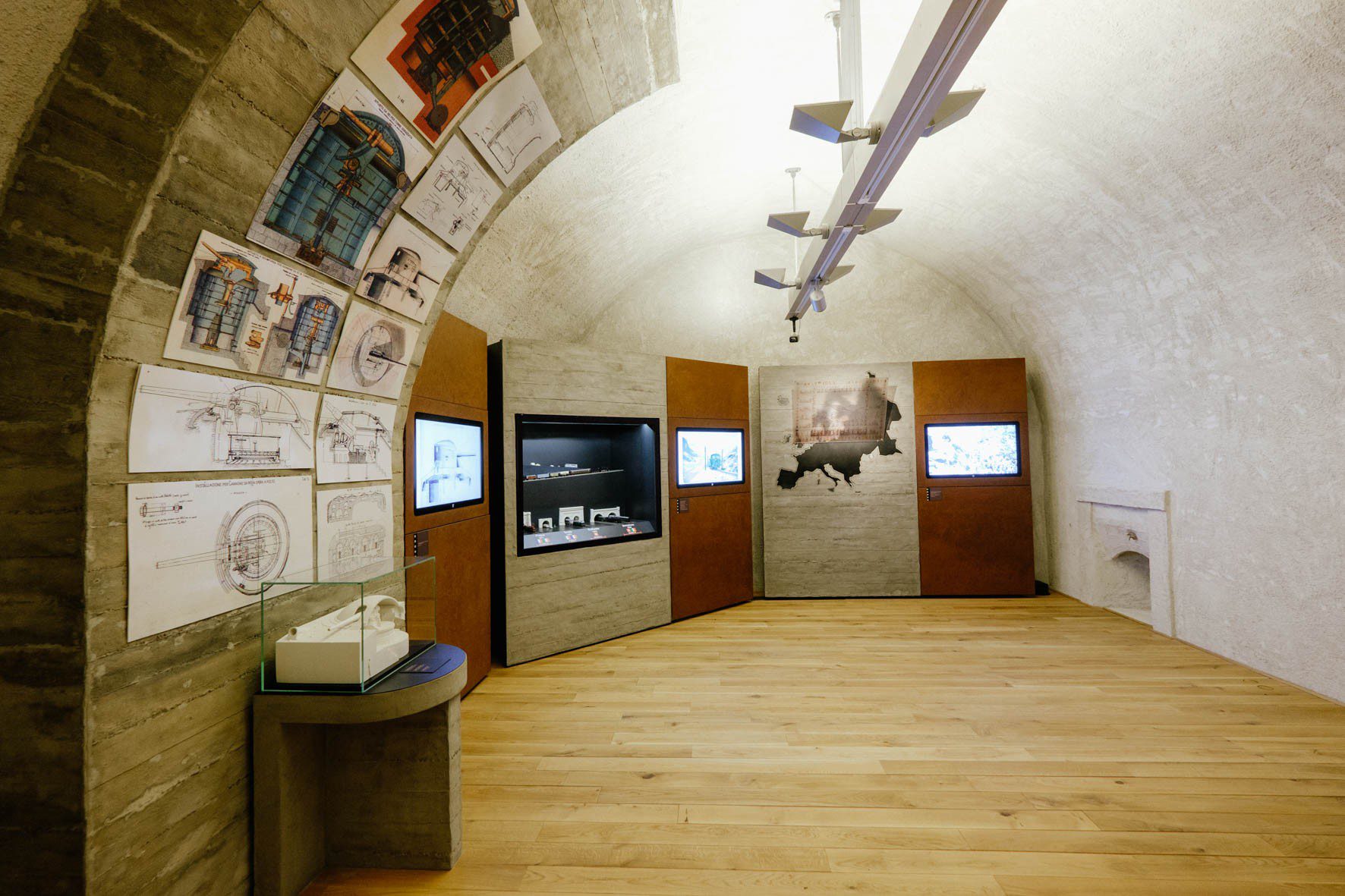
The third and final part of the museum poses the question “The Alps, a frontier?” with the aim of putting the visitor in a position to reflect on the journey made and on the meaning to be given to the term frontier: border or barrier? Obstacle or link?
Thus outlines an exhibition path that conveys a complex and structured vision not only of the Fort of Bard, but also of the historical, social, cultural, and geopolitical context in which it is placed in different historical eras: a journey into the past that concludes with a reflection extremely relevant to the present.
The visitor is thus the protagonist of a dialogue with the place where they are, in search of an identity, that of the Alps, in continuous evolution, which becomes a crossroads of great events of the past and a history of men made of simple memories and actions.
The Ferdinando. Museum of Fortifications and Frontiers
Fort of Bard. Aosta Valley
Opening hours: from Tuesday to Friday: 10:00 – 18:00 | Saturday, Sunday and holidays: 10:00 – 19:00
closed on Monday
Rates: Full price 9.00 euros | Reduced 7.00 euros | Reduced youth (6-18 years) and schools: 5.00 euros
Combined adult ticket (Museum of the Alps, The Ferdinando, Prisons) 15.00 euros
Guided tour (for groups) up to 25 people 80.00 euros + reduced entrance ticket
Rates include admission to the exhibition Paolo Pellegrin. Frontiers.
Public information
Fort of Bard Association | T. + 39 0125 833811 | info@fortedibard.it | www.fortedibard.it
Guided visit reservations | T. + 39 0125 833817 | prenotazioni@fortedibard.it