

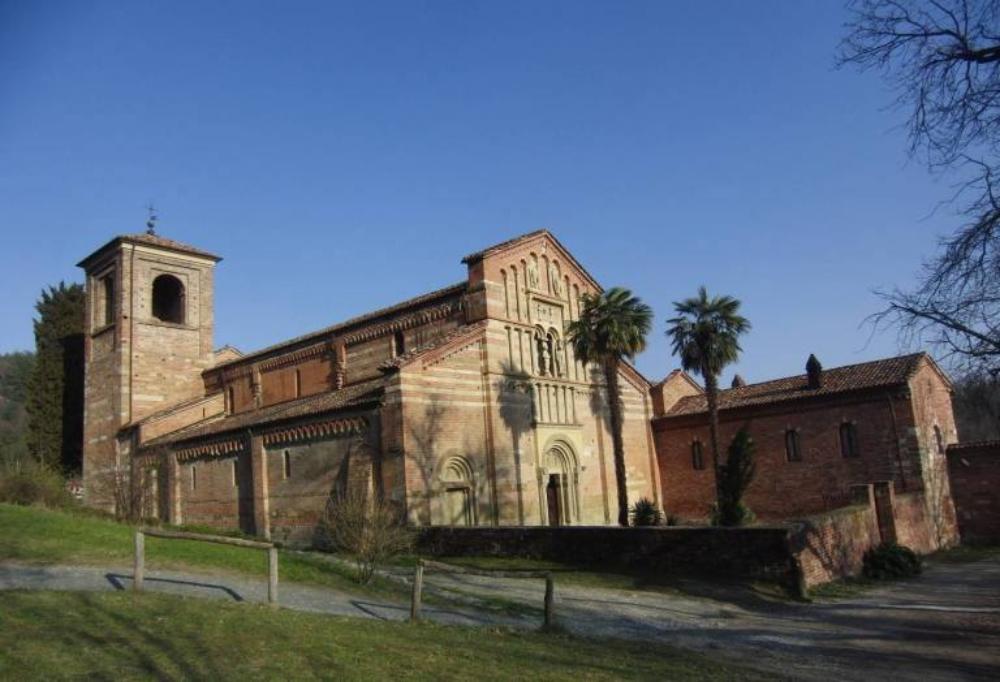


Located between the dioceses of Vercelli, Asti, Turin, and Ivrea, close to the powerful municipalities of Asti and Chieri, the Vezzolano Canonica in Piedmont bears witness, through its important medieval artworks, to a long period of splendor between the 12th and 13th centuries, followed by a slow decline, symbolically encapsulated in two dates: 1405, the year when the canonica was granted in commendam to abbots residing elsewhere, and 1800, when the Napoleonic administration expropriated its assets, turning the church into a rural chapel of the Albugnano parish and the frescoed cloister into a granary. In 1937, the complex was handed over to the State and placed under the Superintendence for Architectural Heritage.
The church, oriented with the apse facing east, originally had a basilical plan, that is, three naves, which was modified in the 13th century when the right nave was transformed into the north side of the cloister. The façade, gabled and made of brick with horizontal sandstone bands, features a rich sculptural decoration of transalpine connotation concentrated in the central part.
The interior showcases early Gothic forms: the central nave is divided by a pontile (or jubé), a rare architectural structure on small columns, supporting a polychrome bas-relief with two superimposed registers depicting the Patriarchs and Stories of the Virgin, attributable to the third decade of the 13th century although bearing the date 1189; on either side of the central window of the apse, a polychrome sculpture of Antelamian derivation (late 12th century) represents the Annunciation.
In the cloister, one of the best preserved in Piedmont, are carved capitals and an important cycle of 14th-century frescoes, including the remarkable depiction of the Contrast of the Three Living and the Three Dead.