


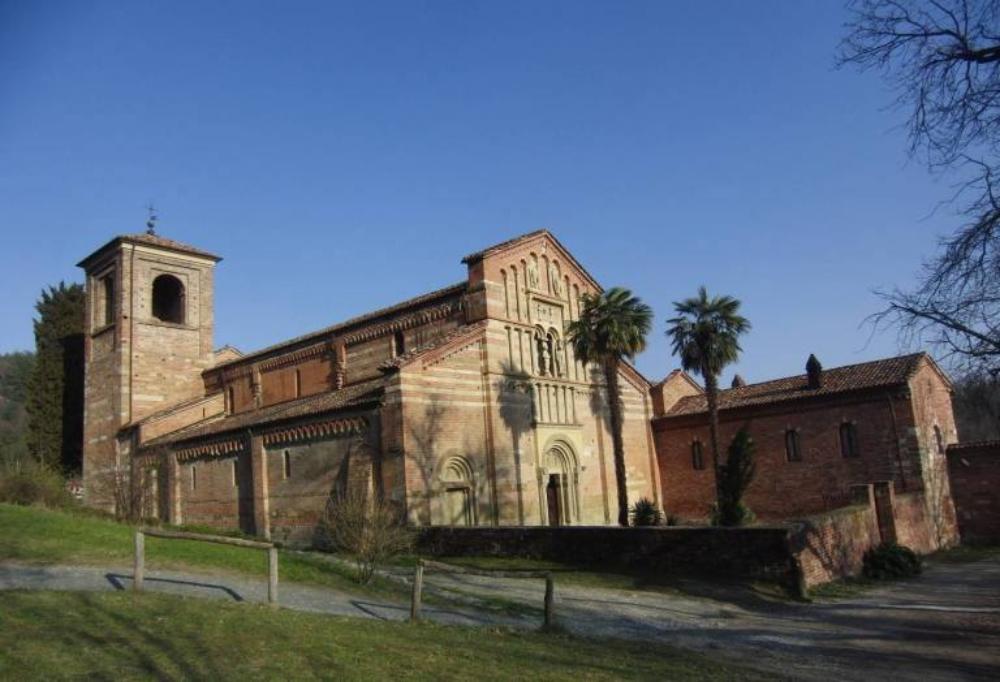


Posted between the dioceses of Vercelli, Asti, Turin, and Ivrea, close to the powerful municipalities of Asti and Chieri, the Canonica of Vezzolano, in Piedmont, testifies with its important medieval works of art to a long period of splendor between the 12th and 13th centuries, followed by a slow decline, which can be symbolically enclosed in two dates: 1405, the year in which the canonical was granted in commendam to abbots residing elsewhere, and 1800, when the Napoleonic administration expropriated its goods, transforming the church into a countryside chapel of the parish of Albugnano and the frescoed cloister into a granary. In 1937 the complex was ceded to the State and delivered to the Superintendence for Architectural Heritage.
La chiesa orientata, cioè con la parte absidale rivolta ad est, aveva in origine una pianta di tipo basilicale, ovvero a tre navate, che venne modificata nel XIII secolo, quando la navatella destra fu trasformata nel lato nord del chiostro. La facciata, a salienti, in cotto con fasce orizzontali in arenaria, presenta una ricca decorazione scultorea di connotazione transalpina concentrata nella parte centrale.
The interior is in early Gothic forms: the central nave is divided by a rood screen (or jubé), a rare architectural structure on small columns, on which a polychrome bas-relief with two superimposed registers depicting the Patriarchs and Stories of the Virgin extends, dating back to the third decade of the 13th century although it bears the date 1189; on the sides of the central window of the apse a polychrome sculpture of Antelamic derivation (late 12th century) represents the Annunciation.
In the cloister, one of the best preserved in Piedmont, there are carved capitals and an important cycle of 14th-century frescoes, with the remarkable representation of the Contrast of the Three Living and the Three Dead.