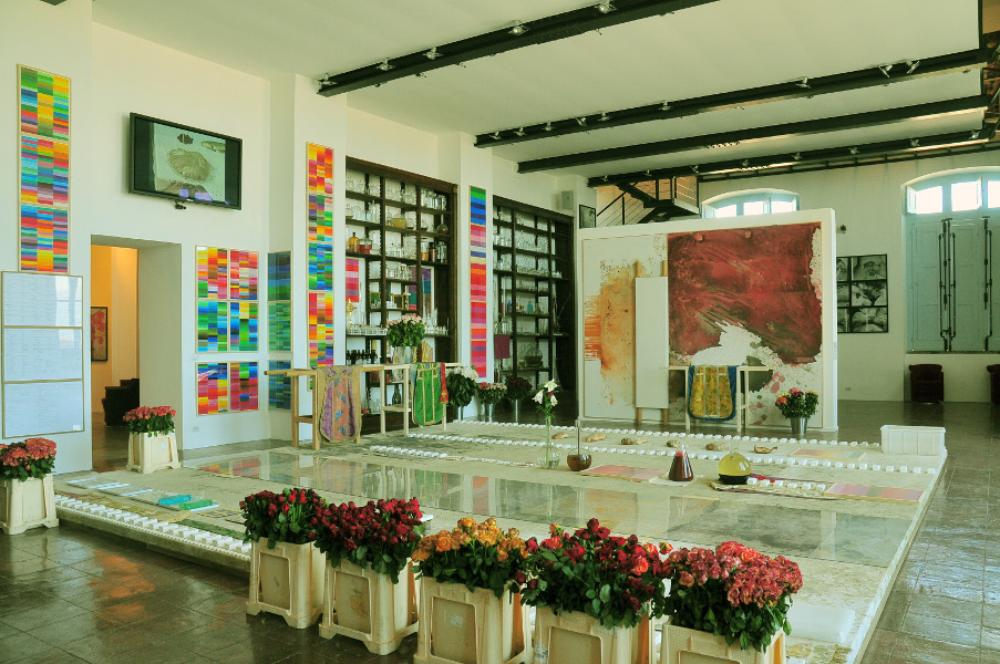
The fortress of Rione Terra, surrounded by the sea on three sides and difficult to access, is the place where the Roman colony of Puteoli was established in 194 BC. The modern regular urban layout testifies to the structure of the ancient city, organized according to a system of orthogonal axes with two main streets: traditionally, the colony’s decumanus maximus is identified with the artery of Via Duomo, of which the ancient paving is still preserved under the modern road; the cardo maximus is instead identified with Via del Vescovado. During the Republican era, few evidences have been uncovered: some stretches of the city walls, which followed a path conditioned by the tuff bank’s trend, and some rooms with polygonal tuff walls and barrel vaults of tuff slabs, found under the Episcopal palace. Along the decumanus of 194 BC, numerous buildings, granaries (horrea), and shops (tabernae) have been identified, rebuilt in opus reticulatum in the Augustan age; their upper level is occupied by a thermal complex with opus sectile floors, while the foundations consist of large cisterns excavated into the tuff bank of the hill. The buildings are connected to the street by a portico formed by opus latericium pillars on piperno base blocks, dating between the Nero and Flavian ages. Along the same road, on the north side, before reaching the city’s temple, a public building opens, whose original function is unknown, which was used in late antiquity as a pistrinum (shop for milling and baking), containing leucitic stone mills still found in situ. On the south side of the same decumanus, at the basement level, there is a large complex consisting of four adjacent cryptoportes oriented North/South, rectangular in plan with barrel vaults, dating to the early decades of the 2nd century BC to which, in the Augustan age, a fifth cryptoporte was added perpendicular to the others, oriented East/West and parallel to the decumanus maximus. From this area comes the sculptural furniture of “opera nobilia,” which constituted a sort of museum path intended to embellish the Augustan complex of the acropolis and is now exhibited, together with other artifacts, at the Archaeological Museum of the Phlegraean Fields in Baia.
Information about Rione Terra
Via Sedile di Porta
80078 Pozzuoli (Naples)
081/19936286 – 19936287; 081.5266007 (Office for the Archaeological Heritage of Pozzuoli)
[email protected]
https://sbanap.campaniabeniculturali.it
Source: MIBACT