


Before proceeding with the purchase of tickets for Pompeii, it is important to consider some aspects. First of all, you should consider whether you prefer a simple admission ticket or if you want to participate in a guided tour. A standard entrance ticket allows you to explore Pompeii at your own pace, while a guided tour gives you the opportunity to deepen your knowledge of Pompeii’s history and culture, led by an expert.
- 1. Queue in person (not recommended)
- 2. Book online
- 3. Book a guided tour (recommended)
- 4. Book a day trip
- What is the best time to visit Pompeii?
- Opening hours of Pompeii
- What you should know about the Pompeii Excavations
- What you should know about tickets for Pompeii
- The best hotels near Pompeii
- Conclusion
Additionally, you should consider the size of your group, the preferred date and time for the visit, the duration of the tour, and the areas you want to visit. Finally, you should also take into account your budget, as ticket and tour prices may vary.
How to buy tickets for Pompeii: Unless you enjoy spending your holidays waiting in long lines, we strongly recommend booking skip-the-line tickets for Pompeii in advance here or booking a guided tour of Pompeii. Between the two, the guided tour is the better option since you will be able to learn about the history of this beautiful archaeological site from an expert guide.
1. Queue in person (not recommended)
When visiting famous or iconic tourist attractions, lining up at the ticket office upon arrival is usually the worst way to get tickets. This is certainly the case here, as waiting to purchase tickets for Pompeii upon your arrival will definitely be a colossal waste of your precious vacation time.
The ticket lines at Pompeii can get quite long, especially in summer, made worse by the sun beating down on you as you are forced to wait outside the entrance. The ticket offices of the Pompeii Archaeological Park are located at each of the three entrances: Porta Marina Superiore, Porta Marina Inferiore/Piazza Esedra e Piazza Anfiteatro.
2. Book online
A better way to handle your visit is to book Pompeii tickets online before your arrival. Tickets can be purchased through the official website of the Pompeii Archaeological Park but this site has some flaws that make it far from ideal to use.
A big issue is that much of the information, including ticket names, is in Italian, which makes navigating the site difficult. Additionally, there is no information regarding the possibility to change or cancel these tickets for a refund, which could become an issue if your plans change. But the biggest problem with buying tickets through the official site is that these are not skip-the-line tickets for Pompeii.
For all these reasons, we recommend you book your ticket for Pompeii through this link or, if you also want an audio guide, through this link. With these easy-to-book tickets, you can use the priority access line at the designated entrance and you can cancel the ticket up to 24 hours in advance for a full refund. Of course, these tickets cost a bit more than standard tickets, but we think it is worth it.
Despite the ruins of Pompeii being a world-class attraction, you will not find much information available while exploring the site. That is why we strongly recommend taking a guided tour of Pompeii if you really want to learn more about its fascinating history. Another advantage of having a professional guide with you is that the ruins of Pompeii are quite extensive and it is helpful to have someone to assist you in navigating the site. Although it is possible to arrange guided tours through the guide booths at the entrances, these tours will not allow you to skip the line, which is a final advantage of joining this tour.
3. Book a guided tour (recommended)
Despite the ruins of Pompeii being a world-class attraction, you will not find much information available while exploring the site. That is why we strongly recommend taking a guided tour of Pompeii if you really want to learn more about its fascinating history. Another advantage of having a professional guide with you is that the ruins of Pompeii are quite extensive and it is helpful to have someone to assist you in navigating the site. Although it is possible to arrange guided tours through the guide booths at the entrances, these tours will not allow you to skip the line, which is a final advantage of joining this tour.
4. Book a day trip
There are always some things to consider when choosing a ticket or a guided tour for Pompeii. You will need to take into account the size of your group, the preferred date and time for your tour, the duration of the tour, and the areas you want to cover. Fortunately, there are several ticket and group tour options to choose from when visiting Pompeii.
Most tourists do not stay near the ruins of Pompeii when visiting but rather come from one of the more established cities in this part of Italy. Many have chosen to make the trip to Pompeii independently by car or train, but there is another option: a day tour.
By booking a day tour, you don’t have to worry about transportation or your schedule, because we take care of it. The most common day tours are from Naples via this link or from Rome via this link. The fantastic thing about these day trips is that they fill the day by also taking you up to Vesuvius to see the fantastic views from the volcano’s summit.
What is the best time to visit Pompeii?
One important thing to consider when visiting Pompeii is the timing of your visit. After all, this historical site is one of the most popular tourist attractions in Italy and can be exceptionally crowded at certain times of the year.
It’s best to avoid visiting during the summer months from June to September; this is not only the busiest time of year but also the hottest, and you will definitely feel the heat if you spend the whole day on the site.
Instead, it’s better to plan your visit for the shoulder seasons in March, April, and October. During these months, the number of tourists should be much more manageable, while the weather should be reasonably comfortable for outdoor sightseeing.
As for the time of day you should come, it’s best to arrive at the ruins early in the morning. You’ll spend hours on the site, and the Archaeological Park becomes more crowded in the late morning with the arrival of tourist groups and day-trippers.
Opening hours of Pompeii
The Pompeii ruins are open every day of the week, but closed on January 1st, May 1st, and December 25th. Most of the surrounding satellite ruins near Pompeii, such as the sites of Boscoreale and Oplontis, are closed on Tuesdays, while the ruins of the Castle of Lettere are open Friday, Saturday, and Sunday.
From November 1 to March 31, the ruins are open from 9:00 AM to 5:00 PM, with last admission at 3:30 PM. Other ruins are also open from 9:00 AM to 5:00 PM but close at 4:00 PM, except for the Castle of Lettere which is open from 9:30 AM to 1:30 PM and from 2:30 PM to 5:00 PM.
From April 1 to October 31, the ruins are open from 9:00 AM to 7:00 PM, with last admission at 5:30 PM. Other ruins are also open from 9:00 AM to 7:00 PM but close at 5:30 PM or 6:30 PM, except for the Castle of Lettere which is open from 9:30 AM to 1:30 PM and from 2:30 PM to 7:30 PM.
What you should know about the Pompeii Excavations
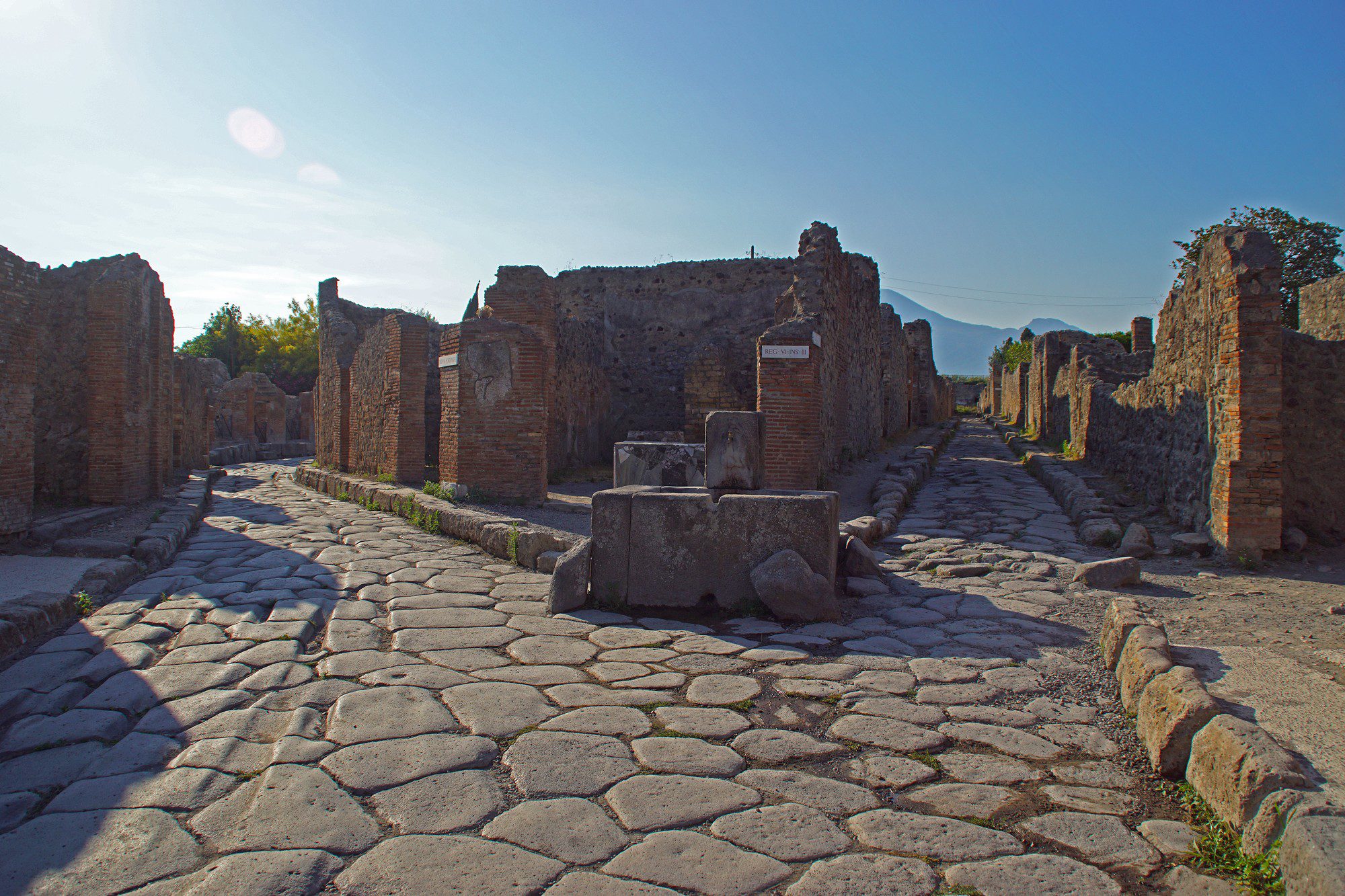
Pompeii, with its 66 hectares of which about 50 have been excavated (including suburban areas), is a unique collection of civic and private buildings, monuments, sculptures, paintings, and mosaics of such importance for the history of archaeology and antiquity to be recognized as a UNESCO World Heritage Site. The ash and lapilli that buried the city due to the eruption of Vesuvius in 79 A.D., as narrated in the two famous letters of Pliny the Younger and also recalled by historians of the time, actually allowed for exceptional preservation, enabling a vivid image of the organization of Roman cities as well as the daily life of its inhabitants.
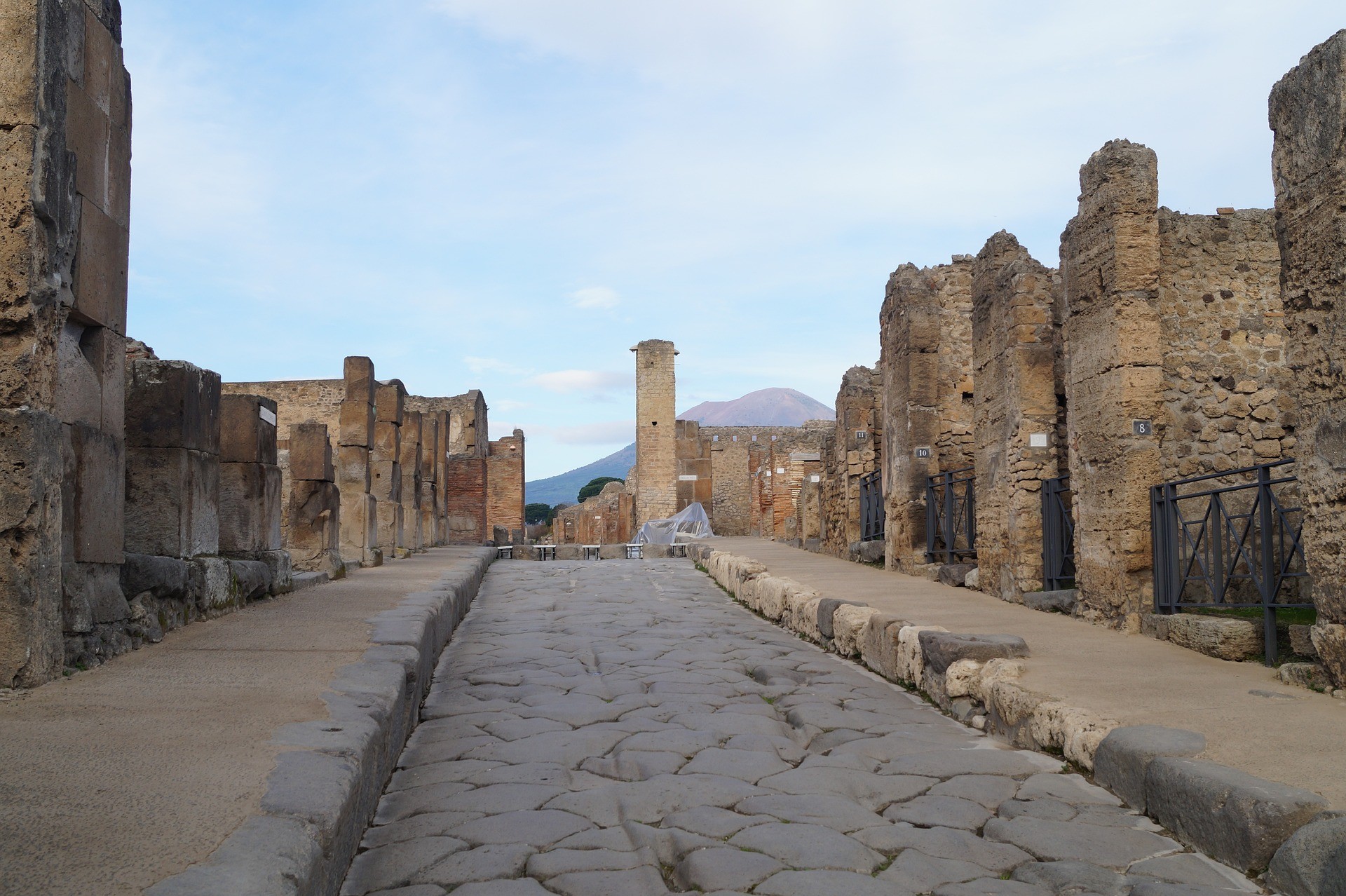
The ancient city stands on a plateau overlooking the valley of the Sarno River, at whose mouth there was an active port. Visitors can now enter through one of the ancient gates located along the walls (Porta Marina entrance), walking along its ancient paved streets where it is possible to visit houses, both modest and luxurious, with their wall and floor decorations, shops, the Forum with its spaces and public buildings, sacred areas, thermal complexes, and buildings for entertainment in the theater district and amphitheater. Also, by following the access roads to the ancient city, one can observe the four necropolises arranged at the exits of the city gates with monumental tombs of various types, while outside the excavation area, it’s possible to visit some of the rural residences that stood throughout the Pompeian countryside, foremost among them the so-called Villa of the Mysteries.
The subdivision of the city, indicated along the route in regiones (districts) and insulae (blocks), was made by Giuseppe Fiorelli in 1858 for study and orientation purposes. The names of the houses, when the owner is not known, were coined by the excavators based on particular finds or other circumstances. Information about the origins of the settlement, probably Etruscan, is uncertain, and only thanks to archaeological investigations has it been possible to identify the oldest evidence, dating from the end of the 7th to the first half of the 6th century B.C., when the first enclosure wall in local grey tuff called ‘pappamonte’ was built to delimit an area of 63.5 hectares. From the 5th century B.C. dates the construction of a new limestone fortress of the Sarno, which was probably similar in route to the previous one; but it was only during the Samnite period that Pompeii received a strong urbanization impulse. Towards the end of the 4th century B.C., following new pressure from the Samnite populations towards the coast, Rome progressively expanded into southern Italy: alliances and victorious military campaigns eventually made it hegemonic throughout Campania (343-290 B.C.).
From the end of the Hannibalic War, especially manifesting in the second half of the 2nd century B.C., there was systematic occupation of entire neighborhoods and restructuring of already occupied areas of the city. Pompeii then became an ally (socia) in the political organization of the Roman republic, but in 90-89 B.C., it rebelled along with other Italic peoples who demanded equal socio-political dignity from Rome. Besieged by the troops of Publius Cornelius Sulla, the city fell and became a Roman colony under the name Cornelia Veneria Pompeianorum (80 B.C.). After the establishment of the colony, Pompeii was enriched with private and public buildings and further embellished especially during the reigns of the emperors Augustus and Tiberius. In 62 A.D., a violent earthquake struck the entire Vesuvius area.
Reconstruction began immediately in Pompeii; but due to the extent of the damage and the swarm of seismic events following the first earthquake, it took a long time: seventeen years later, when on August 24, 79 A.D., the sudden eruption of Vesuvius buried it with ash and lapilli, Pompeii was still a work in progress. Its rediscovery occurred in the 16th century during the construction of the Count of Sarno’s Canal, led by Domenico Fontana; parts of buildings and important public inscriptions came to light, but the site was initially identified as Stabiae. Only in 1748, under the reign of Charles III of Bourbon, did extensive exploration begin to glorify the royal house. Excavations proceeded irregularly in different parts of the ancient site, which was only recognized as Pompeii after some years. Part of the necropolis outside Porta Ercolano, the temple of Isis, and the theater district were uncovered. The French occupation period in the early 1800s saw increased excavations, which later declined with the return of the Bourbons. Work was done in the amphitheater and Forum area and again near Porta Ercolano and the theaters. During the new Bourbon rule, the discovery of the House of the Faun with its large and famous mosaic depicting the battle of Alexander caused great excitement. After Italian unification and the appointment of Giuseppe Fiorelli as excavation director (1861), there was a turning point in excavation methods.
Fiorelli sought to connect the exposed blocks and proceed systematically with archaeological exploration, keeping more detailed excavation records and leaving the paintings in place, which were previously removed and taken to the Royal Museum of Naples according to the subjective taste and value judgments of the excavators and the royal house. He also introduced the plaster cast method, which made it possible to recover the impressions left by the bodies of the eruption victims, giving a dramatic depiction of their end caused by the toxic gases released by the volcano during the eruption. At the start of the last century, exploration extended towards the eastern part of the city in regiones V, IX, I, and II along the routes of the streets – Via di Nola, Via di Stabia, and Via dell’Abbondanza – particularly with Vittorio Spinazzola, with increasing attention to traces left by the houses’ upper floors. This leads to the long period (1924-1961) marked by the direction of Amedeo Maiuri. In his intense excavation activities, especially in the eastern regiones, besides discovering prestigious buildings (such as the Villa of the Mysteries and the House of Menander), he completed the city’s perimeter, excavated the necropolis at Porta Nocera, and methodically began exploration of strata below the 79 A.D. level in search of Pompeii’s oldest phases.
From the second half of the 20th century, to ensure adequate preservation of the already large exposed area of the city, instead of continuing extensive exploration—especially after the damage caused by the 1980 earthquake—systematic conservation interventions and targeted excavation and restoration campaigns have been preferred, for example in the Insula occidentalis, the suburban Baths outside Porta Marina, the House of Julius Polybius in regio IX, the blocks of regiones I and II facing Via di Nocera and Via dell’Abbondanza, and more recently in the House of the Chaste Lovers.
What you should know about tickets for Pompeii
Below are answers to some frequently asked questions about visiting Pompeii.
- Is it necessary to buy tickets for Pompeii in advance? Yes, it is advisable to purchase tickets in advance. Tickets can be bought on site, but availability is not always guaranteed. Also, the ticket office line can be very long. You might be looking at up to two hours of waiting time in summer, which is not ideal if you’re a tourist. Be sure to buy your tickets well in advance to allow for changes and to ensure availability on your preferred dates.
- When do Pompeii tickets go on sale? Unlike many major sites in Italy, Pompeii tickets are not released on a fixed schedule. You can save some money by booking in advance.
- Is it possible to buy tickets for Pompeii on the same day? Yes, it is possible to buy tickets at some of the Pompeii ruins entrances. Porta Marina, Piazza Esedra, and Piazza Anfiteatro are entrances where tickets can be purchased. The entrance fee to Pompeii is approximately €19 per person.
- What are Pompeii’s opening hours? From April to October, the archaeological park is open from 09:00 to 19:00, and from November to March, Pompeii’s opening hours are from 09:00 to 17:00.
- What is the best time to visit Pompeii? The best time to visit Pompeii is in the afternoon, after all cruise ship passengers have left the park. To really appreciate the ruins, it’s better to go when it’s quiet, which is why it’s recommended not to visit on the first Sunday of the month as it is very crowded.
- Are there discounts or free entries for Pompeii? If you visit on the first Sunday of the month, you can get a free entrance ticket to Pompeii at the physical ticket office. But be warned, there will be a lot of people, and availability is limited to prevent overcrowding. EU citizens between 18 and 25 years old are entitled to a reduced ticket of €2.00, and children under 18 have free access. In these cases, an identity document must be presented.
- Do I need to print my tickets for Pompeii? No. Although having a copy of your ticket is never a bad idea, you can show the PDF version of your ticket from your smartphone to enter the ruins of Pompeii.
The best hotels near Pompeii
Although it’s not the most common approach to visiting, you might decide to stay near the Pompeii excavations. Visitors usually stay in Naples or the coastal town of Sorrento and take a short trip, but there are accommodation options in the city of Pompeii if that is what you prefer. Here are some of our recommendations on places to stay in the area.
One of the best accommodation options around Pompeii is the Resort & Winery Bosco De Medici. This four-star resort is located 700 meters (2,300 feet) from the ruins of Pompeii and boasts a wide range of exclusive amenities, including a large outdoor pool, an equestrian center, and a private vineyard.
For a comfortable and relaxing stay with great value for money, be sure to check out the bed and breakfast Nolana ’86. This B&B offers fresh and modern rooms, an excellent free breakfast, and even a shared kitchen if you wish to cook during your stay.
Pompeii is surprisingly lovely if you are looking for budget accommodation, and Agorà Hostel is one of its most popular offerings. In this simple but welcoming hostel, you will enjoy helpful hosts, dormitories and private rooms with air conditioning, and it is a five-minute walk from the entrance to the archaeological park.
Conclusion
We hope this guide has helped you understand how to purchase tickets for Pompeii. Remember, planning ahead is the key to a stress-free and enjoyable visit to this fascinating historical site. Have a great trip!