

The Vatican Museums and the Sistine Chapel are among the most famous attractions in the world and, consequently, the lines to enter can be extremely long. However, there are ways to avoid these long waits and fully enjoy the visit without stress. In this article, we will provide you with all the necessary information on how to purchase tickets for the Vatican Museums and the Sistine Chapel, so you can best plan your trip to Rome.
- The best ways to get tickets for the Vatican Museums and the Sistine Chapel
- 1. Online Purchase
- 2. Booking a guided tour (Recommended)
- 3. Purchasing a Rome tourist pass
- Useful information for your visit to the Vatican Museums and Sistine Chapel
- Ticket prices for the Vatican Museums
- Opening hours of the Vatican Museums
- The best time to visit the Vatican Museums and Sistine Chapel
- How to get to the Vatican Museums
- Security procedure at the Vatican Museums and Sistine Chapel
- Hotels near the Vatican Museums
- What to see at the Vatican Museums and the Sistine Chapel
- Is Vatican City an integral part of Italy?
- How many inhabitants does the Vatican have?
- How old is Vatican City?
- How long did it take to paint the Sistine Chapel?
- Where does the Pope actually reside?
For those in a hurry. How to purchase tickets for the Vatican Museums and the Sistine Chapel. Unless you enjoy spending your vacation waiting in long lines, we recommend that you book skip-the-line tickets for the Vatican Museums and the Sistine Chapel in advance here or book a tour for the Vatican Museums and the Sistine Chapel. Between the two options, choosing the guided tour is the best choice as it not only allows you to avoid long queues but also lets you learn the history of one of the most sacred places for Christianity through an expert guide.
The best ways to get tickets for the Vatican Museums and the Sistine Chapel
There are several ways to purchase tickets for the Vatican Museums and the Sistine Chapel. Here is an overview of the available options:
1. Online Purchase
A quick and convenient way to guarantee access to the Vatican Museums and the Sistine Chapel is to buy tickets online in advance. This allows you to skip the line and go straight to security check.
You can purchase tickets through the official Vatican Museums website, but there are some limitations to consider. For example, tickets can only be booked up to 60 days in advance, which is not ideal for long-term planning. Also, tickets cannot be canceled, only date or name changes are allowed.
To avoid these limitations, we recommend buying tickets through this link. This site offers the possibility to buy tickets without time limits and to cancel them up to 24 hours before the visit for a full refund. Additionally, there are no significant price differences compared to the official site, considering the audio guide and the €4 skip-the-line reservation fee that the official site applies.
If you want to visit the attractions before the crowds arrive, you can buy early access tickets to the Vatican Museums and the Sistine Chapel. This allows you to enter one hour before the regular opening at 8:30 a.m. and you don’t need a guided tour to do so. However, you will have to pay an extra cost for this privilege.
2. Booking a guided tour (Recommended)
For a complete experience of what the Vatican has to offer tourists, nothing beats a guided tour. A Vatican City tour will help you understand what you’re seeing and the deep significance behind it. Additionally, you’ll have the chance to skip the line at the entrance.
The standard tour that most visitors choose lasts about three hours and usually has between 20 and 40 participants. Your tour guide will lead you through the Vatican Museums, the Sistine Chapel, and St. Peter’s Basilica, explaining their history and importance via a headset.
If you’re looking for a more personalized experience, you might consider booking a private tour. With a private tour, you can focus on what interests you most and freely ask your guide questions along the way. For a different experience during your visit, why not try an evening tour? This type of tour is only available on Fridays during the warmer months, from mid-April to the end of October. It gives you access to the same places you visit with regular Vatican tickets but in a much quieter, smaller group setting with few other people around you. All tours include the Vatican Museums, the Sistine Chapel, and St. Peter’s Basilica.
In short, here are all the different types of Vatican tours available:
- Standard guided tour of the Vatican
- Private guided tour of the Vatican
- Evening tour of the Vatican
3. Purchasing a Rome tourist pass
Those who wish to visit many attractions in Rome beyond Vatican City may want to consider purchasing a city tourist pass. Like those offered for other major tourist destinations, these passes help simplify and make tourism more affordable when fully utilized. Tourist passes usually include free admission or discounts to major tourist attractions, along with tours or public transport to offer tourists a way to save money.
The most common tourist pass in Rome is the Roma Pass. It provides free entry or discounts to many of the city’s main tourist attractions, as well as including free public transport. It grants you free access to two of the following attractions: Capitoline Museums, Castel Sant’Angelo, Colosseum and Roman Forum and Palatine Hill. The only downside is that the Roma Pass does not directly help you visit Vatican City.
Alternatively, visitors should consider the Omnia Card + Roma Pass. In addition to all the benefits of the Roma Pass, it also provides priority entry to Vatican attractions through the Omnia Card. This means you have free access to the Vatican Museums and Sistine Chapel, the Basilica of St. Paul Outside the Walls, and the Basilica of St. John Lateran and the Cloister. It is practically a complete pass for Vatican City and Rome.
Useful information for your visit to the Vatican Museums and Sistine Chapel
Ticket prices for the Vatican Museums
Tickets for the Vatican Museums start at €17 for adults, while children aged 6 to 18 and students up to 25 years with a student card pay €8. These prices are for tickets purchased on site after queuing.
Audio guides cost an additional €7, with special versions for children aged 6 to 12 costing €5. “Skip the line” reservations made in advance through the official Vatican Museums website include a booking fee of €4. Guided tours, exclusive sections, and “after hours” visits have additional costs. An exception to all this is the last Sunday of each month when the museums are open to the public for free.
Opening hours of the Vatican Museums
The Vatican Museums and Sistine Chapel are open Monday through Saturday, as well as the last Sunday of each month. They usually open at 9:00 AM and close at 6:00 PM. The last admission is always two hours before closing time.
The museums are closed on the following days: January 1, January 6, February 11, March 19, April 5, May 1, June 29, July 25, August 16, August 29, November 1, November 28, December 8, and December 25-26.
The best time to visit the Vatican Museums and Sistine Chapel
Just as there are better ways to purchase tickets for the Vatican Museums, there are also better times to visit them. Generally, you will find the Vatican quieter from November to February when there are fewer tourists around. You should avoid the Christmas and Easter periods, as it tends to be busier during religious holidays.
If you don’t opt for an after-hours tour, try to start your visit as early as possible. Alternatively, you can wait until late afternoon once many tourist buses have departed, leaving slightly shorter lines and a calmer atmosphere.
As for weekdays, it is best to avoid Saturdays, which is usually the busiest day, followed by Fridays and Mondays, when the number of people visiting for a city weekend can increase. Due to the papal audience usually held on Wednesdays, that day can also have a higher number of visitors. This leaves Tuesdays and Thursdays as the best days to visit.
How to get to the Vatican Museums
Getting to Vatican City is fairly simple, but it will depend on where you are coming from. To give you an idea, the Vatican is about two kilometers from the Trevi Fountain and just over three kilometers from the Colosseum. This means it is within walking distance from these popular attractions.
There are also public transport options to reach the Vatican. Buses 40 and 64 depart from Roma Termini (the main train station in the city) through the city center to just outside the Vatican. A faster option to get from Roma Termini is to take Metro Line A to Ottaviano-S. Pietro station and walk from there.
Security procedure at the Vatican Museums and Sistine Chapel
Regardless of the type of ticket you purchase or how you book it, all visitors are required to go through security screening before entering the Vatican Museums and Sistine Chapel. The good news is that the security line is not comparable to the ticket purchase queue and should take only a few minutes.
For smooth security access, it is worth knowing the rules and what you can and cannot bring with you. Perhaps the most important is the dress code. Since this is a place of worship, visitors are required to dress respectfully, which means no sleeveless tops or deep necklines, no shorts or skirts above the knee, and no hats.
Any luggage, large bags, large umbrellas, camera or camcorder tripods, signs and placards must be left at the cloakroom before entering the exhibition halls. The consumption of alcoholic beverages, food, and drinks is prohibited inside the museum and must be left at the cloakroom. The use of the cloakroom is free.
Hotels near the Vatican Museums
If visiting the Vatican Museums and nearby attractions is a top priority for you, you might want to choose a hotel nearby. Although it is easy to reach the Vatican from other parts of Rome, here are some nearby hotels in case you want everything within reach.
With its privileged location and sumptuous furnishings, the Starhotels Michelangelo Romeis ideal for a luxury stay close to the Vatican. This four-star hotel is just a few minutes on foot from St. Peter’s Square and offers elegant rooms and suites.
Those looking for something more affordable might consider the Residenza Palline. Still close to the Vatican, only 500 meters away, this guesthouse offers a bright and comfortable place with all the amenities you might need.

What to see at the Vatican Museums and the Sistine Chapel
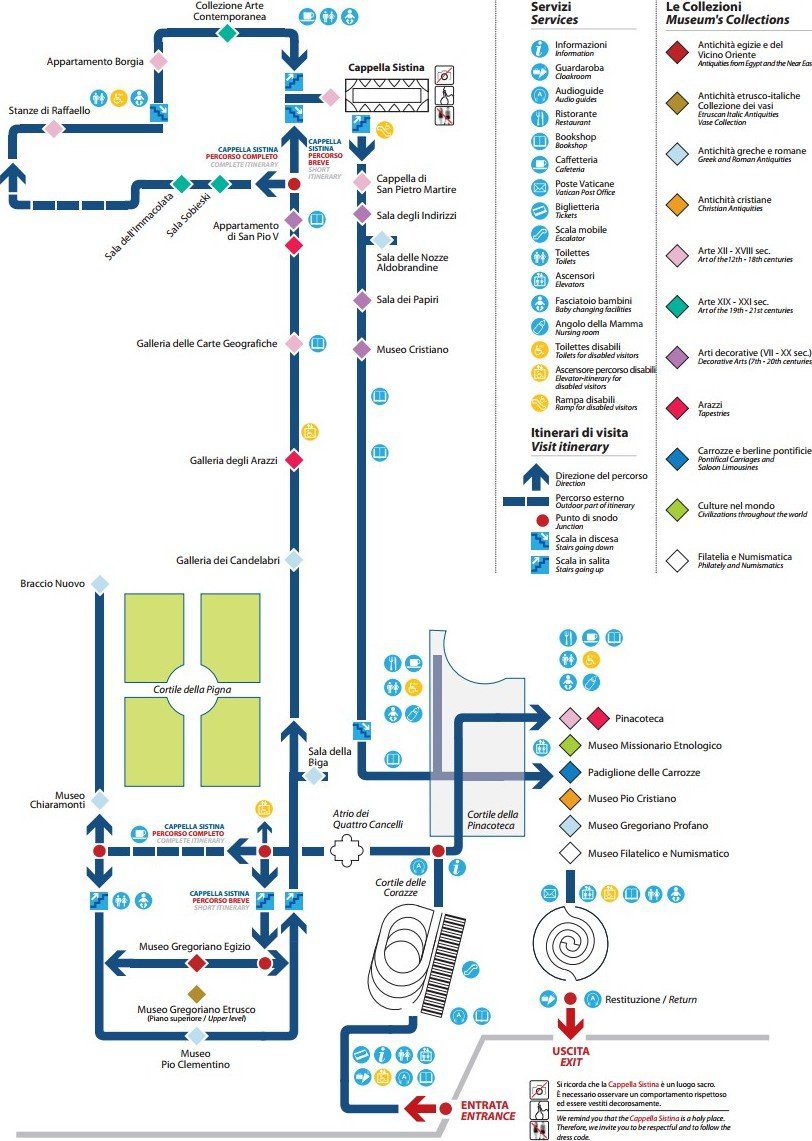
The Vatican Museums and the Sistine Chapel house an extraordinary collection of artworks. Here is an overview of what you can see during your visit:
- Gallery of Tapestries: collection of tapestries from the 16th and 17th centuries.
- Gallery of Maps: decorated by Gregory XIII from 1572 to 1585, it displays geographical maps of Italy and other regions.
- Sobieski and Immaculate Conception Rooms: rooms with artworks and frescoes.
- Raphael Rooms: rooms commissioned by Julius II and Leo X between 1513 and 1521, decorated with frescoes by Raphael.
- Blessed Angelico Chapel: chapel with frescoes by Fra Angelico.
- Sistine Chapel: the most famous artwork of the Vatican Museums, commissioned by Sixtus IV (1471-1484).
- Borgia Apartment: collection of artworks and frescoes.
- Vatican Pinacoteca: collection of paintings by artists such as Leonardo da Vinci, Raphael, and Caravaggio.
- Missionary Ethnological Museum: collection of objects from various cultures.
- Collection of Modern and Contemporary Religious Art: inaugurated by Paul VI, it showcases modern religious artwork.
These are just some highlights of the Vatican Museums, which contain many other artistic treasures of inestimable value.
To fully explore the Sistine Chapel and the Vatican City, the best choice is to opt for a guided tour or rely on a knowledgeable guide. However, it is a pleasure to share some basic facts to get started.
Is Vatican City an integral part of Italy?
Although completely surrounded by Rome and Italy, Vatican City actually belongs to its sovereign state called the Vatican City State.
How many inhabitants does the Vatican have?
In 2019, the Vatican had 825 residents, including 453 citizens and 372 Vatican residents, which include diplomats residing locally and abroad. Not all citizens are clergy, as families of diplomats and members of the famous Swiss Guard also reside there.
How old is Vatican City?
As an independent territory, the Vatican City State is 92 years old. The Apostolic Palace, the official residence of the Pope and the home of the Vatican Museums and the Sistine Chapel that you will visit, dates back to 1589.
How long did it take to paint the Sistine Chapel?
The ceiling of the Sistine Chapel was painted by the renowned Renaissance artist and sculptor Michelangelo. He worked on the ceiling from the spring of 1508 until October 31, 1512, taking over four years.
Where does the Pope actually reside?
The official residence of the Pope is the Apostolic Palace, also known as the Vatican Palace, which also houses the Vatican Museums and the Sistine Chapel. The Papal Apartments inside the palace include the Pope’s bedroom, his private study, and other rooms such as a kitchen and a medical room.
Now that you have this information, you will be well prepared to experience an unforgettable visit to the Sistine Chapel and the Vatican Museums. You will undoubtedly be grateful for having planned ahead when you see the lines, that’s for sure.