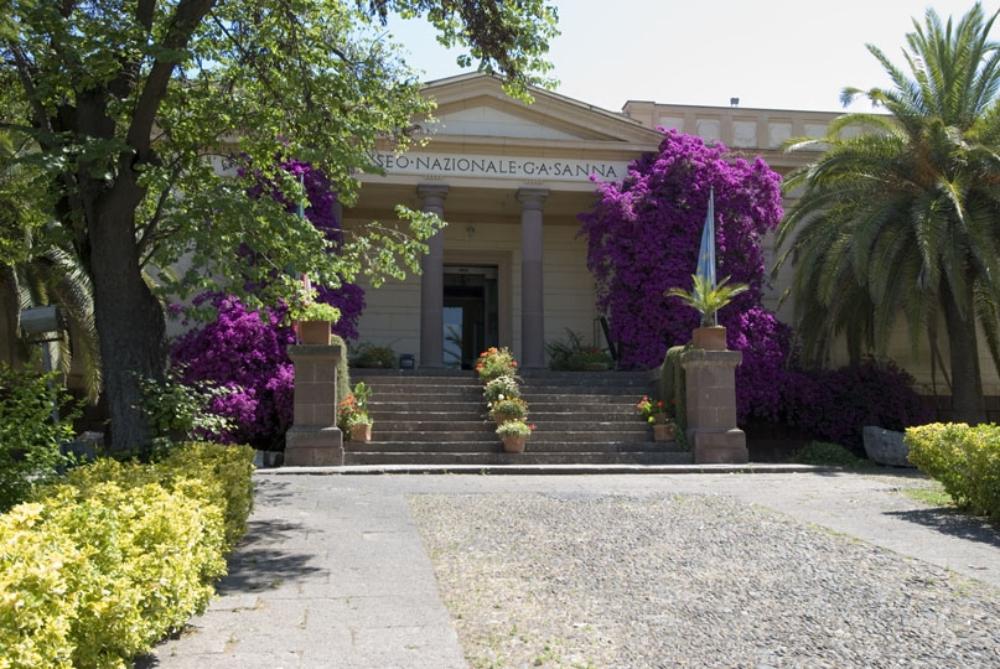


Its headquarters, originally located in the royal palace, were moved in 1856 to the University of Cagliari building, following the donation of the collections made to this institution by King Carlo Felice. At the beginning of the twentieth century, the museum, which was rapidly expanding, needed to have a different location.
The inauguration of the new building, located in Piazza Indipendenza and designed by Dionigi Scano, took place in 1904, with the layout curated by Antonio Taramelli, a renowned archaeologist and superintendent from 1901 to 1931. Since 1993 the museum, which had been extraordinarily enriched by donations from private individuals and materials from excavations, has been moved to the current prestigious location of the Cittadella dei Musei, a multifunctional cultural facility designed by architects Piero Gazzola and Libero Cecchini in the area of the eighteenth-century Royal Arsenal.
The museum offers the opportunity to undertake a complete temporal journey through the prehistory and ancient history of Sardinia via an exhibition path articulated on four floors. In the basement, exhibits are displayed according to a chronological-didactic criterion, showcasing artifacts that illustrate all the cultural phases that succeeded each other on the island starting from the Early Neolithic (circa 6000-4000 BC) up to the Early Middle Ages (8th century AD).
On the other floors, the display of materials follows a topographical criterion with the illustration of the main archaeological sites present in the central-southern territory of Sardinia. Nonetheless, five fundamental cultural moments are highlighted: the pre-Nuragic age, with artifacts from the Neolithic and Eneolithic periods (6000-1800 BC) and the early Bronze Age (1800-1600 BC), the Nuragic period, illustrated by materials dating from the Middle Bronze Age (1600-1300 BC) to the second Iron Age (600 BC), the Phoenician-Punic period (second half of the 8th century BC – 238 BC), the Roman Republican and Imperial age (late 3rd century BC – first half of the 4th century AD) and finally the late Roman and Early Medieval age (up to the 7th-8th century AD).