Alongside the Basilica of San Pietro, the Church of Santa Maria Maggiore is a beautiful example of Romanesque architecture in Italy. It was also the first cathedral of Tuscania and the only one, by ancient privilege, to have an immersion baptismal font with a basin that is still well preserved today.
The origins of the building date back to the 8th century, but the church was almost completely rebuilt between the end of the 11th and the beginning of the 12th century and later entirely renovated again to take on its current three-nave form.
The building is flanked by a massive bell tower that served the dual purpose of calling the faithful and as a lookout and defense tower, given its strategic position at the confluence of numerous and busy roads leading to Tarquinia, Viterbo, toward Rome via Vetralla, and the volcanic area through the Clodia road.
The church’s facade resembles that of San Pietro with a splendid rose window and a loggia beneath it, but the pediment crowning the central part is missing.
The three portals with their lunettes are much more refined than those of the larger sister church. Tuff, a local volcanic stone, is the dominant building material.
The largest central portal is made of white marble. It features four small columns on each side with Corinthian capitals supporting arches that crown the lunette, which displays a high-relief sculpture of the Madonna with Child enthroned, the Lamb of God, the sacrifice of Isaac, and the flight into Egypt. On either side of the entrance portal are carved images of Saint Peter and Saint Paul.
The right and left portals are also finely worked with vegetal motifs, symbolic figures, columns, and Corinthian capitals.
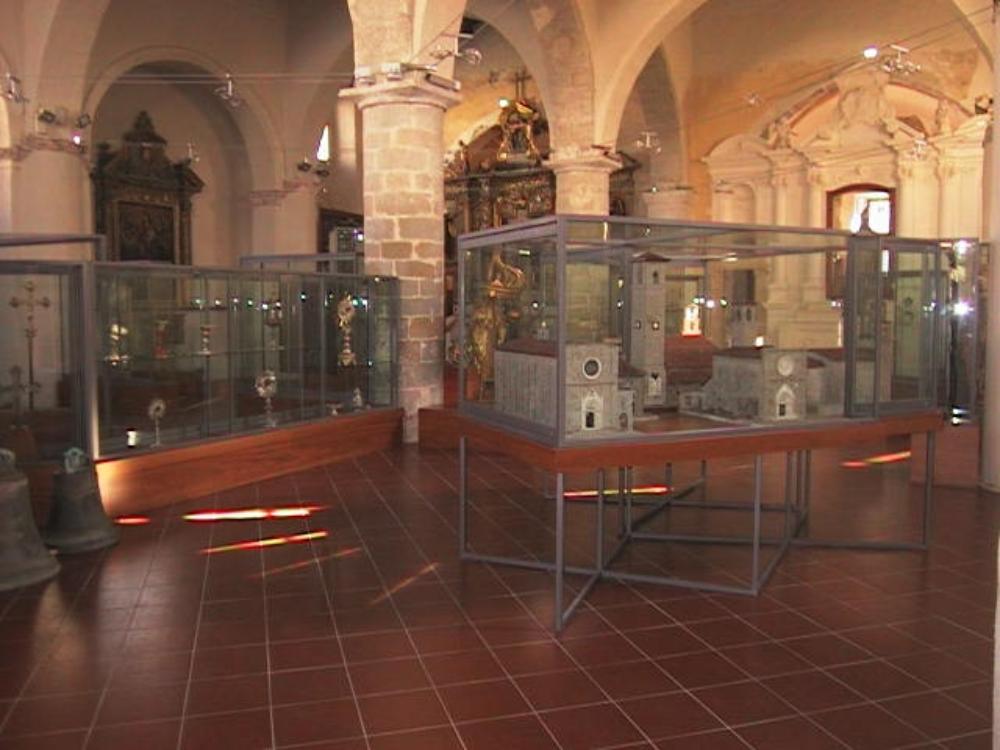
The interior, with three naves, is characterized by columns and pillars that still preserve some frescoes and Romanesque capitals carved and decorated with monstrous subjects. Each nave corresponds, at the back, to an apse, with the central one larger and ending with a superb triumphal arch. Above the arch, a 14th-century fresco by Gregorio and Donato of Arezzo depicting the Last Judgment is still visible, albeit after numerous restorations.
Notable in the right nave is the 13th-century octagonal immersion baptismal font.
For more information about the possibility of using spaces within state-owned properties under the Superintendence’s management (see Use Concession for Spaces)
Information about Church of Santa Maria Maggiore in Tuscania
01017 Tuscania (Viterbo)
0761436486
[email protected]
https://www.polomusealelazio.beniculturali.it/index.php?it/260/chiesa-di-santa-maria-maggiore
Source: MIBACT