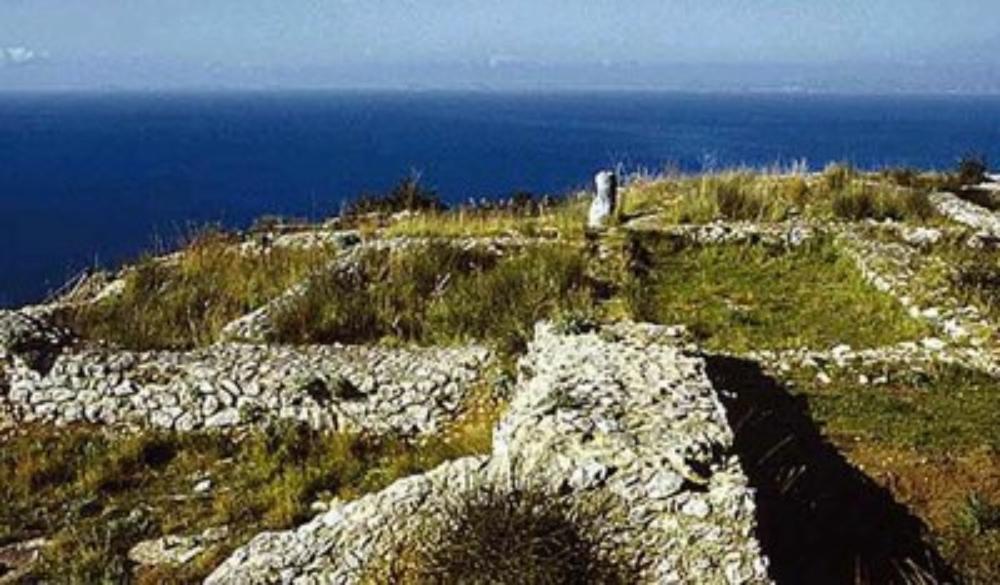
The monument consists of a series of cisterns, made up of two superimposed parts, completely independent, oriented differently and dating back to different periods. They actually belonged to a villa, whose ruins can be partly seen excavated in the tuff rock of the underlying hill and in semi-submerged fishponds in the water body in front. According to one hypothesis, the villa belonged to Hortensius and then passed to Antonia, wife of Drusus, from him to Nero, and finally to Vespasian of the Flavian dynasty. The upper building, located 3.00 m above the current ground level, is a large reservoir from the imperial period, divided into four naves, covered with barrel vaults and supported by three rows of pillars, with one of the vault extrados as a terrace, coated with a signinum floor. The hall is excavated in tuff to a depth of 2.00 m and lined with masonry with an opus reticulatum facing and tuff block bonding, featuring a hydraulic cocciopesto coating of notable thickness. At the center of each vault, there are square inspection wells; while in the north corner, there is a niche showing traces of plaster coating. At the lower level, 6.00 m below the previous one, there is a network of tunnels for water supply, dating back to the Republican age and only partially explored. Oriented East-Southeast / West-Southwest and arranged orthogonally, about 4.00 m high, they are vaulted and connected by narrow and low communication passages, sometimes with a gabled tile roof, sometimes with a flat roof covering. The rooms are excavated in tuff and lined with opus caementicium and coated with cocciopesto. The presence of this type of hydraulic plaster and the curb at the base of the walls demonstrates that these tunnels were also used as cisterns. On their walls, visitors’ names from past centuries are still preserved, written in charcoal.
Information on Cento Camerelle
Via Cento Camerelle
80070 Bacoli (Naples)
0815233690 – 0818040430
[email protected]
https://www.archeona.beniculturali.it
Source: MIBACT