




The cultural facility inaugurated on October 22, 1992, is one of the most important scientific museums in the Campania Region for the number, variety, and rarity of the minerals on display. The Museum exhibits the collection gathered over more than 50 years of research by engineer Pasquale Discepolo. In 28 display cases there are over 3500 minerals of 1400 species from all over the world. Numerous donations have further enriched the collection. Since 1997, the Museum has had a paleontological section, consisting of 4 display cases. Since 2003, the anthropological section made up of 2 display cases can be admired.
The Collection
The displayed specimens show a remarkable level of crystallization, featuring often geometric shapes that seem man-made rather than naturally formed. Among the different museum sections, notable is the one dedicated to volcanic minerals presenting rarities such as lapis lazuli from Monte Somma and splendid vesuvianite crystals.
Also on display are meteorites, extraterrestrial bodies of various chemical compositions, fallen in different locations on the planet at various times. In 2001, the gem section was inaugurated thanks to the donation from architects Ezio De Felice and Eirene Sbriziolo.
The Fossil Section
In the paleontological section, important guide fossils from different geological eras are visible. More than 100 fossils are now displayed, dating from 600 million years ago to just a few thousand years ago.
On show are two dinosaur eggs, respectively from a Sauropod (herbivore) and a Velociraptor-like (carnivore), slabs with footprints of Permian reptiles (270-220 million years ago) and with amphibian fossils. The plant world is also well represented by a slab with conifer and fern leaves.
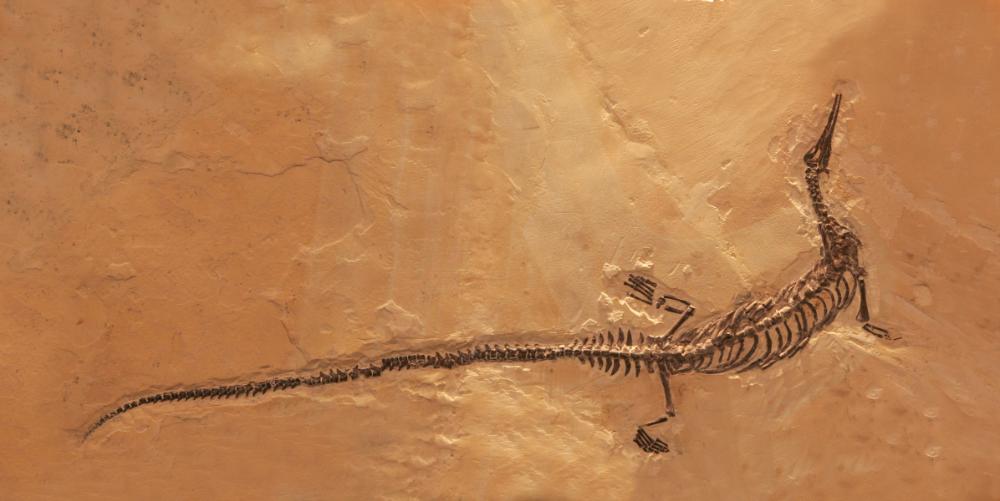
The section also features splendid fishes from the Cretaceous and other marine animals. Numerous teeth (shark, dinosaur, mammoth, etc.) and an insect in amber are present. Noteworthy are a Notosaurus and a Mesosaurus, one of the most significant reptiles for understanding Earth’s geological history, brought forward by Prof. Alfred Wegener in support of his famous “Continental Drift” theory.
Also on display is a faithful reproduction of “Ciro,” the Scipionyx Samniticus, the dinosaur hatchling from Pietraroja (Bn). Also exhibited, accompanied by educational models of the related reptiles, are fascinating dinosaur remains (teeth, claws, vertebrae, etc.) donated by the renowned paleontologist Philip J. Currie.
The Anthropological Section
Since 2003, thanks to donations from Dr. Angelo Pesce, the Museum has been able to set up a section dedicated to stone tools worked by primitive men from the Paleolithic and Neolithic periods who lived in the Saharan area. Among the artifacts are hand axes (amygdales) in quartzite, arrowheads, scrapers in flint or opal, and other serpentine tools. The rock sculpture depicting a herbivore is splendid.
Information about Campanian Mineralogical Museum
Via San Ciro, 2
80069 Vico Equense (Naples)
0818015668
[email protected]
https://www.museomineralogicocampano.it
Source: MIBACT



