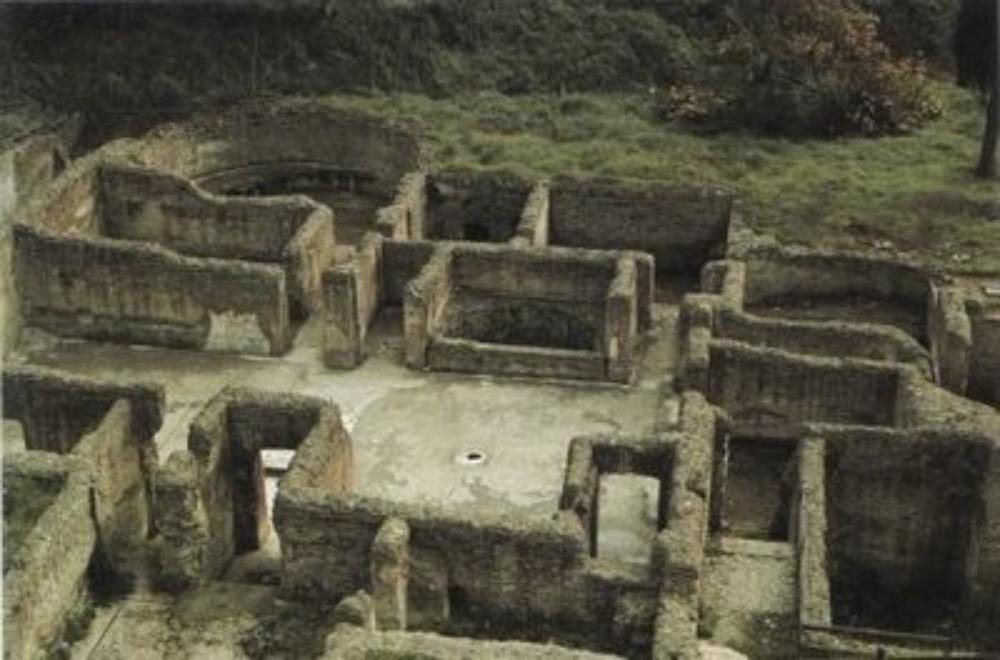
The discovery of the building and the analysis of old and new archaeological findings have clarified how the site became, already from the 1st century AD, and remained so at least until the 4th century AD, a residential district with public buildings. Incorporated into the city walls following the expansion of 440 AD, the complex indeed retained its thermal function until the late antique age, when a significant renovation was undertaken.
The archaeological area includes a series of thermal rooms and still represents the most complete example of thermae documented in Neapolis. The structure, which extends over an area of more than 900 sq meters, can be chronologically placed between the middle and the end of the 1st century AD. The building likely had its main entrance on the ancient road axis (decumanus), traced by the current Via Benedetto Croce, and was organized into two parallel sections: one of the pool, probably overlooking a courtyard used as a gymnasium, and the other of the actual thermal rooms.
Of the ancient gymnasium, today only some traces of the perimeter wall of the portico area and a corridor that separated the gymnasium from the pool are visible; of the latter, initially covered, remains of the poolside and the access stairs have been preserved. On the southern side of the excavation, an octagonal tank from a later period was installed in an environment that probably originally constituted the pool’s access.
Along the entire western side is also a water conduit, perhaps part of a larger channel derived from the Serino aqueduct.
The actual thermal rooms are arranged on two levels, one of which is underground. In the central ground floor room, the laconicum (for hot and dry air baths), connected to the tepidaria (for moderately warm baths), there are clear traces of plumbing: the tubuli for the passage of hot air and some hollow columns (suspensurae) that supported the floor suspended over the hypocaust.
In the northern area of the excavation there is a room later transformed into a cistern which, due to its northward orientation, would suggest a frigidarium (for cold water baths) or a nymphaeum.
Behind its southern wall is finally a vestibule, from which access to the underground level was gained. Some finds recovered during the exploration of the thermal building are displayed in one of the rooms of the Museo dell’Opera di Santa Chiara, along with remains of sculptural furnishings and objects of common use and sacred art recovered from the Angevin-era church (14th century), its cloister, and monastery, which survived the fire that destroyed the monumental complex in 1943.
Opened in 1995 in some rooms of the monastery originally occupied by the nuns’ apartments, the Museum tells the construction history and artistic development of the Franciscan citadel.