


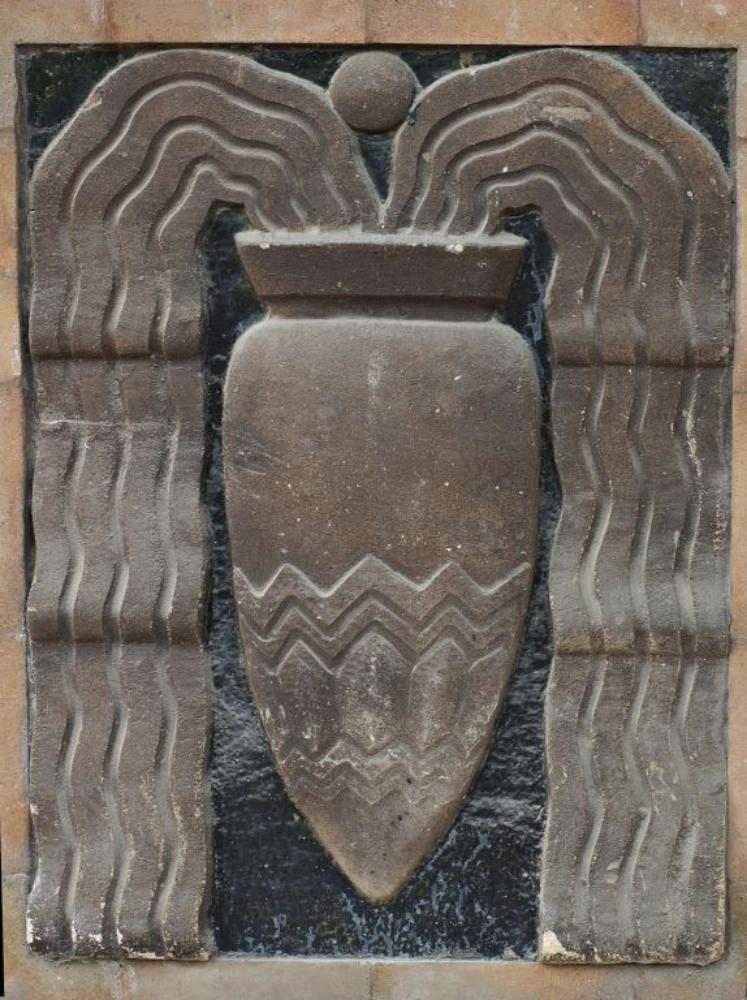


The thermal complex of Castrocaro, used since 1830 thanks to the properties of the brackish waters discovered in modern times by Prof. Antonio Targioni Tozzetti, was officially inaugurated in 1851 through the initiative of Count Antonio Marescotti, who made available for the facility the palace formerly owned by the Guarini counts. In 1869, the purchase of the springs by Dr. Aristide Conti gave new impetus to the emerging thermal industry, expanded by a new establishment. In 1887, the construction of the Conti Spa began, and in 1899 the park layout started, later decorated with sculptures produced in the first quarter of the 19th century by the workshop of the sculptor Casalini. The architectural and decorative complex of the “Fonte Littoria” dates back to 1924, created by the Focaccia and Melandri majolica factory.
The origin of the toponym, Solona, in the language of the Umbrians who first settled the region, and Salsubium in Roman times, reveals the knowledge of the presence of salt and thermal waters since ancient times. Mentioned in 1348 by Flavio Biondo in his “Italia illustrata,” the waters of Castrocaro fell into oblivion for many centuries: until 1829, when a farmer was arrested for violating the salt monopoly law by filling a barrel with water drawn from the spring called “della Bolca” in an attempt to extract salt from it. Seized under a law from 1819, the barrel was entrusted by the Florentine magistrate to the expertise of Antonio Targioni Tozzetti, who, a doctor and husband of the well-known muse of Giacomo Leopardi, recognized the beneficial virtues of the spring. This marked the beginning of a modern thermal activity, started in 1838 and since then increased through a series of private initiatives.
In 1841 the Marchioness Martelli, a Florentine noblewoman, recovered following the use of the Castrocaro water. This event made the spring famous, and thus lawyer Frassineti promoted a first thermal activity with a facility of five rooms, equipped with wooden tubs. Ten years later, the institution founded by Frassineti merged with that established by the Marescotti family in the Guarini Palace of Castrocaro. The water, drawn from the nearby Valle dei Cozzi, was transferred into special barrels transported by carts. Upon Marescotti’s death, the institution passed to his wife and daughter under the name “Sorelle Liverini Spa Establishment.”
In 1870, Aristide Conti, an entrepreneur from Castrocaro, discovered a new thermal spring near his home. Then began a new venture, which expanded the pre-existing establishments with the waters of the Bolga and Cozzi springs, located in the northern area.
In 1929, the ownership of the baths, complemented in 1924 by the architectural complex of the “Fonte Littoria,” decorated with the majolica of the Focaccia and Melandri factory, was transferred from the Conti heirs to INA. In 1936 the spas passed to the State, under the name of Royal Spas of Castrocaro, by order of Mussolini, who personally used the facility, accommodating his guests at the Grand Hotel (1939). The building, designed by Tito Chini (Borgo S.Lorenzo, 1898-Desio, 1947), represented one of the most significant examples of Italian Art Deco produced by the ceramic manufacture of Borgo S.Lorenzo. The intervention of the famous Florentine designer and decorator imposed changes to the original project, which was by engineer Diego Corsani for the thermal establishments: among these, the raising of one floor of part of the building, the terrace facing the park, and the water tower. Of great value are the decorations of the Festival Pavilion (1936-1941), designed by Corsani but reinvented by Chini’s creativity, assisted in the painted parts by designers Donatello and Loris Faggi, and Cosimo Donatini. The use of materials was also skillful: terracotta (exposed bricks), black marble, travertine, and iridescent ceramics (Tramonti).
In 1961 the thermal complex, integrated, in the park, by a swimming pool, was converted into an SRL; in the seventies new buildings were added, intended to accommodate departments reserved for inhalation treatments and therapies for rhinogenic deafness; between 1972 and ’74, the “A” establishment was built, still in use today. This imposing building is divided into three virtually distinct sections that rise in the central part of the park, about a hundred meters from Via Marconi and the main entrance on Via Roma, connected by a “canopy” vault flanked by pentagonal buildings used as shops. In the nineties, the “C” establishment was created, equipped with multiple sections reserved for mud treatments. Located near the previous one, this section communicates in the southeast part with the “B” establishment. Unfortunately, at that time studies on environmental impact were not advanced enough to allow a better assessment of the juxtaposition of a new building to the previous structures. All this has not been without consequences for the layout of the thermal complex, where the new building units, intended for the thermal market of the seventies, introduced changes to the existing structures, interrupting the continuity of the park.
Since 1995 the complex has been managed by “Salsubium SPA,” currently relaunching and improving thermal activity through a series of adjustments and renovations.
Information about Castrocaro Spa – Grand Hotel Spa
Viale Guglielmo Marconi 14/16,
47011 Castrocaro Terme e Terra del Sole (Forlì-Cesena)
Source: MIBACT