


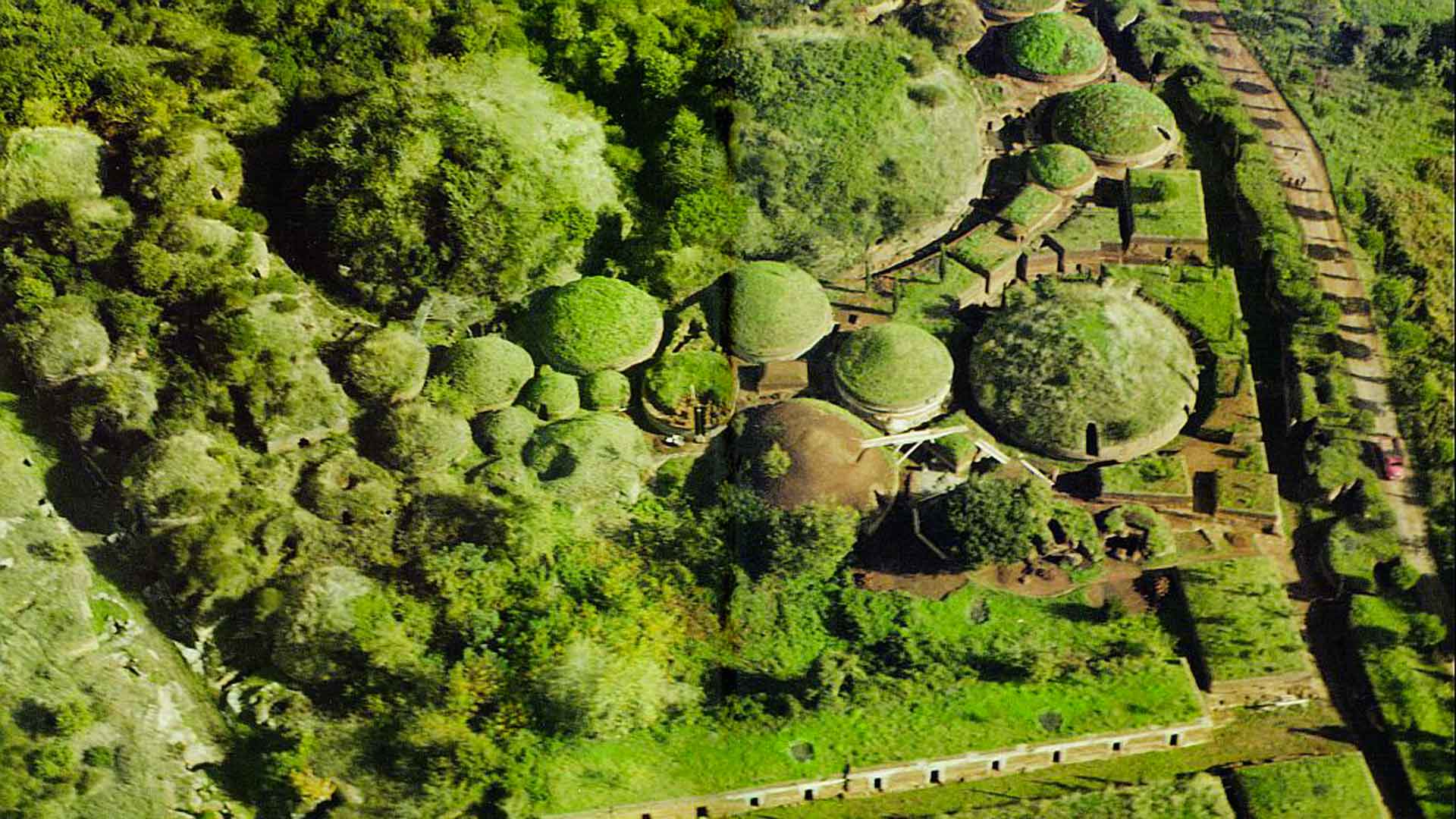
The Banditaccia Necropolis in Cerveteri, in Lazio, is the main burial area of the ancient Caere, where most of the monumental tombs are concentrated. It is an immense complex (about 20,000 chamber tombs are estimated to be in this necropolis alone) with absolutely unique characteristics.
The necropolises of Cerveteri and Tarquinia were included in the UNESCO World Heritage List in 2004 and represent the first example of sites related to the Etruscan civilization.
In some tombs (the Tomb of the Capitals, the large Tumulus II with the Tombs of the Funeral Beds, the Hut, the Greek Vases and Dolia, the Tombs of the Pillar, the Cornice and the Little House) multimedia installations have been created that evoke the ancient world that created this place.
The oldest tombs in the Banditaccia Necropolis in Cerveteri are of the well-type, with cremations inside biconical vases, and pit-type tombs for the inhumed.
From the 7th century BC, with the prevalence of the inhumation rite, large tumuli developed with burial chambers dug into the tuff and decorated with patterns inspired by domestic architecture forms.
These monuments, belonging to high-ranking families, yielded rich grave goods often including materials imported from the Near East and Greece.
During the 6th century BC, alongside the tumulus type, now of medium and small size, regularly aligned dado tombs along the sepulchral roads and the channeled tombs progressively became established.
By the 4th century BC, the hypogeum type consisting of a single room with benches against the walls became widespread, alongside which more imposing funerary monuments belonging to families of gentilician rank appeared as isolated episodes.
This is the case of the Tomb of the Reliefs which, located within the Banditaccia Enclosure, displays on its walls a rich parade of everyday objects rendered in stucco and painted, as well as among the ‘Commune’ tombs are remembered those of the Alcove, the Sarcophagi, the Triclinium, the Tamsnie, monuments that like the Torlonia Tomb in the necropolis of Monte Abatone, testify to the exceptional nature of the funerary architectural experiences of ancient Caere.
Nearby
Regolini Galassi Tumulus and Sorbo Necropolis
The Regolini Galassi Tumulus was discovered intact in 1836 and is very famous for the rich finds preserved in the Vatican Museums, dating to around the mid-7th century BC. Enclosed in a tumulus, it consists of two long narrow chambers aligned with each other and two lateral oval rooms, with a roof made of large squared blocks that progressively overlap to close the tomb at the top, forming a ribbed vault.
It held three individuals, one cremated and two inhumed. Among the grave goods, a silver amphora bearing the inscription ‘mi larthia’ (I belong to Larth) reveals the name of the prince buried in the tomb.