
Wellness tourism Italy, European wellness economy, spas and thermal baths, tourism investments, territorial development: Italy positions itself as the fourth wellness economy in Europe. A factor that strengthens the strategic role of the wellness segment for the national tourism system and opens new prospects for destinations, operators, and investors.
Add us to your preferred sources.

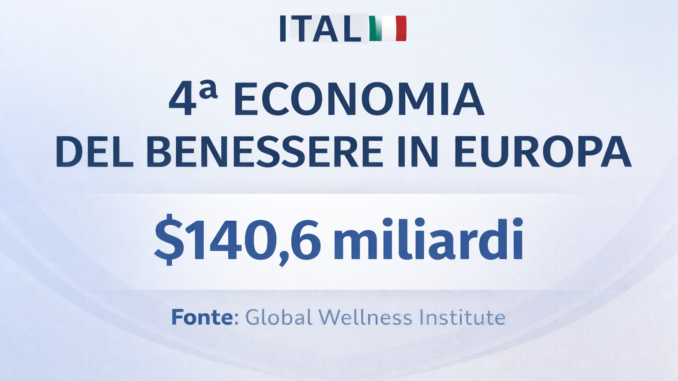
Wellness tourism Italy, wellness economy, spas and thermal baths, tourism investments, wellness destinations: Italy is among the leading European markets for wellness. According to the Global Wellness Institute (GWI), the country ranks fourth in the wellness economy in Europe and is in the top 10 worldwide, with an estimated value of $140.6 billion (2019–2024 data). Source: Global Wellness Institute
Summary
Why does this data matter for tourism in Italy
GWI’s ranking is not just a “list”. It is an economic indicator measuring the overall size of the wellness economy: a scope that includes wellness tourism, spa and thermal baths, physical activities, healthy eating, preventive health, personal care, real estate oriented towards wellness, and other areas connected to quality of life.
For the Italian tourism system, the news is relevant for three reasons:
- International positioning: being among the top European markets enhances the country’s credibility in the wellness segment.
- Average value: wellness tends to generate higher spending and more “premium” products, with interesting impacts on hospitality and services.
- Territorial distribution: many wellness destinations are outside major hubs (and this can aid widespread growth).
What is the wellness economy and what does it truly include
When talking about the “economy of wellbeing,” people often think only of spas and thermal baths. In reality, the Global Wellness Institute‘s approach is broader: wellbeing is an ecosystem traversing lifestyles, consumption choices, and travel modes.
In tourism, this translates into demand for:
- rejuvenating experiences (thermal, spa, medical wellness);
- nature and outdoor activities (hiking, parks, retreats, “soft” sports);
- quality nutrition and food culture (also in a healthy way);
- authentic places and slower-paced times;
- services that enhance comfort, sleep, balance, and prevention.
It’s not just about “adding a spa” to a hotel but designing a coherent, measurable, and sellable offer that combines territory, accommodation, and services.
Wellness tourism: from “service” to tourist product
The key transition for many Italian destinations is to turn wellness from a simple “plus” to a product. This involves working on:
- Positioning (whom are we speaking to, what need are we solving);
- Experiences (clear packages: 2-3-5 days, seasonal, pricing);
- Local network (thermal/spa + hotel + outdoor + catering + culture);
- Distribution (channels, partnerships, international marketing);
- Quality and standards (training, protocols, reputation).
This is where GWI data becomes operational: if Italy is already a major market, there is a solid foundation to build offers and investments on. The difference lies in the ability to “systematize” assets.
Where Italy can grow the most
Wellness in Italy has a natural advantage (territory, culture, historic thermalism), but also some recurring fragilities: fragmentation, inconsistent standards, lack of clear product and often generic communication.
The areas with the greatest potential, from a tourism perspective, are:
- Thermal and thermal destination repositions (not just care but prevention and lifestyle);
- Medical wellness and evidence-based programs, where international demand is strong;
- Outdoor wellness (hiking, parks, soft sports, nature and silence);
- “Smart” enogastronomy (quality, typicality, and wellbeing together, without moralism);
- Cities and wellness (city breaks + urban spas/thermal baths, growing formats).
Global Wellness Economy: Italy’s numbers in 2024

Italy and wellness, data
Italy continues to be one of the most significant wellness markets in Europe, with a diverse and cross-sectoral economic structure involving tourism, health, nutrition, real estate, and personal services.
The five largest wellness sectors in Italy
- Personal care and beauty: 38.43 billion dollars ($35.4 billion €)
- Healthy eating, nutrition, and weight loss: 25.93 billion dollars ($23.9 billion €)
- Physical activity: 21.25 billion dollars ($19.6 billion €)
- Wellness tourism: 19.99 billion dollars ($18.4 billion €)
- Public health, prevention, and personalized medicine: 12.4 billion dollars ($11.4 billion €)
Fastest growing sectors (2019–2024)
Two segments stand out for dynamism and development prospects:
- Wellness real estate: +22.9% growth, reaching $3.61 billion in 2024
- Mental wellness: +11% growth, reaching $5.65 billion in 2024
Italy’s positioning on the global stage
“Italy represents one of the most mature and integrated wellness markets in the world. Its deep tradition in thermalism and preventive medicine, combined with solid public-private collaboration and a world-class natural and medical heritage, positions Italy not only as a wellness destination but as a global model for health and longevity.”
— Susie Ellis, President and CEO of the Global Wellness Institute
FullTravel Lab Analysis
Global Wellness Economy data confirms that wellness tourism is not an isolated segment but part of an integrated economic ecosystem.
For Italian operators, this means:
- Integrating hospitality, nutrition, and prevention into a coherent offer
- Developing public-private partnerships in thermal and medical areas
- Investing in infrastructure and properties oriented towards wellness
- Building tourism products focused on longevity and preventive health
The most strategic data is not only the overall value of the sector but the rapid growth of segments like wellness real estate and mental health: two key indicators of structural market transformation.
In this scenario, Italy is not just a destination: it is a wellness economic platform.
FAQs
Is Italy really the fourth largest wellness economy in Europe?
Yes. According to Global Wellness Institute, Italy ranks fourth in Europe and tenth worldwide in the size of the wellness economy. GWI source
What is the value of Italy’s wellness economy according to GWI?
GWI estimates a value of 140.6 billion dollars (2019–2024 data). GWI Source
What’s the difference between wellness tourism and the wellness economy?
Wellness tourism is a part of the wellness economy. The wellness economy includes many sectors (from spa to prevention, from fitness to healthy eating), while tourism specifically concerns consumption and services related to travel and stays focused on wellbeing.
Pubblicato in Hospitality
Be the first to comment