


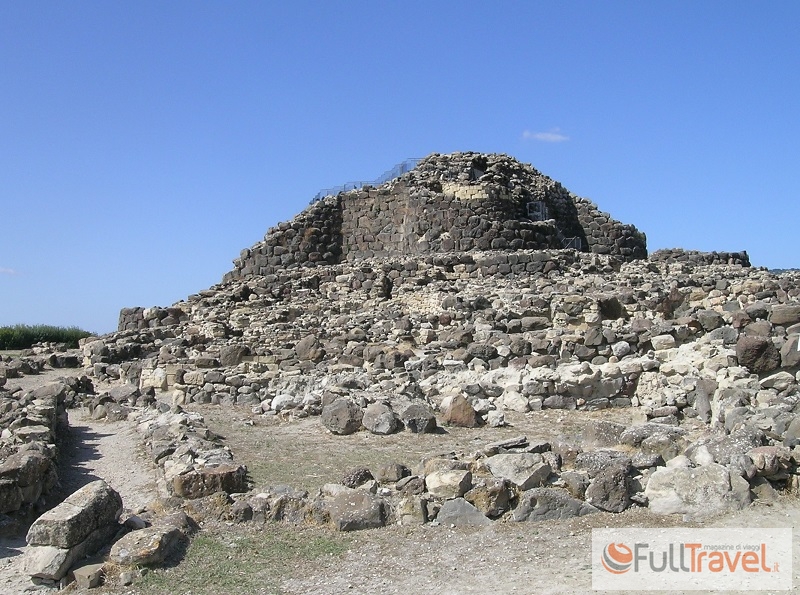


Su Nuraxi (“the nuraghe”) di Barumini is the only World Heritage Site in Sardinia. While on one hand UNESCO wanted to recognize the architectural uniqueness of the nuraghi, stating that “no parallel exists anywhere else in the world,” the choice of Su Nuraxi di Barumini among the approximately 7,000 existing nuraghi in Sardinia is due to the fact that it was the first case where the excavation campaign was conducted scientifically (this was in the 1950s). In Barumini, the entire surrounding village was also excavated, giving us a complete view of the history of the complex, which lasted about 1,800 years.
Su Nuraxi: the discovery
Su Nuraxi was discovered and studied by the father of Sardinian archaeology, the Academic of the Lincei Giovanni Lilliu, who was also born and raised in Barumini and had always noticed a strange hill in the countryside just outside his village. Lilliu, besides being a skilled archaeologist, was also lucky. In fact, in the central tower, which constitutes the first core of the entire complex, he found a wooden beam, probably the step of a ladder.
It was precisely this beam, thanks to carbon-14 analysis, that allowed dating the beginning of the site’s history and, more generally, to give a more precise chronological connotation to the Nuragic age. We are in the full Bronze Age, with the central tower of Barumini dating back to 1600-1500 BC.
Construction Features of Su Nuraxi
The construction features of Su Nuraxi are the classic ones for this type of monument: large basalt blocks, coming from the nearby Giara Plateau, are placed next to each other creating a truncated conical shape, and they stand independently without the need for cement mortar. The internal rooms have a pseudodome or tholos vault, built with circles of projecting stones that become progressively narrower. Although they may seem very tall to us, what we see today of the nuraghi is only one of the two or three floors they were built on, accessed by a spiral staircase running between the outer wall and the masonry work of the tholos. A trace of this staircase can be seen inside the central tower of Su Nuraxi, to the left of the entrance.
The second construction phase dates back to the 13th-12th century BC and sees the construction of a defensive wall with four towers surrounding the central tower: Su Nuraxi became a quadrilobate nuraghe. The walls and the new towers enclose a courtyard of 56 square meters with a well in the center connected to a water spring. Considering the living conditions of the prehistoric age and how crucial water was in a land like Sardinia, where rainfall is often scarce, we can easily affirm that the fortress was built to protect the source, a guarantee of survival for the community.
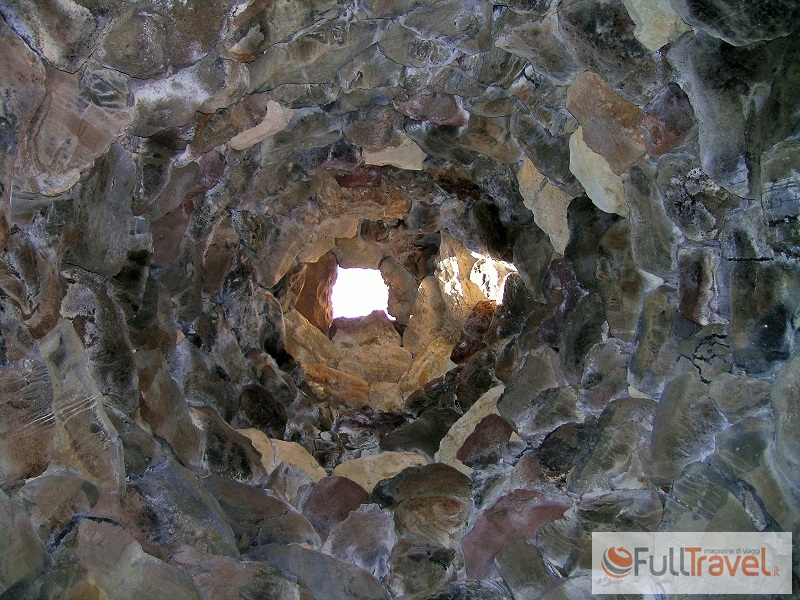
Relations with the surrounding tribes must not have been idyllic: about a century later, in fact, the entrance to the central courtyard and all the loopholes were enclosed in an imposing reinforcement wall about 3 meters thick, which clings to the citadel like a second skin and brings the wall thickness to 5-6 meters. Inside, entry is no longer at ground level but by climbing a rope ladder to an elevated opening.
At this point, the complex becomes truly imposing: as already mentioned, we must imagine the towers not only much taller than how we see them today, but also equipped with terraces from which the territory could be more effectively controlled and which gave the nuraghi an appearance vaguely reminiscent of medieval castles. These terraces have not survived to us, but the large corbels that supported them, detached from the towers, have. One is placed above the edge of the well of Su Nuraxi. The reinforcement of the defensive wall might have allowed the construction of even wider terraces, enhancing the defensive function of the building.
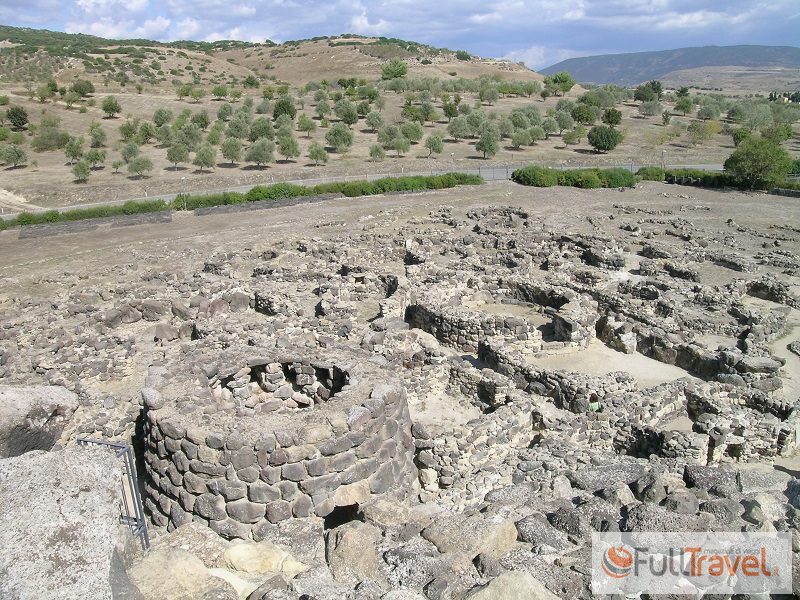
During this period, an external defensive wall was also built, equipped with seven towers, and the village developed with about sixty huts, circular and single-room. One of these, larger and equipped with a row of stones following the internal perimeter serving as a seat, is identified as the meeting hut.
Su Nuraxi through the centuries
In the following centuries, the site underwent a phase of decline that led it, in the 8th century BC, to remain uninhabited and fall into ruin. Therefore, in the fourth phase of settlement (8th-6th century BC), the nuragic fortress lost its military importance, but the tower became a symbol, perhaps with religious meanings. In fact, as documented in other sites as well, a model of a stone nuraghe was found inside the meeting hut. It was probably placed in the center of the space, almost like a totem to inspire decisions to be made.
The village instead experienced a new phase of development: the outer defensive wall was partly demolished and the 150 huts built during this period clustered at the foot of the ancient citadel. Where the huts leaned against the straight walls of the ancient fortress, mostly rectangular and trapezoidal plans with multiple rooms now appear. The dwellings were grouped into blocks connected by narrow streets and some infrastructure appeared, such as primitive sewage water canalization systems.
The last phase coincides with the Punic and Roman period (6th century BC – 3rd century AD). About fifty village huts continued to be inhabited by the rural population. In the silo of one of the nuraghe towers, a deposit of ex-votos dating from the 6th to the 1st century BC was found. This suggests that at that time part of the space had become a sanctuary dedicated to Demeter and Kore, deities linked to agriculture, similarly to what happens in the nearby nuraghe Genna Maria of Villanovaforru.
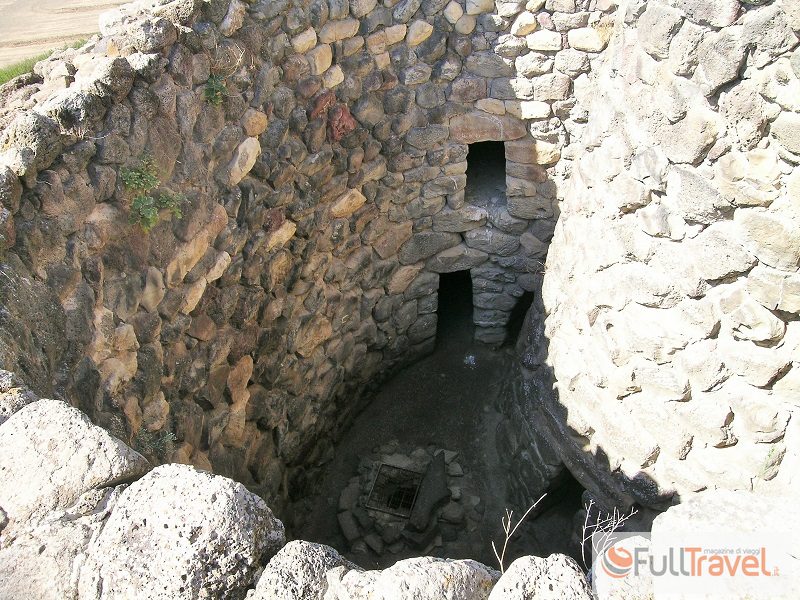
The collapses and accumulations of other materials gradually filled the courtyard and the other structures of the nuraghe, which, over the centuries, has become covered with vegetation taking on the appearance of the hill that had originally attracted the attention of the young Giovanni Lilliu.
In Barumini there is also another site of great interest: it is Casa Zapata, a noble house from the late 16th century AD beneath which a nuraghe was hidden, now visible thanks to a fine system of glass walkways. Casa Zapata also houses a small museum that preserves the most important finds from Su Nuraxi, including the wooden beam that allowed dating of the central tower and the stone nuraghe model.

 di Barumini, l’unico sito patrimonio dell’umanità in Sardegna. Guida ai nuraghi patrimonio Unesco della Sardegna.)