


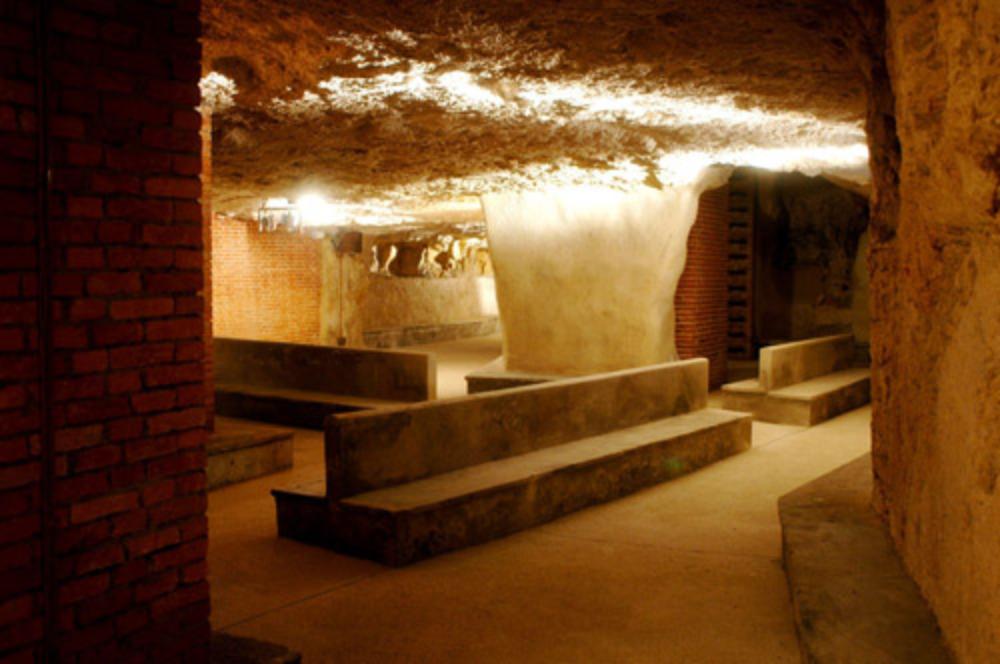


The hypogeum of Piazza Duomo is an underground path that connects the Duomo square to the Marina walls in an east-west direction. It consists of a main gallery, from which several smaller galleries branch off, one of which reconnects to the large cistern of the Archbishop’s Palace. Built by Bishop Paolo Faraone (1619-1629), the cistern played an essential role not only in supplying water to the Archbishop’s Palace but to the entire Ortigia. During the route, it is possible to glimpse the remains of other wells or ancient cisterns, intercepted and destroyed during excavation work of the galleries.
A first cluster of galleries is related to the presence of a previous quarry located in Piazza Duomo and remembered in the 18th century because the stone for the construction of the Cathedral facade was quarried from it. The access point was identified in 1869 during public works “almost opposite the entrance door of the Archbishop’s Palace, but leaning somewhat towards the part of the Monastery of St. Lucia: a large pulley was installed there, and through it the masters lifted stone that was of the same nature as that of the columns…” The war events related to the Second World War brought attention back to the underground chambers identified in the previous century. In view of Italy’s entry into the war, the Citizens’ Committee of U.M.P.A. (Military Union for Anti-Aircraft Protection) arranged gathering points for the civilian population in case of attack. To prepare the anti-air raid shelter of Piazza Duomo, teams of “pirriatori” were called to enlarge the ancient quarry, dig a room to store the simulacrum of Saint Lucia in zinc boxes, hidden since December 1942 along with the treasure, and arrange accesses for the population located in the retaining wall of the archbishop’s garden with an additional entrance to the galleries in the ancient Marina walls. Hence, an underground path was created connecting Piazza Duomo to the Marina, joined, via a secondary gallery running north-south, to the cistern. After the war ended, the shelters were decommissioned. Connected to memories now consigned to History, the anti-air raid shelter of Piazza Duomo—like every testimony, architectural or otherwise, that composes the millenary urban history of Ortigia—presents itself as a unique complex, the final outcome of the anthropic stratification of the site, which gathers contributions linked to different phases of the city’s history – among which the cistern is the chronologically oldest element.
Information on the hypogeic path of Piazza Duomo
Piazza Duomo,
96100 Siracusa (Siracusa)
0931481111
[email protected]
Source: MIBACT