


Il Palazzo del Quirinale can be visited by reservation. When it comes to what to see in the Quirinale, there is an embarrassment of choice.
The Quirinal in the era before Christ
In the area of the Quirinal hill arose in the 4th century BC the temple of the God Quirinus which gave the hill its name and the temple of the Goddess Salus in which ceremonies were held to promote the wellbeing of the state; the most imposing presences on the hill were certainly those of the Baths of Constantine and the temple of Serapis, built by Caracalla in 217 AD. From the ancient Roman temple come the two sculptural groups of the Dioscuri, whose constant presence on the Quirinal led the hill to assume the name of Monte Cavallo.
The Quirinal hill is one of the heights of Rome consisting of a massive hill, separated from the Pincian Hill to the North by the Sallustian Valley, and from the Viminal Hill to the South by the Quirinal Valley, later known as San Vitale. On the northwest and south slopes it originally appeared sheer with steep accesses, different altitudes now scarcely appreciable in the current urban fabric with levels deeply altered especially by the construction of the papal palaces.
The collis Quirinalis
In ancient times the Quirinal was the hill par excellence and the individual summits that stood out there were also called colles. The name Quirinal, therefore, has come to indicate the entire hill which was actually divided into four heights: collis Latiaris, collis Mucialis or Sanqualis, collis Salutaris and collis Quirinalis.
The collis Quirinalis had great strategic importance and was firmly fortified from the earliest age; it was later included within the city walls, called Servian (4th century BC). According to archaeological and documentary data, the collis Quirinalis would correspond to the area between the Collina gate of the Servian Wall and the via delle Quattro Fontane (where the Quirinalis gate is to be located); the collis Salutaris between this and the via della Dataria (corresponding to the Salutaris gate); the collis Mucialis between this and Largo Magnanapoli (where the Sanqualis gate was); the collis Latiaris between this and the saddle that originally connected the Quirinal and the Capitoline Hill, a saddle later cut by order of Emperor Trajan for the construction of his forum.
Alta Semita
The main road axis of the hill consisted of a summit path, called Alta Semita (today’s via del Quirinale – via XX Settembre) which connected porta Salutaris with porta Collina running from west to east towards the Sabine territory. On the hill there were important places of worship, among the oldest those of Quirinus, Salus and Semosancus or like the more recent temple that Emperor Domitian raised on the site of his birthplace and the grandest temple of Serapis that Emperor Caracalla had raised in the 3rd century.

The Quirinal in the Imperial Era
In the administrative territorial division of the Augustan age, the Quirinal was included in Region VI (Alta Semita). In the imperial era, the regional boundaries moved with the new Aurelian age circuit (3rd century AD), which included areas that were previously suburban such as the Castra Praetoria and the Horti Sallustiani.
The district was characterized from the Republican age as an aristocratic settlement area, a particular feature preserved also in the imperial age; many mansions included those of Pomponius Atticus, friend of Cicero, of the Gens Flavia, of the Claudi, of Fulvius Plautianus; among the hill’s inhabitants, literary sources recall the poet Martial. The two male statues in the Quirinal square portray the Dioscuri, while holding the reins of the prancing horses, according to a rare iconographic scheme that appears from the Severan age (3rd century AD).
The Quirinal from the Fifteenth to the Eighteenth Century
The sculptures, probably pertaining to the so-called Temple of Serapis, were always reused on the hill in the baths of Constantine, on the occasion of restorations following the earthquake of 443 AD. Interest in the two sculptural groups was rekindled in the fifteenth century, when Pope Pius II had a first partial restoration of the two colossi carried out between 1469 and 1470. However, it was in the following century with Sixtus V that the sculptures, included in the program of expansion and embellishment of the square, underwent a complete restoration carried out in 1585 and were moved to the sides of a marble basin to form a monumental backdrop for the road axis coming from Porta Pia. Finally, in 1786, Pius VI placed the sculptural group in its current position, on the sides of the obelisk coming from the Mausoleum of Augustus, while in 1818 Pius VII replaced the original basin with a granite shell from the Roman Forum.
The Quirinal in the Middle Ages
In the Middle Ages, the hill became populated with churches, noble mansions, and towers, while the ancient buildings fell into ruin and their marble began to be used to build new structures. In the 1400s and early 1500s, palaces and villas of nobles and prelates were arranged around the square and along the ancient Alta Semita street (today via del Quirinale), including Cardinal Oliviero Carafa, owner of a villa with a vineyard where today stands the Palazzo del Quirinale.
The Quirinal in the Sixteenth Century
In 1550, the Villa Carafa was rented by Cardinal Ippolito d’Este, who also owned the Villa d’Este in Tivoli, who transformed the vineyard into a very elaborate garden, enriched with fountains, water games, and ancient sculptures. The beauty and pleasantness of the Cardinal d’Este’s vineyard induced Pope Gregory XIII (1572-85) to expand the small villa at his own expense, entrusting the task of the new building to architect Ottaviano Mascarino. Between 1583 and 1585, he created an elegant villa with a porticoed facade and loggia connected internally by a splendid spiral staircase; the project also included the so-called “little tower,” the belvedere crowning the mansion.
After the death of Gregory XIII, his successor Sixtus V (1585-90) bought the Villa of Monte Cavallo from the Carafa family in 1587 to make it the summer residence of the Pontificate. The small villa built by Mascarino was not sufficient to host the papal court or to meet its representation needs; therefore, Sixtus V entrusted architect Domenico Fontana with the task of enlarging the building by constructing a long wing towards the square and a second palace on via del Quirinale, forming a large internal courtyard.
Sixtus V also took care of arranging the square, providing for the restoration of the sculptural group of the “Dioscuri,” which was completed with the addition of a fountain. Sixtus V died at the Quirinal, and the palace renovation project was completed by his successors. Particularly significant was the intervention of Clement VIII (1592-1605), who focused his attention on the garden, ordering the construction of the monumental Organ Fountain, decorated with mosaics, stuccoes, statues, and animated by the sound of a water organ.

The Quirinal Today
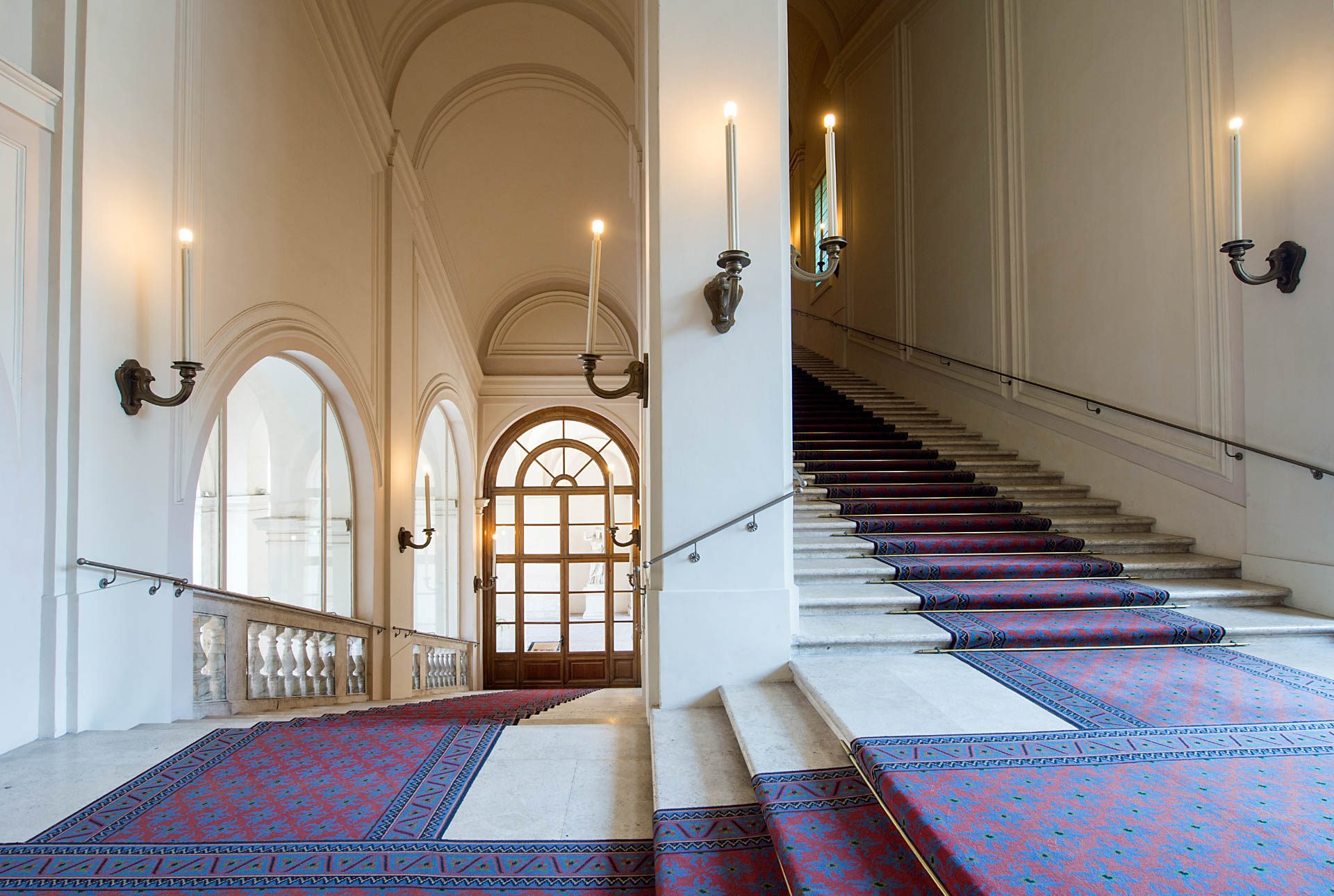
The architecture of the Palace in the appearance it still maintains today was completed during the pontificate of Pope Paul V Borghese (1605-21). Architect Flaminio Ponzio took care of the construction of the wing facing the garden, including, among other things, the Grand Staircase, the Great Consistory Hall (today the Banquet Hall), and the Annunziata Chapel, frescoed by Guido Reni with some collaborators.




