For the new headquarters of the University, the architect Giulio Cesare Fontana was commissioned to start the renovation of the old riding school outside the door of S. Maria di Costantinopoli: the Palazzo degli Studi, with works not yet completed, was inaugurated on June 14, 1615.
Charles of Bourbon, once ascended to the throne of Naples, ordered the resumption of the works of the Palazzo degli Studi; the measures adopted in the following years aimed to restore dignity and functionality to the university complex until its definitive transfer, in 1777, inside the suppressed Collegio Massimo dei Gesuiti al Salvatore.
The suppression of religious orders, decreed by the government of Joseph Bonaparte and Joachim Murat, with the related requisition of all cultural assets, laid the foundations for the activation of a library center accessible to a university-level audience.
As part of the distribution of monastic funds, Giuseppe Capecelatro, Minister of the Interior, signed on September 27, 1808 the provision according to which the Royal University of Studies could benefit from books formerly belonging to suppressed monasteries and destined for the Royal College established at Salvatore.
Between 1808 and 1810 the Prefect of the Library, physicist and naturalist Giuseppe Antonio Ruffa, gathered the books coming from the monasteries of S. Lorenzo, S. Maria degli Angeli, S. Pietro Martire, della Sanità, dei SS. Apostoli, S. Brigida, S. Domenico Maggiore.
Unfortunately, the disbursement of funds and materials, stacked without order and without any inventory and therefore in fact unconsultable, was interrupted in favor of the new Murattian project which provided, in the old monastery of Monte Oliveto, the foundation of a Municipal Library dedicated to the French sovereign, for which, in 1812, the collections of Marquis Francesco Taccone and Francesco Orlando, eminent bibliophiles, were purchased.
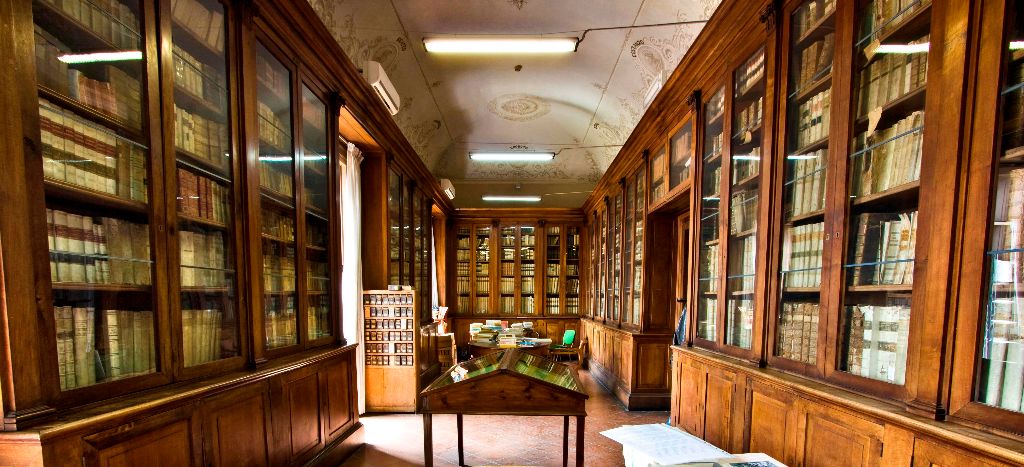
The Bourbon restoration, in 1815, marked the definitive decline of the Gioacchina Library and, conversely, the revival of that of the Royal Studies, to which the large hall on the first floor of the Collegio al Salvatore was assigned and, initially, all the book heritage accumulated in the Gioacchina.
In 1819, however, a royal edict forced the Studies Library to deliver to the Royal Library all the most valuable bibliographic books. The University, in 1822, proceeded with the appointment of its new head, designating the mathematician Vincenzo Flauti who was tasked with establishing a “modern” and efficient structure: materials were ordered on shelves transported from Monte Oliveto, the printing of the catalog by authors began, and suitable regulations modeled on those of the Royal Library were formulated. In January 1827 the Library was opened to the public.
The rector Michele Tenore, a botanist of international fame, on the occasion of the works of the VII Congress of Scientists, in 1845, endowed the Library with a special fund for the subscription to Italian and foreign scientific journals and periodicals, thus updating its bibliographic heritage.
In the aftermath of the Unification, the University entered the first-class government library list and famous librarians and scholars succeeded each other as directors: Carlo Neri (1861), Tommaso Gar (1863), Giulio Minervini (1867-1886). These were the years in which the University’s Library took on a particular cultural profile, recording a significant increase both for the acquisition of book collections of religious corporations suppressed in 1861 and for spontaneous donations from professors, but above all for a progressive increase in financial endowment that allowed the purchase of important collections.
The Library was enriched with the collections of Filippo and Carlo Cassola (chemistry), Francesco Briganti (natural sciences), Paolo Panceri (zoology and comparative anatomy), Oronzo Gabriele Costa (paleontology), Celestino Cavedani (philology and archaeology); also notable: the Dante collection donated in 1872 by Alfonso della Valle di Casanova, rich in ancient and valuable editions; the Vittorio Imbriani library, mainly of literary and linguistic interest, donated by his wife Gigia Rosnati in 1891; the substantial collection of works and brochures of legal and literary character offered in the late nineteenth century by Domenico Viti and Domenico De Pilla.
At the direction of the mathematician Dino Padelletti (1887), responsible for the reorganization of periodicals, incunabula, and Aldine editions, with the compilation of special catalogs, followed those of Alessandro Moroni (1888-1895), who collaborated with Salvatore Di Giacomo, Giuseppe Fumagalli (1895-1897), Emidio Martini (until 1900), and also Alfonso Miola, Mariano Fava, Gaetano Burgada, Giuseppe d’Elia, and Giovanni Bresciano until 1933. In the early twentieth century, the donations of Padelletti, Battaglini (mathematics), and Aievoli (medicine) were cataloged, strengthening the scientific identity conferred on the Library since Flauti’s direction.
Restored after the 1930 earthquake, the Library suffered serious damages and the loss of valuable cinquecentine, Bodonian books, and volumes from the Casanova collection kept in the Convent of the Minor Friars of S. Francesco in Minturno during the last war. Following the 1980 earthquake, numerous restoration and consolidation interventions allowed the enhancement of facilities and a significant renewal of services and structures.
But the institutional tasks of protection and conservation do not exhaust the Library’s activity which, deeply rooted in the fabric of the city, provides a cultural service through the constant modernization of its organization capable of responding positively to an increasingly numerous and diversified demand.