


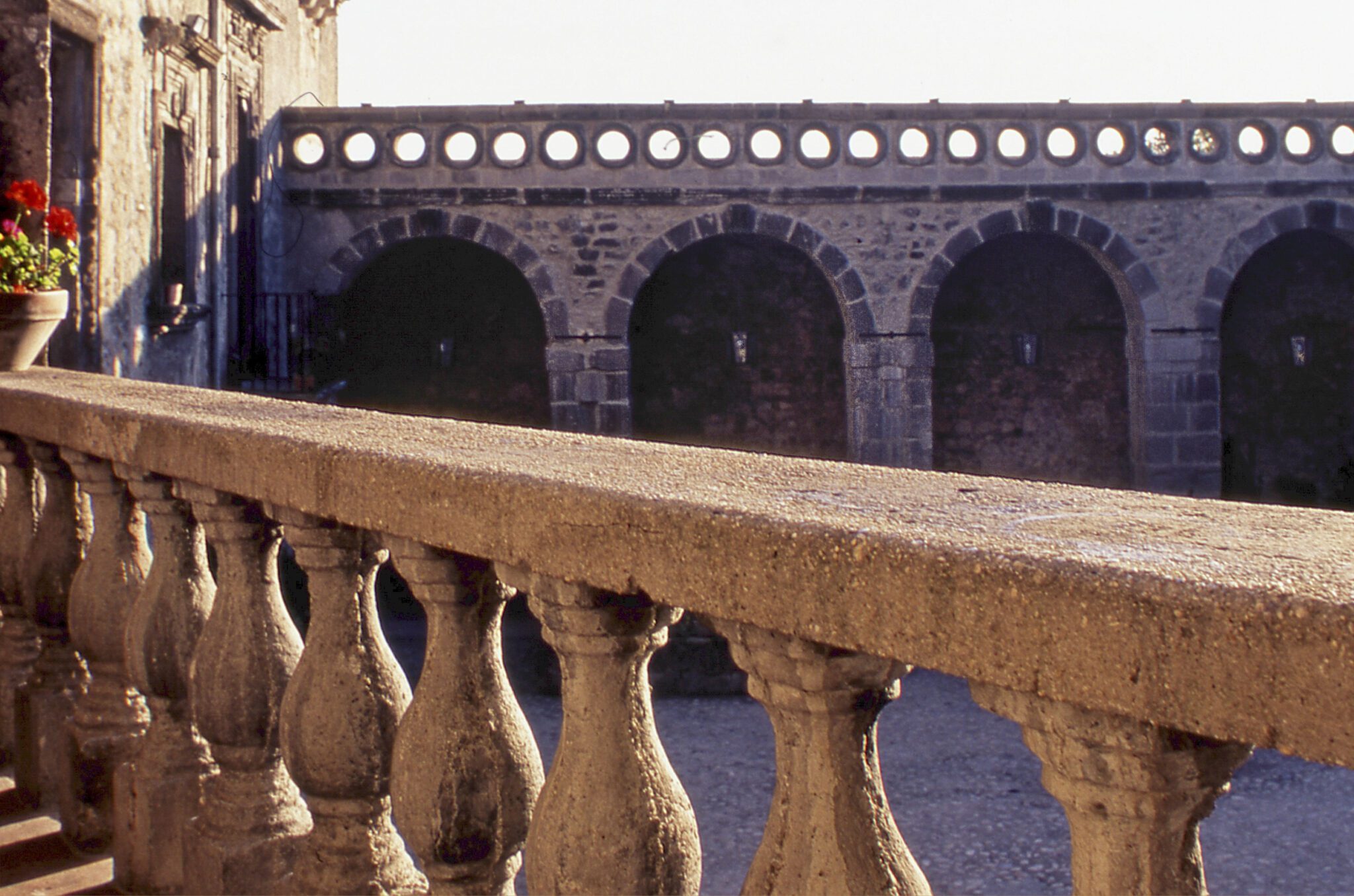


Faicchio, ancient walls
The walls were erected by the Samnites who inhabited the region, and scholars have dated them between the 6th and 7th centuries BC; but the first settlements in the territory of the Titerno Mountain Community date back to the Neolithic era, favored by the abundance of water, vegetation, and animal life. The archaeological finds now preserved and displayed in the Sannio museum in Benevento retrace the stages of human evolutionary processes from when humans, nomadic hunters, following watercourses, arrived in the Titerno valley. The remains of stilt villages and the discovery of necropolises, pottery, and tool artifacts clearly outline the path of man through its various phases, from the Neolithic period to the Bronze Age, from the Iron Age to the time of Rome’s founding.
Of Roman era are both the aqueduct of Fabio Massimo, from the 3rd century BC, still functional; and the “Ponte dell’Occhio,” a humpback bridge resting on polygonal pillars, built over the Titerno river to facilitate communication between the populations of the Matese and Monte Erbano,
Maples, lindens, and beeches, oaks, ashes, and medicinal plants characterize the area, covering the flanks of the surrounding mountains. The karst phenomenon manifests on the clayey and dry terrain with a rare and magnificent example of a “polje” similar to those in the Matese massif, creating a one-kilometer-long hollow with a flat bottom free of vegetation, called Campo del Monaco, which remains enclosed between Monte Monaco di Gioia and Monte Erbano.
The Titerno River
Along the Titerno river, at the foot of Monte Monaco di Gioia, on top of a block of tuff, Faicchio, the ancient Faìfola, rises with its ducal Castle that towers through the houses perched on the small hill. The village was originally inhabited by the Pentri Samnites, skilled merchants and good artisans, and warlike enough to conquer all the tribes of Campania and Basilicata; the minting of copper coins favored the rapid economic development of the Samnite civilization, which soon became a real threat to the Romans. The threat of this excessive territorial expansion soon led to battle with Rome, which reestablished its power by defeating them and forcing them to flee. Alternating events and continuous subjugations lead to the medieval period, when the Ducal Castle became a gathering center for the people, who began to develop their homes and activities around the feudal lord’s residence.
The year 1151 is the certain chronological reference to which the castle is traced back, with ownership under the First Count of Cerreto Guglielmo I Sanframondo; the structure is now in excellent condition thanks to restoration work carried out by the current owner, lawyer Umberto Fragola. But the first renovations of the castle date back to 1479 by the hand of the Duke of Maddaloni, followed in 1612 by restorations commissioned by Gabriele de Martino. This is attested by the plaque on the entrance portal. The structure also withstood the terrible earthquake that had its epicenter in Venafro and nearly destroyed Faicchio on June 5, 1688, on Pentecost day. The castle has four cylindrical towers at the corners, a large courtyard partly porticoed, the hall of arms and armor, the trapdoors, the prison cell, the halls with original 18th-century furnishings, and has been the seat of the Free Faculty of Tourism Sciences; some rooms, those that were once the guardhouse, are still used for receptions, and a hotel, the Albergo dei Duchi, operated until a few years ago. The building is highly evocative, immediately taking the imagination to eras when chivalry and conspiracies went hand in hand, and while the Duke asserted his right of “prima noctis,” wolves, ghosts, and storms disturbed the nights.