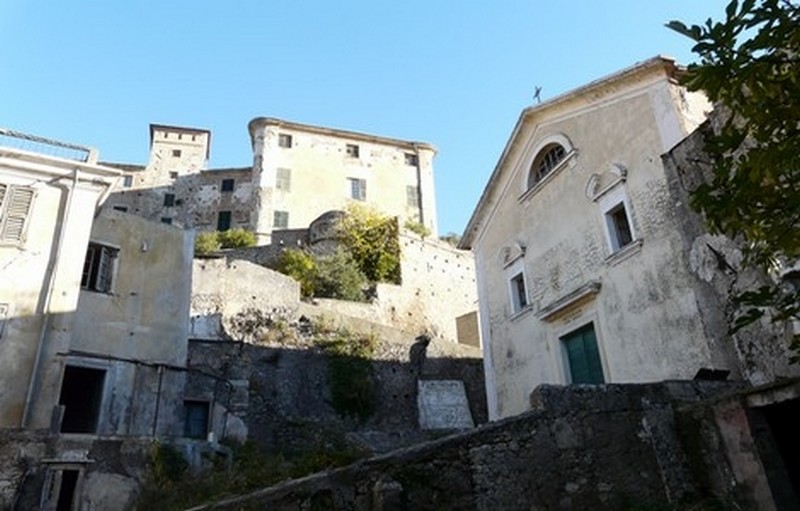


Spello is a municipality in Umbria well known for its beautiful historic center, for the works of Pinturicchio, and for the flower festival that every year, on the day of Corpus Christi, attracts many tourists. Spello Umbria. It is located at about 219 meters above sea level, thus in a very favorable position for the flora, and lies on the slope of Monte Subasio, above the Topino tributary. It is only 4 kilometers from Foligno and about 35 kilometers from the Umbrian capital, Perugia. Spello is also culture, thanks to its heritage of museums, art galleries, and ancient villas. Here is what to see in Spello in half a day or even in two days.
- What to see in Spello
- 1 Collegiate Church of Santa Maria Maggiore and Pinturicchio
- Spello Pinturicchio
- 2 Spello flower festival
- What to visit in Spello
- 3 Spello Civic Art Gallery
- 4 Permanent Collection Emilio Greco
- 5 Villa Fidelia
- Spello and surroundings
- 6 Mosaics of Villa Sant’Anna
- What to do in Spello
- 7 Subasio Municipal Theater of Spello
- 8 Spello hotel
What to see in Spello
1 Collegiate Church of Santa Maria Maggiore and Pinturicchio
Founded in the 11th-12th centuries, the church of Santa Maria Maggiore in Spello features a façade dating back to 1644, made on the occasion of the building’s expansion. Note the architrave, the jambs with beautiful frieze and acanthus spirals of the portal, works by stonemasons active between the 12th and 13th centuries between Foligno and Bevagna and partly attributed to craftsmen from Spoleto. The church is in the shape of a Latin cross and has a nave with a ribbed vault. In the second half of the 17th century, it was equipped with as many as seven altars and rich stucco decoration. On the altars, numerous works attributable to the 17th century. To the right of the entrance, marble altar of Gaius Titienus Flaccus (now used as a holy water font) already present in Santa Maria Maggiore since the 15th century, next to it a marble baptismal font, shaped like a pyx, by Gasparino from Val di Lugano (1509-1511).
Spello Pinturicchio
Along the left wall, after the second left altar, opens the Baglioni Chapel, commissioned in 1500 by Troilo Baglioni to the artist Bernardino di Betto called il Pinturicchio (Perugia, circa 1452 – Siena, December 11, 1513). It features a floor rich in maiolica decorations from Deruta from 1566. The chapel is entirely decorated with frescoes by the artist, starting from the vault sections with the Sibyls Tiburtina, Eritrea, Europea, Samia seated on thrones; on the left wall, the Annunciation with self-portrait and signature of the artist. On the back wall, Adoration of the Shepherds and arrival of the Magi, on the right wall Disputation among the Doctors in the Temple.
Also along the left wall, note the Renaissance sandstone pulpit by Simone da Campione (1545). The main altar covered by the ciborium (or canopy) in caciolfa stone by Rocco di Tommaso da Vicenza (1515). In the roundels; eight terracotta heads by Giandomenico da Carrara: Prophets (1562). On the pillars flanking the apse, two works by Perugino, on the left “Pietà, Saint John the Evangelist, and Mary Magdalene”, removed from an unknown location (work dated 1521) and on the right “Madonna with Child, Saint Catherine of Alexandria and Saint Blaise”, removed from an unknown location (work dated 1521).
2 Spello flower festival
In the days leading up to the Corpus Domini in Spello, Perugia, one witnesses a real general mobilization of numerous teams of Flower Arrangers, who spread out along the slopes of Mount Subasio, through the fields and plains of the green Umbrian valleys. Visiting Spello during this period is a very experiential event. During flower gathering, other citizens and especially the older ladies spend their evenings in cool ground-floor rooms, separating petals by color and finely chopping fragrant herbs.
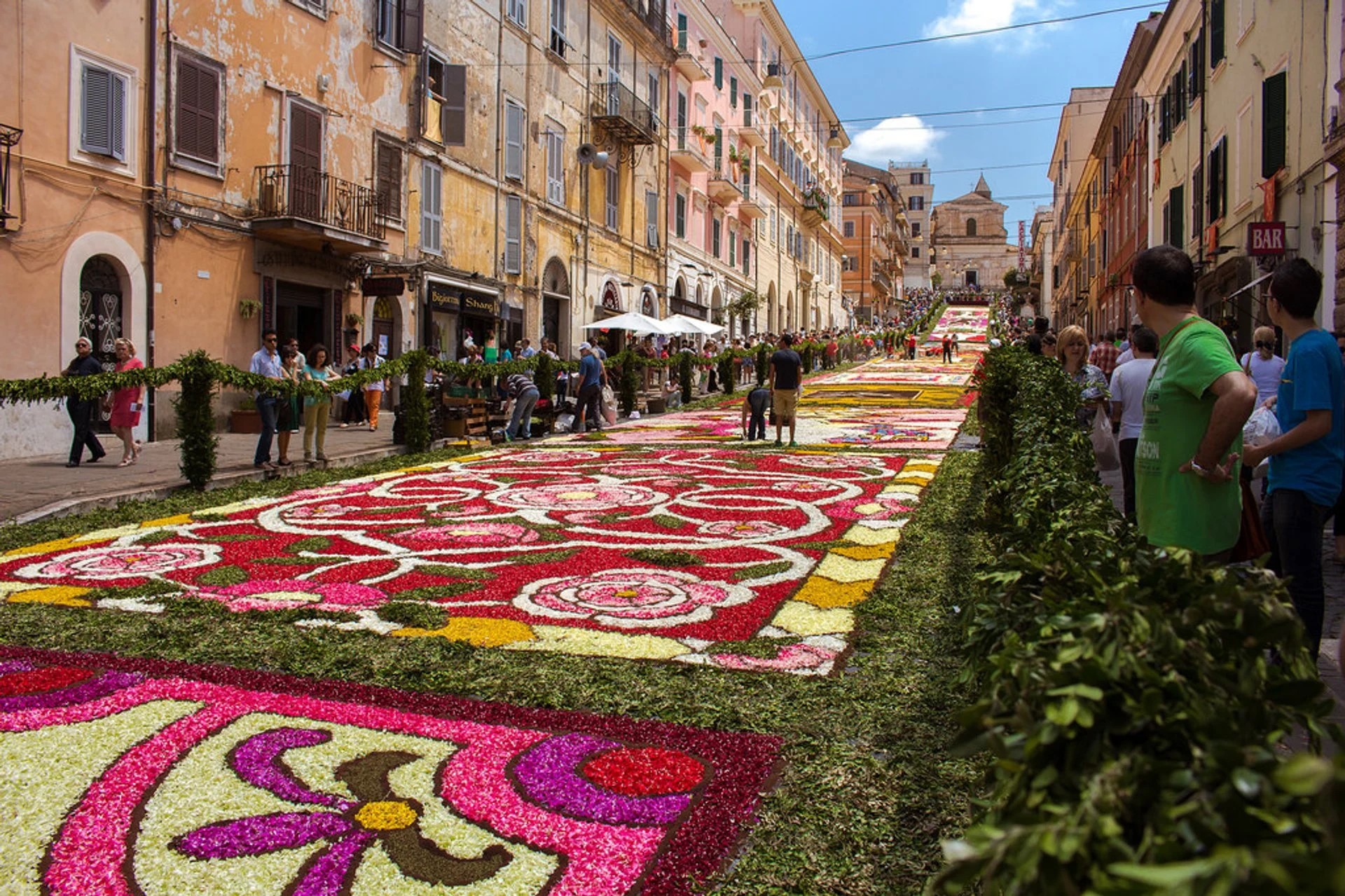
On the eve of the Corpus Domini, from early afternoon, the streets of Spello involved in the Procession route are closed to traffic and literally invaded by groups of citizens and visitors of all ages. First, appropriate lighting systems are set up, and then tried-and-tested protective systems (rain and wind shelters) are arranged on the relevant street sections to prevent unpredictable adverse weather from disturbing or compromising the work of the Flower Arrangers. After these preliminary operations, the drawing on the road surface begins, using various techniques: from freehand drawing to dusting, from metal stencils to cardboard shapes.
Once the drawings are done, using different techniques, the colorful petals are finally laid down to give the desired color tones and achieve the intended artistic effects. During Saturday afternoon and throughout the night before the celebration, the flower arrangers work on the streets, bent down to draw, lay out, and arrange millions of petals capable of producing those magical masterpieces that blend ancient and modern art, full of emotional and cultural suggestions connected to themes of religious tradition and also to the most current topical events.
The work lasts all night and only at 9:00 in the morning are the streets covered by a single multicolored and fragrant carpet: a unique spectacle to behold. Consider that an average of about 70 flower carpets are created along a single floral route – each carpet is 12 to 15 meters long, with a minimum surface area of 15 square meters – plus large paintings ranging from 25 to 90 square meters. The uniqueness of the event is certainly due to the execution technique, which consists of exclusive use of untreated plant elements with no chemical agents or preservatives, nor with artificial or powdered dyes; in this way the petal, laid on the road surface (it cannot be glued), reigns supreme in an engaging combination of colors and fragrances. The artworks are executed directly on the untreated road surface: the subjects and decorations are always renewed, connected to the great Umbrian Painting tradition, from the Renaissance to the 1700s, and sometimes the figurative theme also opens to the major testimonies of modern art. With the passage of the Holy Procession led by the Bishop carrying the monstrance, an experience of very high artistic commitment, civil, cultural, and human solidarity, and ethical and religious tension is concluded, materializing in a dazzling harmony of colors. Source: Municipality of Spello.
What to visit in Spello
3 Spello Civic Art Gallery
The Spello Civic Art Gallery is located in the historic center, in Piazza Matteotti. Since 1994 it has been housed in the Palazzo dei Canonici, a sixteenth-century building adjacent to the church of Santa Maria Maggiore. The visit to the museum will allow you to get in touch with the city’s history through its precious testimonies. The collection was born in 1916, when the prior of the Collegiate Church of Santa Maria Maggiore gathered a first group of works chosen from the most significant pieces preserved in Santa Maria Maggiore and in the oratories dependent on it. To this were added objects previously acquired following the post-unification nationalizations.
The current visit route, divided into seven rooms, is inspired by chronological and typological criteria that allow you to appreciate the relationships between Spello and other artistic centers of Umbria over the centuries. In addition to numerous paintings, textiles, and sacred furnishings, of notable interest is a wooden Madonna from the 13th century (although mutilated by the theft of the child in 2008), the early 14th-century Deposed Crucifix, the gilded silver processional cross by Paolo Vanni from 1398, and the Madonna with Child attributed to Pinturicchio. Coming from the adjacent church of Santa Maria Maggiore, the latter invites a visit to the Cappella Bella, a marvelous frescoed work by the same artist.
4 Permanent Collection Emilio Greco
The permanent exhibition of Emilio Greco was set up to pay tribute to the artist on the occasion of the 25th anniversary of the first exhibition in Spello, a protagonist of Meetings on the Streets in 1983, and recipient in 1985 of honorary citizenship. Following this, the artist donated a substantial selection of works to the municipality. The collection is divided into three rooms according to the chronological order of the works, including graphics, lithographs, etchings, drawings, and a selection of sculptures in bronze, plaster, and resin, dated between the mid-1960s and the late 1980s. Without a doubt, among the museum route, the work Accocolata is the most evocative. Continuing the visit to the museum, the visitor’s attention cannot fail to be drawn to the female figures proposed by the artist, especially frequent in his portrait production created between the mid-1950s and the early 1960s.

5 Villa Fidelia
Villa Fidelia is located a short distance from the historic center of Spello, near the Roman amphitheater and the Romanesque church of San Claudio. The ancient Roman settlement on which the villa stands consisted of a large sacred area, in which there were the so-called Temple of Venus, the Theater, and the Baths. The original layout was built in the 16th century by the Counts Acuti Urbani of San Lorenzo. In the 1700s, the villa passed to Donna Teresa Pamphili Grillo, who transformed and expanded the residence built by the Urbani and established the Italian garden. Upon her death, the property first went to the Sperelli counts and later to the very wealthy landowner Gregorio Piermarini, who made significant transformations and expansions between 1805 and 1830. After various vicissitudes, in 1923, the villa was purchased by engineer Decio Costanzi, who divided the complex, selling the oldest part to the Missionary Sisters of Egypt and the remaining part, including the Casino, gardens, and outbuildings, to the Province of Perugia.
The most remarkable feature of Villa Fidelia is the extraordinary external arrangements that created the Vesuvian garden at the entrance, the racetrack, the Italian garden, and the park with the cypress grove. The garden called “Vesuvian” or Baroque, located near the entrance, is designed on a steep slope that leads to the main door of the casino. Bounded on the long sides by a double row of majestic cypresses, it consists of rounded terraces connected by sinuous staircases alternating with short grassy areas with boxwood hedges skillfully shaped into unique forms. The highlight of this composition is the beautiful exedra fountain, placed centrally, equipped with a statue depicting Diana, goddess of the hunt, and topped by an elegant backdrop hiding the cistern, decorated with niches and surmounted by a clock. Juxtaposed to this unique garden, in the twentieth century, a large racetrack with a circular shape was built.
The Italian garden, dating back to the 18th century and located at the back of the casino, is of older design. The garden, narrow and rectangular, stretches over 150 meters and is currently divided into four large main flower beds, each doubly bordered by boxwood hedges and further subdivided into four smaller beds. The internal grassy parterres were entirely occupied by rose beds. A large number of citrus pots decorate the edges of the garden, which in spring fills with their intoxicating fragrance. The upper edge is lined with rows of cypresses, the main protagonists of the composition that also includes a beautiful park and a dense groves of holm oaks. The villa hosted Queen Giovanna and King Boris of Bulgaria during their honeymoon in 1930. The villa hosts theatrical performances, concerts, and opera events in its park. Since 2003, it has been a venue for temporary exhibitions.

Spello and surroundings
6 Mosaics of Villa Sant’Anna
In July 2005, just outside the walls of Spello, remains of a monumental complex of considerable size came to light. Subsequent archaeological investigations identified seven rooms, probably related to the central body of a villa or a public building from the late imperial age.
The first room of the Villa Sant’Anna almost entirely preserves the three-colored mosaic flooring (white, pink, and black), depicting geometric elements. In a second room, the flooring, also in polychrome mosaic, and remains of polychrome frescoed walls are preserved. The flooring, covering about 140 square meters, presents a decoration with a modular pattern commonly called “cushions” with zoomorphic and anthropomorphic representations. Inside the oval cushions, figures of wild animals (panther, deer, wild boar, duck, etc.) and fantastical creatures are depicted.
At the center of the room emerges a pouring scene with two male figures, nude, in profile. The figure on the left supports on his shoulders an amphora from which he pours wine into a cup held by the figure on the right; the wine falling from the glass is collected in a crater resting on the ground. Other figures, always made with black tesserae, are symmetrically arranged holding plant elements or attributes linked to the world of agriculture, probably representing the four seasons.
A third room features geometric flooring with larger tesserae. It is very likely the peristyle whose full length is known to be 24.50×5 meters.
The fluidity of the design and the color rendering, especially of the larger room, testify to the high technical quality of the workshop, whose craftsmen could have come from Rome to meet the needs of a particularly wealthy client and a specific social setting. The villa can be dated to the early 4th century AD, to which the materials returned from the excavation also appear to point.
What to do in Spello
7 Subasio Municipal Theater of Spello
The Subasio Civic Theater is located inside the historic center of Spello, not far from the remains of the Arch of Augustus. It is an elegant neoclassical-style building, built in 1787 based on a design by Alessio Lorenzini, characterized by a horseshoe-shaped layout developed on three tiers of boxes with a total capacity of 200 spectators. Remarkable is the rich stucco and pictorial decoration that features ancient Latin mottos. The venue of the Subasio Theater was previously used as a meeting place for members of the Academy of the Quiet and then restored and transformed into a place for performances directly managed by the Academics.
8 Spello hotel
The hotels, guesthouses, holiday homes where to sleep in Spello.