

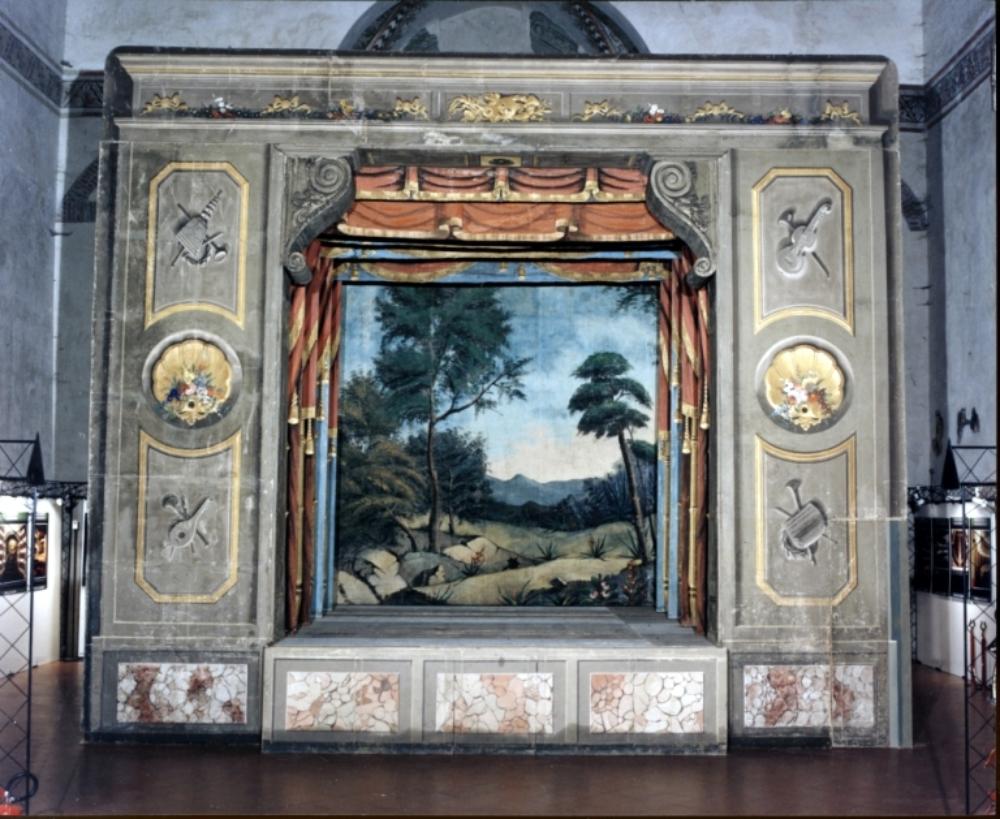

Il Baraccano Conservatory Theatre is not a theatrical building, but a modular structure made of wood and painted canvas that altogether reproduces a stage mouth and stage. The lack of sufficiently documented information does not allow to precisely determine the period of its construction.
It was located inside the Baraccano Conservatory, in Bologna, an architectural complex of great historical interest whose origins date back to the 15th century. Originally founded as a hospital for pilgrims, after the 1527 plague it was transformed “into a refuge for those ‘girls of honest condition’ made orphans by recent calamities” (quoting Arte e .., p. 461). From this moment begins the function of the Conservatory, as a secular institution aimed at education and professional training provided for specific internal work activities.
“The continuous transformations that have characterized the building history of the Baraccano conservatory culminated in radical transformation works carried out on projects by Angelo Venturoli between 1812 and 1816. On the plans dated May 4, 1812, ‘Plan of the four floors of the Conservatory of the Baraccano girls, located on the public street of S. Stefano; aimed at concentrating another Conservatory inside it with demonstrations of the different innovations,’ the dimensions of the large halls on the first floor used as dormitories are shown.
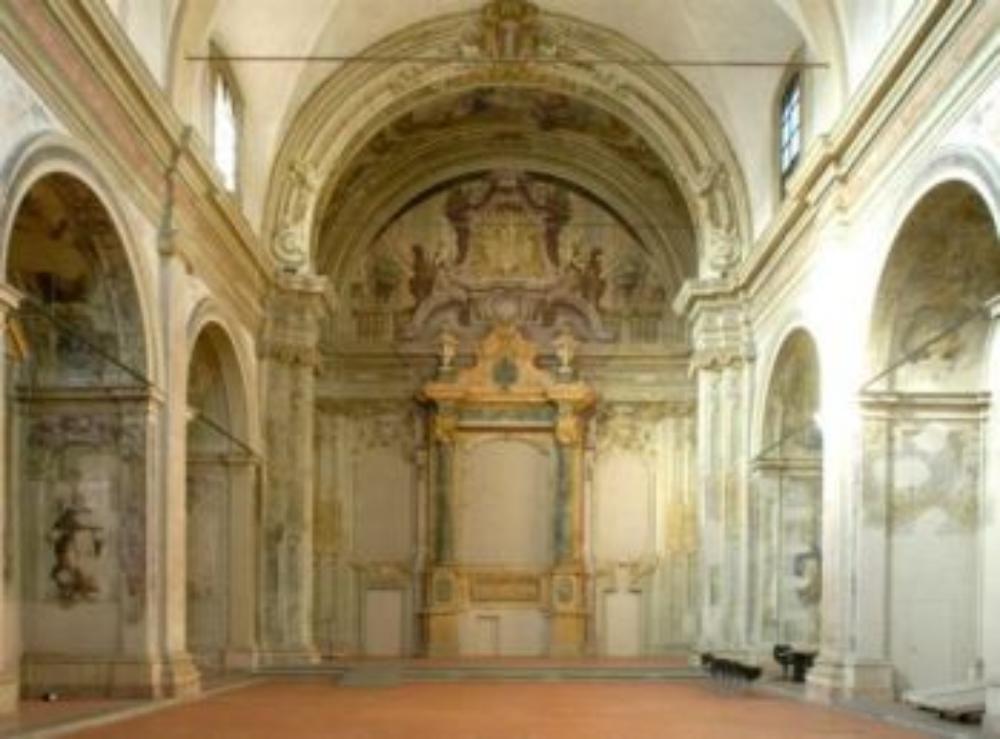
In the place where the little theatre was located, at the moment of the Conservatory’s closure (1969), a transverse wall separating two rooms appears. It is therefore assumed that the location of the little theatre, which involved the demolition of this wall, may date back to the last adjustment works of the complex carried out in the post-Unification period, at the turn of the 19th and 20th centuries” (Paolo Nannelli). The structure consists of the parts that make up the stage mouth, in canvas, fixed on wooden frames, painted in tempera with ornamental motifs recalling the typical decorations of theater rooms (musical instruments, masks) and a series of wings and harlequins as connectors, made of the same material. Everything is prepared to insert scenes and backdrops necessary for staging performances.
In 1980, on the occasion of the exhibition “Art and Piety,” the Baraccano hosted a section entitled “Girls, nuns, and mothers.” At that time, the little theatre was still assembled in the former dormitory room. Subsequently dismantled, it has remained until today in the adjacent room used as storage for furniture and artworks that furnished the numerous rooms of the building. The presence of seven backdrops, some of which are painted on both sides, indicates a lively theater activity. In fact, we find the most varied scenes: from the image of buildings along a road leading out of the city, to a landscape with trees and hills, from interior scenes (a poor room and a rich room), to the depiction of the typical red theater curtain, up to the curious representation of the Palazzo d’Accursio in full view, lacking depth perspective.
The conservation conditions of the little theatre suffer from the lack of maintenance and the long stay of its parts (dismantled) in the storage where it has remained until today. A first cleaning and consolidation intervention of the more fragile parts lays the foundation for a forthcoming, hoped recovery of the structure and its scenic and decorative apparatus. (Luisa Masetti Bitelli)