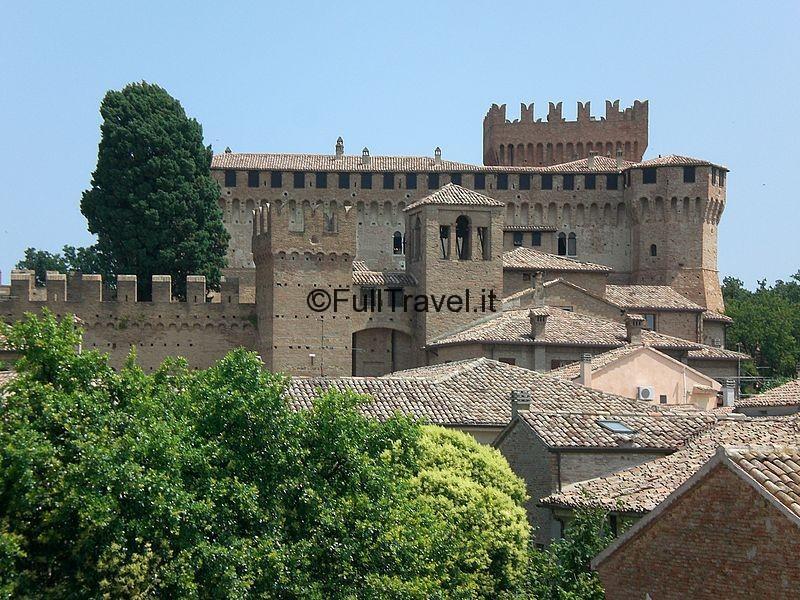


In its 12 km length, all facing the sea, between Gabicce and Pesaro, it nonetheless holds unsuspected attractions and curiosities. Starting with a spectacular cliff, a temple of fossils and rare gypsum crystals, which plunges into transparent waters, behind which rises a fan of hills covered with woods, patches of vineyards and olive trees, where valuable archaeological sites lie hidden (after the Sicilian ones of Piazza Armerina, the mosaics of the Roman villa of Colombarone are among those that most excite scholars; not to mention the remains of the two ancient ports of Santa Marina and Vallugola), Renaissance villas and gardens (see box), well-maintained and signposted trails and trekking routes.
“We are the only green lung in the area and one of the rare promontories of the Adriatic between Trieste and the Gargano” – explains Nadia Regnoli, the president, always at the forefront for the establishment of the Park Authority, which took place in 1996 – “A land full of wonders, just a stone’s throw from the golden beaches of Pesaro and Gabicce, where it is pleasant to stop by to immerse yourself in unspoiled environments or simply to enjoy the evening cool, perhaps taking advantage of one of the many original summer cultural initiatives.” Starting from Gabicce, provincial road no. 44, the “Panoramica”, quickly strings together the chain of ancient fishing villages: Gabicce Monte, Casteldimezzo, Fiorenzuola di Focara, Santa Marina. Clusters of stone and brick houses enclosed by mighty walls, which watch over the sea from above and at whose feet run narrow strips of beach, covered by curious golden pebbles called cogoli. On the clearest days, from the square of Gabicce Monte, a sort of terrace-lounge suspended between sky and sea, the view stretches over the entire Romagna Riviera up to Ravenna. In nearby Casteldimezzo, where a 15th-century wooden Crucifix is kept in the church, found, according to a legend dear to the inhabitants, on the seashore inside a large chest, an old ridge road allows you to reach the walls of Fiorenzuola di Focara, once home to flint miners and clam fishermen, where a plaque on the entrance door bears some verses by Dante, according to whom “vows and prayers” were needed to escape the windstorms that struck the promontory. These are places where it is nice to stroll without haste, enjoying the pleasure of small things; to explore the narrow streets, peeking at the enticing menus of typical inns and the programs of traditional festivals, which regularly revive parades in medieval costume and ancient forgotten crafts.
The Renaissance Villas
Renaissance villas and gardens are among the park’s beauties. Among these, Villa Imperiale and Villa Caprile stand out, two prestigious and charming complexes, which reveal how, in the 16th century, living in a villa was a choice of pleasure and noble delight. Villa Imperiale consists of two cores, the Sforza one from the late 1400s and the one commissioned in 1530 by Francesco Maria I Della Rovere, designed by the architect Girolamo Genga. Passing through the entrance portal crowned by a daring watchtower, one is captivated by the magic of the interior rooms, which open onto frescoes by Dosso Dossi, Raffaellino del Colle, Bronzino, Camillo Mantovano, and by the chronicles of the time, which tell of stays by artists and writers such as Torquato and Bernardo Tasso, Pietro Bembo, Baldassarre Castiglione. The exteriors are also splendid, animated by Italian gardens and a lush park. The complex is private and can be visited on specific days and times. Information: tel. 0721.69341. Owned by the Province of Pesaro and Urbino is instead Villa Caprile, now home to the Agricultural Institute “A.Cecchi”, which sports a majestic white silhouette, terraced gardens (including one Italian-style, with curious water features), grottos, an oratory, and an 18th-century outdoor theater for open-air shows. It was built starting in 1640 as a representative residence of the Mosca family and, as a place of delights, hosted figures such as Giacomo Casanova, Stendhal, Duke Ferdinand IV of Parma, and Carolina of Brunswick.
Birds of Prey Observation
Being one of the very few elevations on the Adriatic coast between Trieste and the Gargano, the San Bartolo cliff is a preferred stopping point for migratory birds and a precious destination for lovers of nature tourism. Throughout the migration season, some zoologists, collaborators of the park, walk daily to the highest point of the cliff to observe with powerful binoculars the flight of birds of prey, cranes, white storks, and the very rare black storks: for them, there is no greater satisfaction than seeing a pair of peregrine falcons nesting right on the cliff. Since 1998, in collaboration with the University of Urbino, the San Bartolo Park has hosted not only this important observation station but also promotes the scientific study of raptor migrations. Indeed, over 3,000 specimens stop here annually, especially kestrels, honey buzzards, and marsh harriers, but there are also buzzards, osprey, sparrowhawks, harriers, harriers, merlins, and hobbies.
Parco di San Bartolo e borghi antichi
Tra le bellezze che la costa adriatica italiana schiude, c’è anche il Parco Naturale del Monte San Bartolo, uno dei polmoni verdi più giovani della penisola e il più piccolo delle Marche, solo 1600 ettari di estensione.
Geen reacties
Al je reizen in één app: vluchten, hotels, cruises, treinen, taxi’s, vakanties en huwelijksreizen.
We vergelijken realtime de prijzen van meer dan 100 bureaus om de beste deals te vinden, zonder extra kosten.
FullTravel App is een gratis metazoekmachine: lowcost en lijnvluchten (700+ maatschappijen), hotels (Booking, Airbnb…), cruises, treinen, bussen, taxi’s, fietsen, vakanties, huwelijksreizen en nog veel meer.