

David Bowie was born in London, in the Brixton district. Although he lived elsewhere for many years (primarily in New York and Berlin), London remains a city indissolubly linked to his career and success.
This ten-stop itinerary takes place among the neighborhoods of Brixton, Soho, Mayfair, Hammersmith, and South Kensington and is a true pilgrimage recommended for those who love the great artist.
10 David Bowie Places in London: Exploratory Itinerary
1 David Bowie’s Birthplace
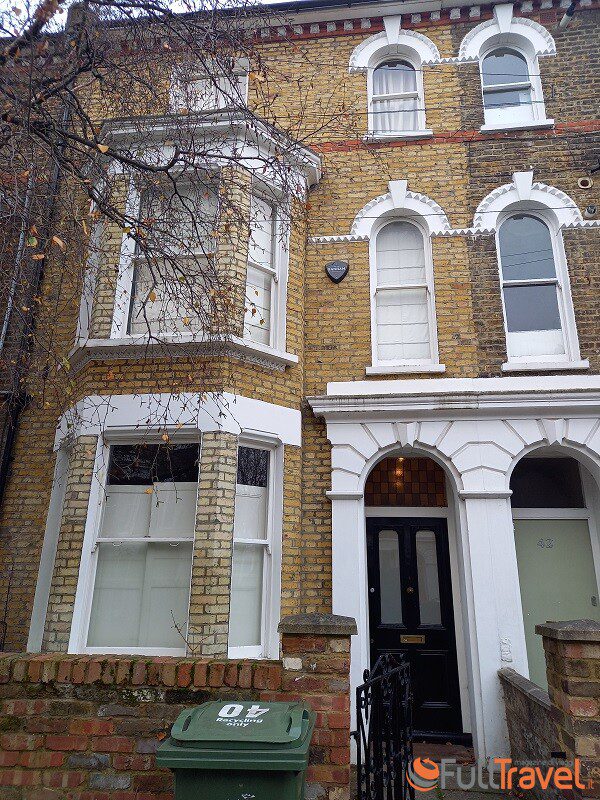
Where: 40 Stansfield Road – SW9 9RY. Underground: Brixton.
David Robert Jones was born on January 8, 1947, in this house on the border between Brixton and Stockwell, to Margaret Mary “Peggy” Burns, who worked as a cinema waitress, and Haywood Stanton “John” Jones, an employee at the charity Barnardo’s. Bowie lived in this house until he was six years old, when the family moved to Bromley.
2 The Brixton Mural
Where: Tunstall Road – SW9 8BN. Underground: Brixton.
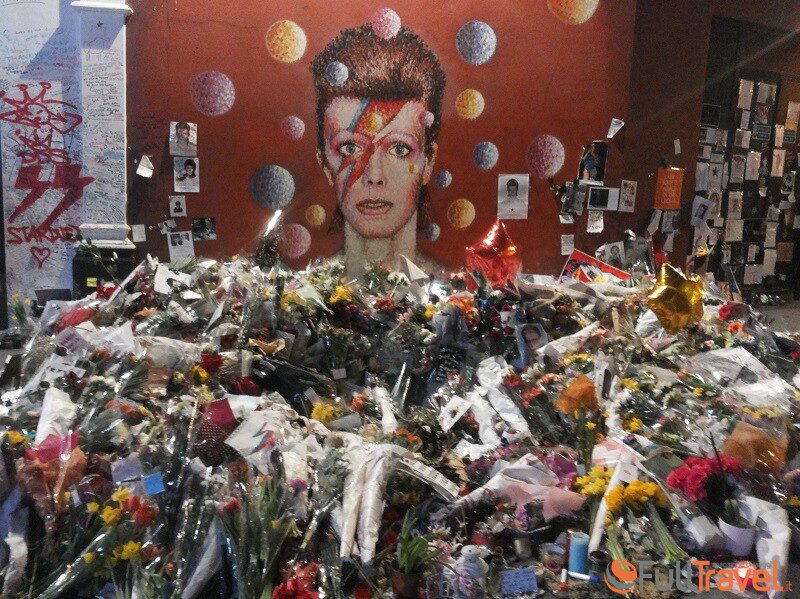
Opposite Brixton Underground station, along the side facade of the large Morleys store, is the famous David Bowie mural, inspired by the iconic cover of the album Aladdin Sane. The mural was painted in 2013 by Australian artist James Cochran, on the occasion of the Victoria & Albert Museum exhibit dedicated to Bowie.
In January 2016, after the artist’s death, this site became a true place of worship, with thousands of people (including the undersigned) coming there to leave a flower or a note. Many wrote messages on the mural, which was later repainted and protected with a plastic screen.
3 Heddon Street
Where: 23 Heddon Street – W1B 4BQ. Underground: Piccadilly Circus or Oxford Circus.
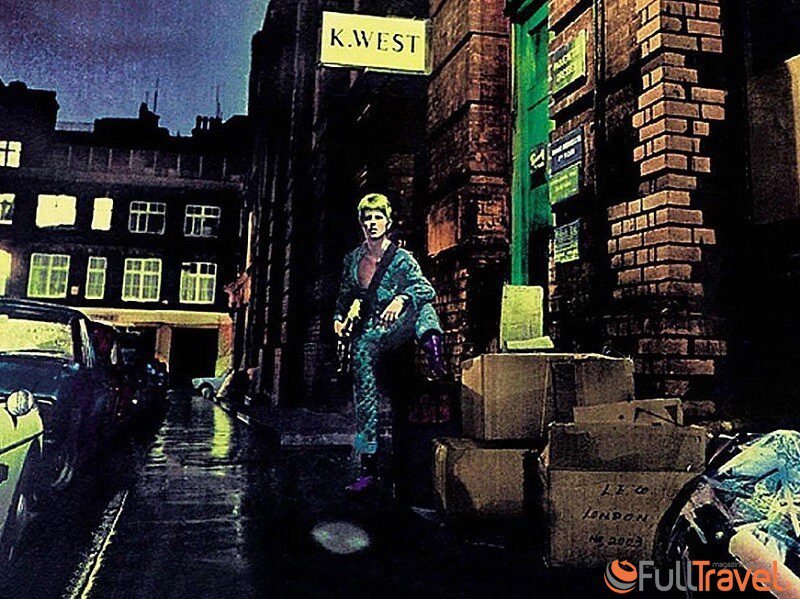
In this quiet pedestrian side street off Regent Street, opposite number 23, the photo for the cover of The Rise and Fall of Ziggy Stardust and The Spiders from Mars was taken. In January 1972, photographer Brian Ward was shooting images for the album at a studio in Heddon Street. At one point he suggested taking some photos outside, but the band refused because the temperature was freezing and it was raining. Only Bowie agreed.
The exact spot where the photo was taken is marked by a commemorative plaque unveiled in 2012 by members of the Spiders from Mars Trevor Bolder and Mick Woodmansey and Gary Kemp of Spandau Ballet, Bowie’s longtime fan.
4 Trident Studios
Where: 17 St. Anne’s Court – W1F 0BQ. Underground: Tottenham Court Road or Leicester Square.
In these Soho studios, David Bowie recorded five albums: Space Oddity (1969), The Man Who Sold the World (1970), Hunky Dory (1971), The Rise and Fall of Ziggy Stardust and The Spiders From Mars (1972) and Aladdin Sane (1973).
The portfolio of productions at Trident Studios is incredible. Their success was due to various factors, not least the use of cutting-edge technology. For example, they were among the first to have an eight-track recording system, while even Abbey Road Studios used only four tracks.
The Trident grand piano is an absolute legend: it was a Bechstein handmade in the mid-19th century. It was notoriously hard to play because the keys were very stiff. But once you got into it, the sound was bright and crystal clear, so much so that it was called “the best rock and roll piano ever”. It can be heard, among others, on the Beatles’ Hey Jude, Queen’s Killer Queen and Elton John’s Your Song. And, of course, on Suffragette City, Life on Mars?, Oh! You Pretty Things and Aladdin Sane.

5 La Gioconda Cafè
Where: 9 Denmark Street, Soho – WC2H 8LS. Today it houses the Flat Iron restaurant. Underground: Tottenham Court Road.
Denmark Street earned the nickname Britain’s Tin Pan Alley, referring to the homonymous area of New York home to music publishers, songwriters and producers. Denmark Street was the place to be if you wanted to become musicians because the right people gathered there. And so did David Bowie, who left the London suburbs where he lived at the time, converted an old ambulance into a sort of camper, and literally camped out roadside.
During this stay, his local spot was La Gioconda Cafè (at number 9), also frequented by Jimi Hendrix, Elton John and Marc Bolan. In this venue, Bowie formed one of his bands, The Lower Third.
What remains today on Denmark Street of its long musical history are only some instrument shops. La Gioconda became a steakhouse restaurant of the Flat Iron chain and the street, as a whole, is part of a regeneration project for the entire Tottenham Court Road area.

6 Marquee Club
Where: 90 Wardour Street – W1F 0TH. Today a condominium. Underground: Tottenham Court Road, Leicester Square or Piccadilly Circus.
The Marquee is one of London’s historic clubs. Every (and I mean every) English artist of the Sixties, Seventies and Eighties performed there.
David Bowie regularly attended the club as a spectator and played 22 concerts there between 1965-1973. The first four concerts were with the band The Lower Third. Later, with the new band The Buzz, he got a residency which guaranteed him 14 dates in 1966. In 1969, when David Jones became David Bowie (to avoid confusion with Davy Jones, singer of the Monkees), he played once at the Marquee after the release of Space Oddity and last on February 3, 1970, to present the album Hunky Dory.
With the invention of the alter ego Ziggy Stardust, Bowie became enormously famous and the Marquee too small to hold the crowds of fans. So the artist returned to play there only for two dates, by invitation only, in October 1973, to record a show for the American NBC TV.
In 1988 the Wardour Street building was sold and transformed: the main hall where the club was located was demolished and replaced by a restaurant, while the club’s original entrance is now the entrance to the Soho Loft Apartments. The club moved first to Charing Cross and later to other Soho locations, finally closing permanently after ups and downs in 2008.
Watch a clip from the 1973 NBC concert below.
7 The Wag
Where: 33-37 Wardour Street – W1D 6PU. Today home to the O’Neill’s gastro pub. Underground: Leicester Square or Piccadilly Circus.
In 1984, David Bowie shot the video for the single Blue Jean at The Wag, directed by Julien Temple, which won the Grammy for Best Video in 1985.
This venue on the edge of Soho’s Chinatown has a long and glorious history. In the Fifties and Sixties, it was home to the Flamingo Club, where one could hear the best jazz and R&B around, and was also one of the first English clubs to host ska bands. In the early Seventies, after a brief period called The Temple, the upper floors became the Whisky a Go Go, which was renamed The Wag in 1981.
The Wag was one of the key underground clubs in music and fashion in the Eighties, counting Boy George, Sade, George Michael, Jean Paul Gaultier and John Galliano among its regulars.
In 2001 it ceased being a club and became an O’Neill’s chain pub.
Watch the Blue Jean video
8 Hard Rock Cafe Mayfair
Where: 150 Old Park Lane, Mayfair – W1K 1QZ. Underground: Hyde Park Corner.
The famous rock history-inspired restaurant hides a small treasure inside: The Vault, formerly the vault of Coutts Bank, where even the Queen kept her personal valuables. Today it is a small rock memorabilia museum where a guitar that belonged to David Bowie is displayed. The most precious item is the guitar played by Jimi Hendrix at the Isle of Wight (insured for more than 4 million pounds); also remarkable is the Jean Paul Gaultier corset worn by Madonna on the Blonde Ambition Tour.
The museum is open daily from 12:00 to 20:00 (until 21:00 on Fridays and Saturdays) with free admission.
9 Hammersmith Odeon
Where: 45 Queen Caroline Street, Hammersmith – W6 9QH. Underground: Hammersmith.
David Bowie performed at the Hammersmith Odeon (now known as Eventim Apollo) on July 3, 1973. The concert became historic because with the performance of the last song, Rock and Roll Suicide, Bowie symbolically killed his alter ego Ziggy Stardust. It was a totally unexpected event and caused much dismay among fans, as well as the Spiders from Mars who discovered they had been fired this way. The concert was fully recorded by Donn Alan Pennebaker and became a documentary entitled Ziggy Stardust and the Spiders from Mars, released in 1979.
The Hammersmith Odeon opened in 1932 as the Gaumont Palace. Throughout its long history, it has hosted concerts by many artists including Buddy Holly, the Beatles, Queen, Elton John and Blondie. It was also the venue for numerous live concert audio and video recordings and appears in the interior photo of The Who’s album Quadrophenia.
In 2021, concerts scheduled include those by Ellie Goulding, Thom Yorke and Ronan Keating.
Watch Rock and Roll Suicide from Ziggy Stardust’s last concert.
10 Royal Albert Hall
Where: Kensington Gore, South Kensington SW7 2AP – Underground: South Kensington.
Although the Royal Albert Hall is a legendary concert hall, David Bowie played there only twice. The first time was on March 12, 1970, when he sang Space Oddity alone during a charity concert for mentally disabled children.
The second time was May 29, 2006, as a surprise guest of David Gilmour. The two legends closed the concert duetting in Arnold Layne and Comfortably Numb. That was Bowie’s last performance in the UK.
The Royal Albert Hall hosts the BBC Proms every year, a rich summer series of concerts. The July 29, 2016 Prom was dedicated to David Bowie’s music and featured Anna Calvi, Laura Mvula and Marc Almond, among others.
The Royal Albert Hall has a full program of events this year, with concerts including Brian Adams, Eric Clapton and Patti Smith. Guided tours will also resume from spring 2021, bookable through the website.
Watch Comfortably Numb performed by David Gilmour and David Bowie at the Royal Albert Hall