


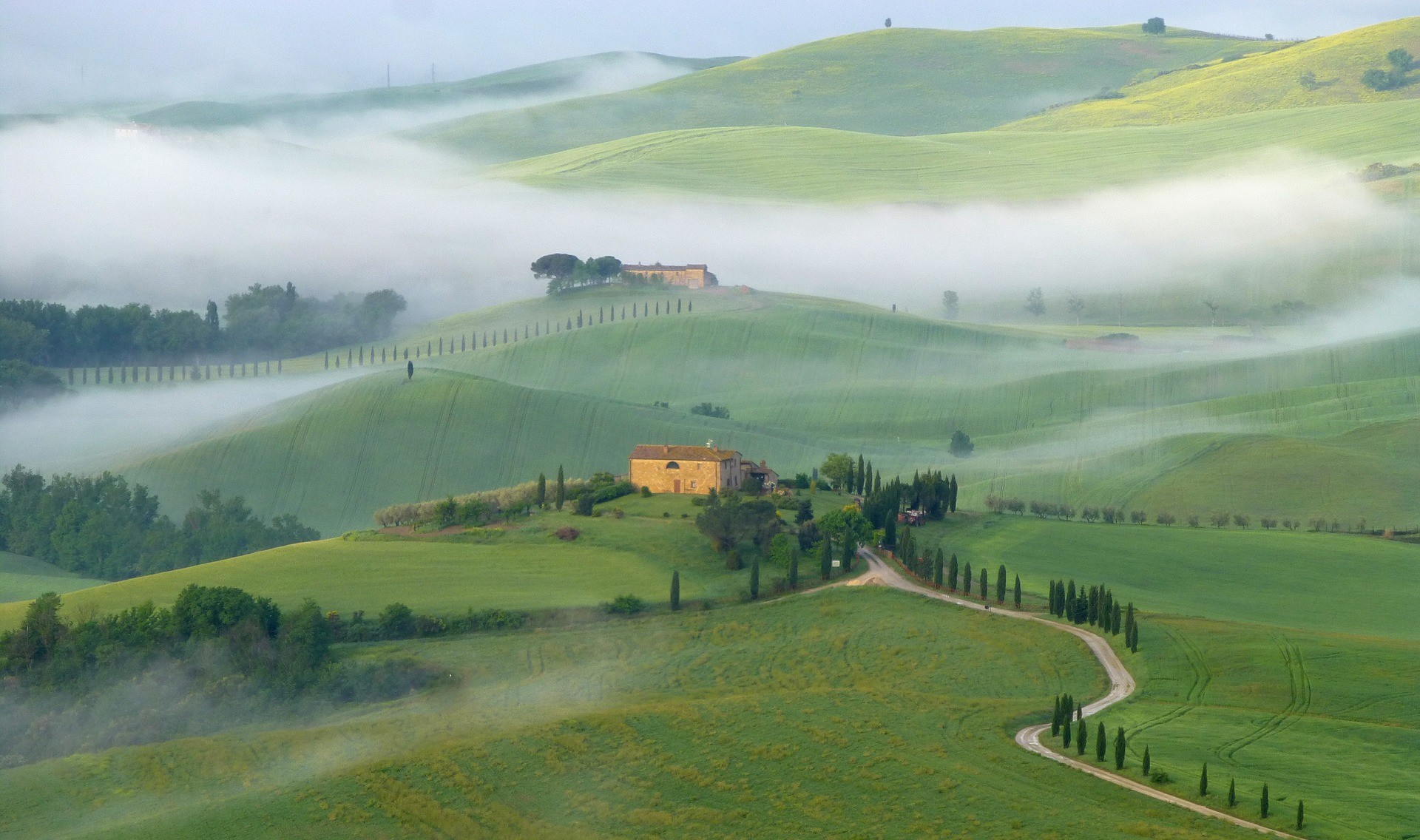

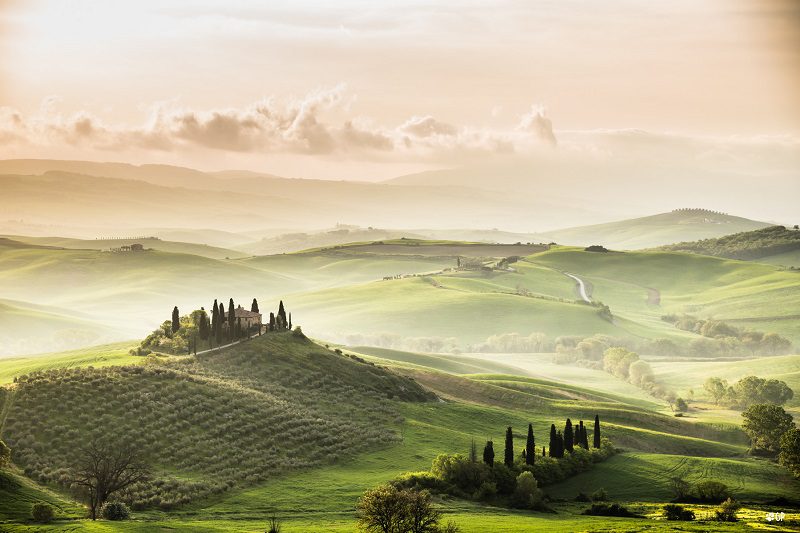
La Val d’Orcia is a Tuscan territory, in the province of Siena. Its landscapes are characterized by conical hills adorned with cypresses, often topped by a fortified village. Today’s Val d’Orcia is like a photograph of the ideal Renaissance rural landscape: for this reason, it was inscribed by UNESCO in 2004 on the World Heritage list.
The Renaissance Landscape of the Val d’Orcia
The transformation of the Val d’Orcia territory took place starting from the 15th century. From that moment, local merchants and bankers invested in the agricultural development of the area, so that it would become productive and create wealth. The change occurred according to a typically Renaissance mindset, that is, with the very rational objective of profitability, but without neglecting aesthetics.
It was the local entrepreneurs themselves who promoted the creation of villages, fortresses, and monasteries that still picturesquely dot the territory today. They also commissioned numerous paintings from artists of the Sienese school who celebrated the image of the region, showing the fulfilled realization of Renaissance utopias on ideal places. Thus, the Val d’Orcia became an example for other intellectuals, artists, and politicians of the time of good governance of the landscape, where man lives productively in harmony with nature.
After the Renaissance, there was a gradual decline in the economic importance of the area. This meant that the Val d’Orcia never experienced excessive agricultural or industrial development, leaving the landscape essentially unchanged compared to the 15th-16th centuries. With the awareness of this richness came protections, first with the creation of the Val d’Orcia Local Protected Natural Area, and finally with the UNESCO designation.

Slow tourism in Val d’Orcia
One of the most fascinating ways to discover Val d’Orcia is through slow tourism. Bicycle routes, walking paths, or steam train rides offer the opportunity to experience the beautiful landscape authentically.
In Val d’Orcia takes place the Eroica, the non-competitive cycling event that evokes the cycling of the past. The Eroica is a cult event for vintage cycling enthusiasts and it is very difficult to participate because the spots are booked in record time by fans from all over the world. However, during the year its dirt trails remain open and can be traveled by bicycle or motorcycle.

The Via Francigena, the ancient route that since the Middle Ages linked the two most important pilgrimage destinations in Europe: Rome and Canterbury, passes through Val d’Orcia. Siena was located along the route and this favored its urban and demographic development during the Late Middle Ages. From Siena, the road arrives at San Quirico d’Orcia and from here crosses Val d’Orcia, until reaching Acquapendente, where the route connects to the Via Cassia. Traveling the Via Francigena is not only a hiking experience but also a spiritual one: along the way, one encounters monasteries, countryside churches, and altars that, over the centuries, have accompanied and guided pilgrims.
Another alternative way to enjoy the magnificent landscape of Val d’Orcia is with the historic Asciano-Monte Antico railway. This route, opened between 1865 and 1872, was abandoned after the Second World War only to be rediscovered and enhanced by the State Railways Foundation in recent times. Its 51 km, traveled unhurriedly by steam trains, allow you to discover glimpses of landscape otherwise unreachable.
The Villages of Val d’Orcia
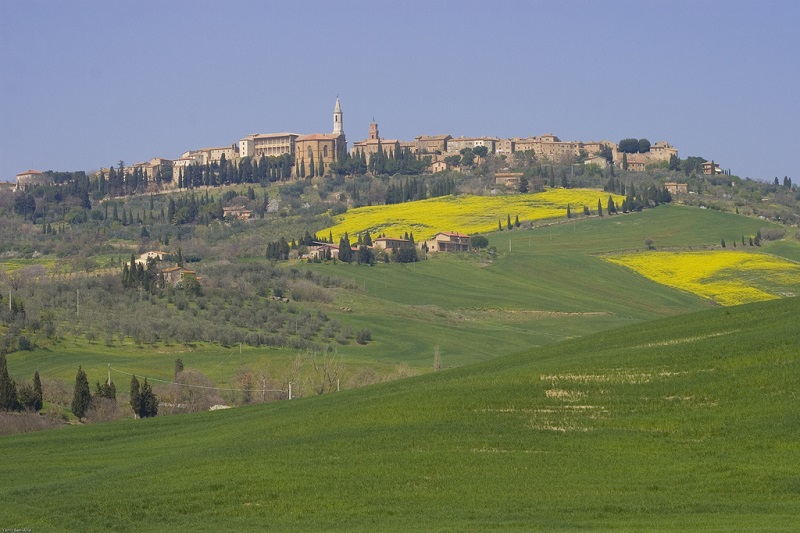
Val d’Orcia is an area belonging to five municipalities: Pienza, Montalcino, San Quirico d’Orcia, Radicofani, and Castiglione d’Orcia. These are small towns perched on panoramic hills, from which it is possible to admire the beautiful landscape. Exploring the alleys of these villages, discovering the countless art treasures they hold, is truly an invitation to beauty.
Pienza itself is a UNESCO World Heritage Site. Its urban plan was commissioned by Pope Pius II, from whom the name derives, to Bernardo Rossellino, an architect follower of Leon Battista Alberti. Therefore, it was designed according to the criteria of the ideal Renaissance city, of which Alberti was the main theorist. A curiosity: in the municipal territory of Pienza is the Quercia delle Checche, a monumental 300-year-old oak tree, the first to receive the recognition of Italy’s green monument by MIBACT.
Montalcino, a city known for the production of the famous Brunello wine, is entirely surrounded by walls that culminate in the perfection of its medieval fortress, which is also the venue of the annual Jazz and Wine Festival. Between these two locations is San Quirico d’Orcia, a village that rises next to the Via Francigena. At its entrance, there is a beautiful avenue of cypresses, one of the most iconic places in this area.
Radicofani is also crossed by the Via Francigena and is dominated by an imposing fortress, visible for miles around. In the Romanesque church of San Pietro, it is possible to admire a rich collection of artistic terracottas by Andrea Della Robbia. At Castiglione d’Orcia, instead, the characteristic Palio del Boscaiolo takes place, where representatives of this traditional craft compete in wood-cutting skill contests. Finally, small villages such as Contignano, Bagno Vignoni, Campiglia d’Orcia, Monticchiello, and Bagni San Filippo also deserve a visit, as they are administratively fractions of these municipalities.
The Val d’Orcia as a Source of Inspiration
The landscape of the Val d’Orcia, with its nature and picturesque villages, has been a source of inspiration for centuries, starting from its 15th and 16th-century representations by the painters of the Sienese school who influenced the landscape and urban planning of other areas of Tuscany and central Italy during the same period. In the following centuries, the type of inspiration changed: in the 18th and 19th centuries, the Val d’Orcia could be visited during the Grand Tour, during which some months were dedicated to Tuscany to discover Renaissance art and culture.
More recently, the Val d’Orcia has been a source of inspiration for numerous photographers, writers, and film directors. The list of Italian and foreign films shot here is very long. To mention only some of the best known, there are Gladiator by Ridley Scott, The English Patient by Anthony Minghella, Brother Sun, Sister Moon and Romeo and Juliet, both by Franco Zeffirelli, and Nostalgia by Andrei Tarkovsky.
Where to eat in Val d’Orcia
Val d’Orcia, thanks to the extraordinary variety of flavors of its typical dishes, foods and wines, is a perfect destination for lovers of food and wine tourism. Some products have a very ancient history that dates back to the Roman era or even the Etruscans.
Thus, for example, the pecorino di Pienza, of which even Lorenzo the Magnificent was a great admirer. When visiting Pienza it is worth stopping at one of the various shops along Corso Rossellino to try the different qualities of this extraordinary cheese. In addition to the different aging degrees (from one and a half months to 24 months), there are some variants that add further flavor nuances to the product: pecorinos with orange/reddish rind, for example, are rubbed with tomato and olive oil before aging; others are wrapped in leaves, others are rubbed with grape must.
The typical fresh pasta of Val d’Orcia are pici, similar to thick spaghetti, with an irregular shape. The simplest are made only with flour and water, but there are also versions with egg or spinach. The most typical condiments for pici are aglione (a tomato sauce with plenty of garlic), cacio e pepe, with porcini mushrooms or with a game ragù, for example wild boar or hare. The DOP cinta senese salamis, produced from free-range pigs, are also unmissable. In addition to the exceptional flavor, they are generally less fatty than common pork salamis.
All these tasty foods deserve to be accompanied by wines full of personality, capable at the same time of enhancing their flavors. The most famous wines of the area are red and are based on sangiovese grapes. Probably the best known is the prestigious Brunello di Montalcino, produced 100% with sangiovese grapes. Smaller, but still majority percentages characterize the Nobile di Montepulciano and the Orcia, the wine with the most recent DOC recognition.

Where to sleep in Val d’Orcia
A vacation in Val d’Orcia is a source of inspiration for everyone, especially if you choose to stay in authentic accommodations. You can choose to reside in the heart of one of the medieval villages, in one of the many historic palaces converted into bed & breakfasts. If you are traveling in a group, you can rent a country house. Even in this case, the offer is very wide and ranges from simple, yet comfortable solutions, to beautiful historic villas with pools.
Finally, for those who want to experience the essence of Val d’Orcia amidst the indulgence of discreet luxury, the ideal solution is the Hotel Fonteverde, in San Casciano dei Bagni. The hotel rises around a Renaissance portico commissioned by Grand Duke Ferdinando I de’ Medici. The infinity pools of its SPA, fed by a nearby thermal spring already known to the Etruscans, allow you to relax enjoying the benefits of sulfurous water while admiring the landscapes of Val d’Orcia. And, no less important, the culinary offerings of its restaurants range from traditional Tuscan dishes to lighter and balanced options that combine taste with wellness. Because even good food is a source of inspiration.




