


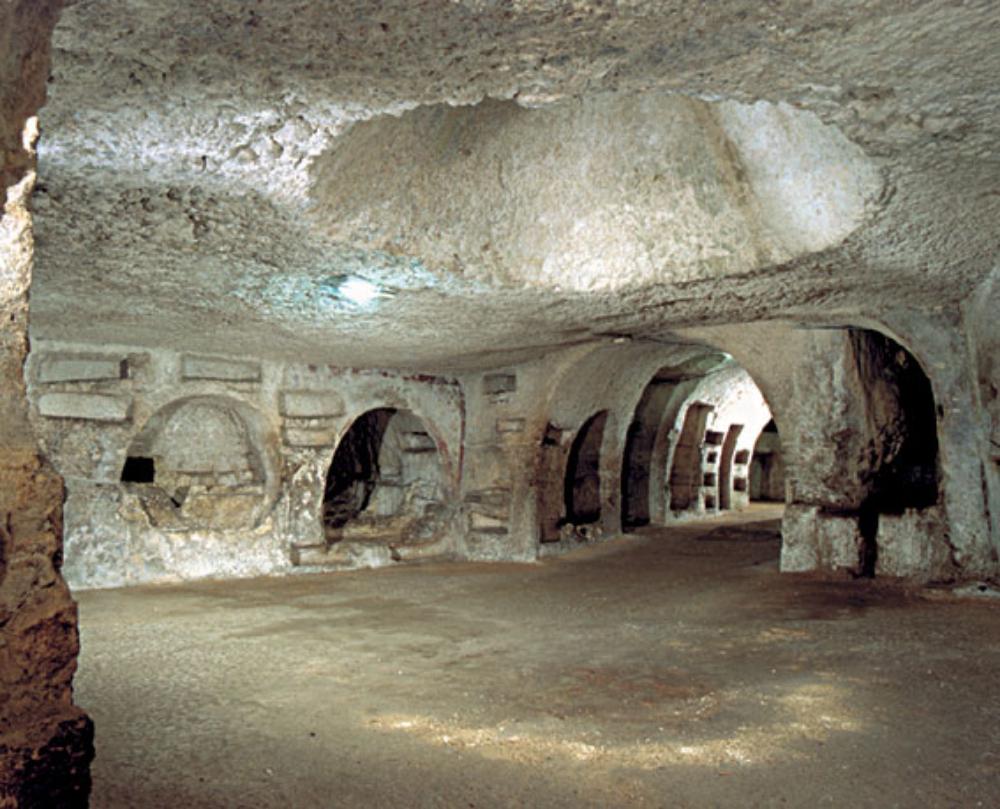

The funerary area of Vigna Cassia, visitable upon request at the Pontifical Commission of Sacred Archaeology of Syracuse, consists of a community cemetery and five private hypogea, chronologically attributable to the 3rd, 4th, and 5th centuries. Proposing a topographic development similar to Roman models, the true catacomb is divided into three regions – S. Maria di Gesù Maggiore and Marcia – of which the first two originate already within the 3rd century, the last only in the 4th. The view of the plan confirms what has been said: the cemetery of S. Maria di Gesù, on your right, is obtained by the expansion of a pre-existing aqueduct, on the walls of which a series of loculi (rectangular cavities with the long side visible) are cut; the solution allows a quick and economical intervention on the rock which fits well with a pre-Constantinian period. A confirmation of the early chronology of this region is found in the Major cemetery, located at the center of the plan and datable, based on a hoard containing, among other things, coins issued under Gallienus and Claudius II the Gothic, to around the middle of the 3rd century. The materials found in this area confirm the dating, proposing a commission of pagan and Christian culture that Santi Luigi Agnello had rightly highlighted already in the fifties.
A community cemetery does not exclude the existence of private spaces (cubicula), which are almost physiological and which, in this case, are represented by small round rooms obtained from a reuse, not particularly cared for, of deactivated cisterns of the previous city water supply system.
A less confused topographic development characterizes the cemetery of Marcia, on the left in the plan, whose regular layout closely resembles that of the catacomb of San Giovanni. The dating of the origin of this region therefore shifts to the 4th century, in the post-Peace of the Church era, with use still in full swing in the 5th century, also suggested by the chronology that traditionally accompanied the painting of Marcia, locatable in the lunette of an arcosolium of the north-western branch of the cemetery.
The ideological pluralism that characterizes the original nuclei of the catacomb concerns even more the hypogea of the platform above the community cemetery which, intended to serve individual families or corporations, reveal an even more marked coexistence between pagans and Christians. Once again, inscriptions are the most effective indicators of this phenomenon. Noteworthy is the restoration of the paintings of hypogeum II, carried out in October 1997 by PCAS-Syracuse, which restored clear images of a figurative cycle entirely of Christian subject matter, one of the most precious documents of the underground heritage of Syracuse.
Salvation and resurrection of the soul are the concepts symbolically expressed by the scenes decorating two arcosolia of the hypogeum: two moments of the Jonah trilogy, Daniel in the lions’ den, portrait of a deceased among orants, resurrection of Lazarus and peacocks inserted in the flowered gardens of the paradisiacal habitat.”
Information about the Catacomb of San Giovanni
Piazza San Giovanni, snc
96100 Syracuse (Syracuse)
093164694
[email protected]
https://www.catacombesiracusa.it
Source: MIBACT



