

Pur essendo una metropoli, ciò che colpisce di Dublino, capitale dell’Irlanda, è l’ordinata, seppur vivace, quotidianità che vi si respira: a dispetto del fatto che conta più di un milione di abitanti compreso l’hinterland, Dublino dà l’idea di essere un luogo raccolto e poco caotico.
The busiest area, especially on the weekend, is Temple Bar, a historic and famous district of Dublin full of pubs and various venues. Every Friday the party explodes here with musical groups everywhere and beer aplenty.
A few steps from these lively streets stands the Dublin Castle, the ancient castle of the city which, despite being right in the center, seems to confine external noises outside its walls. Visitors are welcomed by a very green garden that leads to the actual entrance. Various rooms of the Castle can be visited, depending on scheduled institutional commitments that may require the closure of some wings of the building. One cannot leave before admiring the rich exhibition of the Chester Beatty Library, also inside the fortress.
When it comes to museums, Dublin holds its own with the Irish Museum of Modern Art, the National Gallery, the National Museum, the Writer’s Museum, or the Natural History Museum. To get an overview of Dublin’s history, on Dame Street there is the City Hall, an example of Georgian architecture and a place where the city’s history is told through permanent exhibitions.
Not far from here, there’s the Trinity College, Dublin’s university, inside which you can visit the ancient library and the Book of Kells, a finely decorated illuminated manuscript created by Irish monks, containing the Latin translation of the four Gospels.
A stop in the Trinity College gardens and then you can visit the statue of Molly Malone to start a walk along Grafton Street, Dublin’s shopping street.
Also worth admiring are the churches, two of which are particularly important: the Christchurch Cathedral, Anglican in denomination, is the oldest building in Dublin; just a few hundred meters more and you find yourself before the St. Patrick’s Cathedral, also Protestant, even larger and surrounded by gardens and flowers.
Continuing towards this urban area, you easily reach the Guinness Storehouse, the factory that produces the famous dark beer. Visitors can tour its six floors, at the end of which they can enjoy a pint in the Gravity Bar, a venue surrounded entirely by windows that sits atop the Guinness tower and offers a breathtaking 360° view over Dublin.
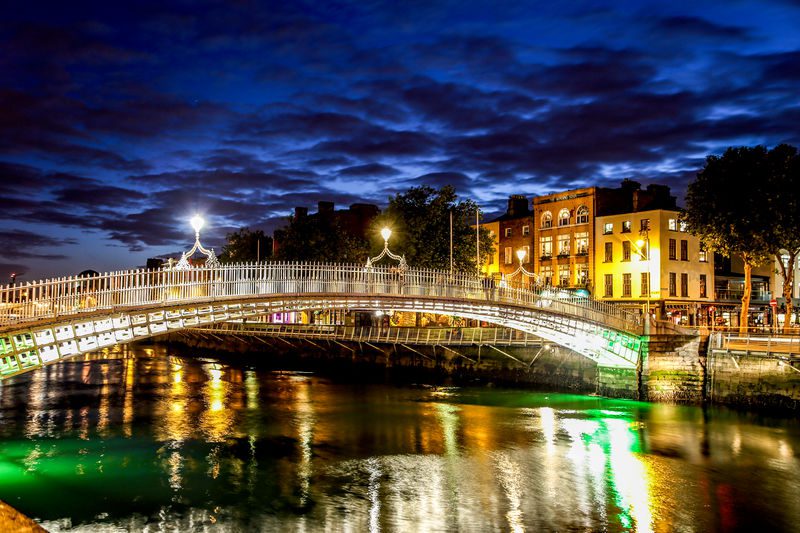
You can also visit what remains of the historic distillery of Jameson, the company producing the famous whiskey. It’s time to return toward Temple Bar, guided by the light in the sky of the Spire on O’Connell Street, the largest street in Dublin. From here you can head to the banks of the River Liffey which divides the city into north and south sides; the most characteristic bridge connecting the two areas is the Ha’penny bridge: on one side is Temple Bar, on the other the lively neighborhood full of small music shops, clothing stores, food from every culture, and very picturesque and characteristic fruit and flower markets.
For those who love nature, the Phoenix Park is wonderful, a huge park within which is the Dublin Zoo and lots of greenery to experience. Very unique, at times poetic, is the Dublin Bay, which James Joyce wrote extensively about; his statue is visible along O’Connell Street.
Even the Docks, the port area that is changing face in favor of new super-modern buildings, offers characteristic views… who knows for how long, given the speed at which construction is happening!