

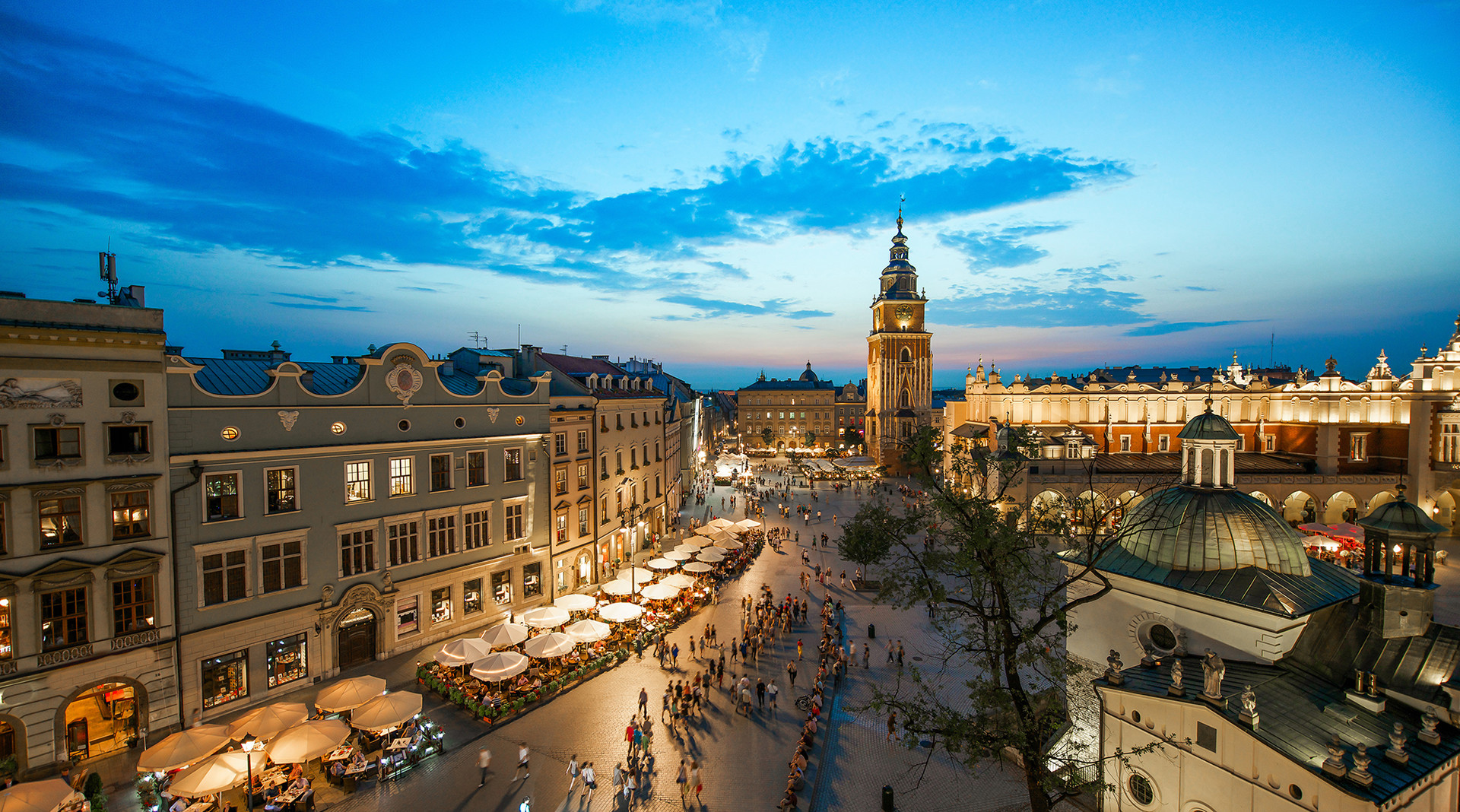


What to See in Poland
Poland borders Slovakia and the Czech Republic to the south. To the northeast, it borders Lithuania and the Russian province of Kaliningrad. The northern side is bathed by the cold waters of the Baltic Sea and enlivened by the large ports of Gdańsk and Szczecin.
The interior of Poland, from the Baltic to the Carpathians, is nothing but an endless plain. A plain that ripples southwest, near the Sudetes, forming hills with a gentle and graceful profile. While to the northeast lies the Masurian Lake District, a sparsely populated region that is also economically and industrially underdeveloped. Almost all the waterways, which the country is rich in, flow into the Baltic Sea, starting with the two main ones, the Oder and the Vistula, which bathes Warsaw, the capital of Poland, and the enchanting Kraków.
What’s the Weather Like in Poland
Poland’s latitude and geographic position provide a decidedly northern climate with modest temperatures. Summer is very short, two, at most three months; winter is harsh with heavy snowfall; the middle seasons, spring and autumn, are windy, humid, and rainy.
Today Poland is a parliamentary republic and has been an integral part of the European Union since 2004, although it still retains its original currency, the zloty. It is also a country in continuous development and modernization, with an economy based on market laws and free competition. In recent decades, much effort has been spent reforming and privatizing strategic sectors such as coal, steel, energy, railways, and transportation.
Poland and Tourism
Tourism has also had a good boost, seeking to enhance one of the oldest historical, monumental, and cultural heritages in Europe. It should not be forgotten that Poland boasts a history spanning over a millennium, peaking in the 16th century when, under the Jagiellonian dynasty, it was one of the richest, most cultured, and powerful countries. Poland was also home to the first written constitution of the Old Continent, dated 1791, known as the May Constitution of Poland.
The Poland Fact Sheet
- Country: Poland
- Area: 312,685 km²
- Capital: Warsaw
- Population: 38,230,080 inhabitants
- Language: Polish, Belarusian, German, Ukrainian
- Religion: Catholics 90.7%, non-religious/atheist 7.9%, Orthodox 1.4%
- Form of State: Republic
- Main cities: Radom, Sosnowiec, Kraków, Wrocław
Information about Poland
- Currency: new zloty
- International dialing code: 0048
- International car code: PL
- Driving lane: right
- Entry documents: for stays up to three months, Italian citizens need only a valid identity card. For minors under 15 years old, a passport is required, or registration with a photo in the parents’ passport.
- Required vaccination: None
- Electricity: 220V
- Measurement system: metric decimal
- Time zones: None
- Fixed-date holidays: May 3 Constitution Day, November 11 Independence Day (achieved in 1918 after being divided among Russian, Prussian, and Austrian domains)
- Climate: The continental climate is characterized by hot summers and rather harsh winters. Generally, central Poland is the driest region, unlike the mountainous zones marked by abundant precipitation. Summer is usually warm, but often interrupted by strong thunderstorms.
- Average temperatures: 8.4°C (-3°C in winter, 19.5°C in summer)
- Transport: In Warsaw, it’s convenient to get around on foot but buses are also widely used and frequent.
- Airports: Warsaw, Łódź, Kraków, Wrocław