


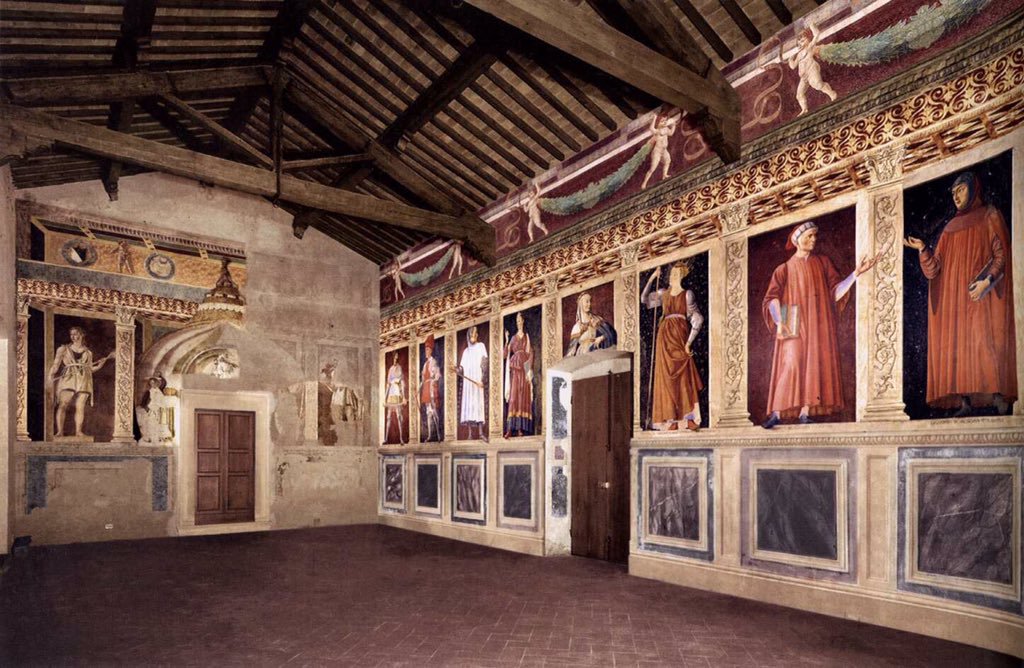

The building owes its fame to the cycle of frescoes depicting “Illustrious Men and Women” that Andrea del Castagno executed around 1455 beneath the loggia, later transformed into a hall.
The paintings, rediscovered under the whitewash that concealed them in 1847, were removed and acquired by the grand ducal government. Exhibited in 1865 at the Bargello Museum, they were subsequently transferred to the Andrea del Castagno Museum in Sant’Apollonia, then, after the flood, placed in the rooms of the ancient church of San Pier Scheraggio, on the ground floor of the Uffizi Gallery, where they are still located.
In the villa’s hall, thanks to the reconstruction of the overall design carried out in 1965 based on the traces remaining underneath, it is now possible to appreciate the reading of the entire pictorial cycle.
The nine illustrious characters are depicted in the following order: Pippo Spano (Florentine condottiero serving Emperor Sigismund against the Turks), Farinata degli Uberti (leader of the Ghibellines and defender of Florence), Niccolò Acciaioli (founder of the Certosa del Galluzzo), the Cumaean Sibyl (associated with the prophets of the Old Testament), Queen Esther (who intervened with the Persian king Ahasuerus to defend her people threatened with destruction), Queen Tomyris (leader of the nomadic Massagetae who avenged her son’s death by triggering the battle in which Cyrus the Great died; this figure is damaged near the door opening), Dante Alighieri, Francesco Petrarca, Giovanni Boccaccio.
Furthermore, in 1948-49, some tests conducted on the walls of the hall revealed other frescoes still in situ: a group with the Madonna and Child beneath a pavilion-like canopy supported by two angels, flanked by the figures of Adam and Eve. The upper part of the frieze, where putti, garlands, and heraldic shields are depicted, was executed in 1472.
Villa Carducci-Pandolfini in Legnaia
Via Guardiavia, 18 50143 Florence