

The remains of the monument are located in the archaeological area of Metaponto, more precisely on the last swell of the Givoni, ancient coastal ridges, near the right bank of the Bradano river, built on the remains of an ancient Neolithic village, along the prehistoric road coming from Siris-Heraclea, about 3 km from the ancient city of Metaponto.
The temple, restored in 1961, was initially attributed to the worship of the goddess Athena, later on a fragment of a vase found during the 1926 archaeological excavations, a votive dedication to the goddess Hera was discovered.
Until the 19th century, the Palatine Tables were locally also called “Mensole Palatine” or “Colonne Palatine”, probably recalling the battles against the Saracens of the Paladins of France. The temple was also called “Pythagoras’ School”, in memory of the great philosopher Pythagoras. In the Middle Ages it was still called “Mensae Imperatoris”, probably in remembrance of Emperor Otto II who, in the expedition against the Saracens in 982, camped at Metaponto.
The remains of the temple consist of 15 columns with 20 flutes and Doric order capitals. Of the 15 columns, 10 are on the northern side and 5 on the southern side. Originally the columns were 32, since the temple had a peripteral shape with 12 columns on the long sides and 6 on the short sides. The stylobate was 34.29 meters long and 13.66 meters wide, the cella measured 17.79 x 8.68 meters. The temple is heavily degraded because it was built with local limestone (called mazzarro).
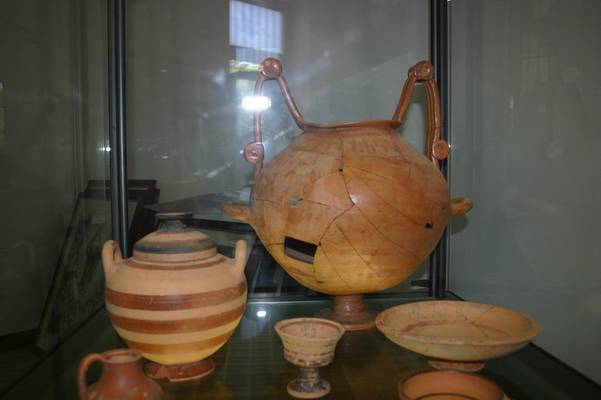
Near the temple, excavations of 1926 uncovered numerous remains of ancient terracotta decorations, figurines, ceramics, and other pieces of columns displayed at the Metaponto National Archaeological Museum.
Information about Temple of the Palatine Tables
Bernalda (Matera)
0835745327
[email protected]
Source: MIBACT