




In the second half of the 19th century, after the demolition of the temporary arenas built on the city’s bastions and the fire at the Aliprandi Theater (1881), Modena lacked a theatrical building intended for popular and escapist performances. This gap was filled by the merchant Gaetano Storchi who, at his own expense and for charitable purposes, built the eponymous theater – designed by architect Vincenzo Maestri – founding a charitable institution to aid the sick and needy by using part of the evening proceeds.
Unlike the Municipal Theater, overlooking one of the main streets in the city center, the Storchi was built on land (donated free of charge by the Municipality) in the new buildable area created with the construction of the Garibaldi barrier (1884), following the demolition of the Bologna gate (1882). The theater’s unique location also accounts for its equally original architectural structure with a double facade – the main one, to the north, facing the square (now Largo) Garibaldi, and the western one facing the promenade along the walls (now Viale Martiri della Libertà) – executed in Greco-Roman style according to the dictates of the contemporary eclectic precepts well known to Maestri, a fine connoisseur of antiquity and related literature, a cultured builder or restorer of residences for the rising bourgeoisie.
The architect developed a formally elegant and harmonious project, where the refined use of sculptural decoration differentiated the various parts of the building, which was modernly equipped with service rooms, a smoking room, and a café. However, construction was economical, on land that proved unstable from the start, and with the use of poor-quality materials which soon compromised stability; the ornamentation, by Maestri’s own admission, became crude and rough, so that already in its making the theater assumed, especially on the outside, a bare appearance far from the images published in the periodical “Ricordi di Architettura” (1887, vol. X, fs. IX, tav. II) which featured the original drawings. The front shows two projections with a double row of paired windows and a pediment crowning; between them are two architraved loggias with Doric columns the first and Ionic the second, covered by a terrace at the level of the projections’ cornice. The facade towards the walls has the same partition but originally showed only the ground floor loggia covered with a usable terrace.
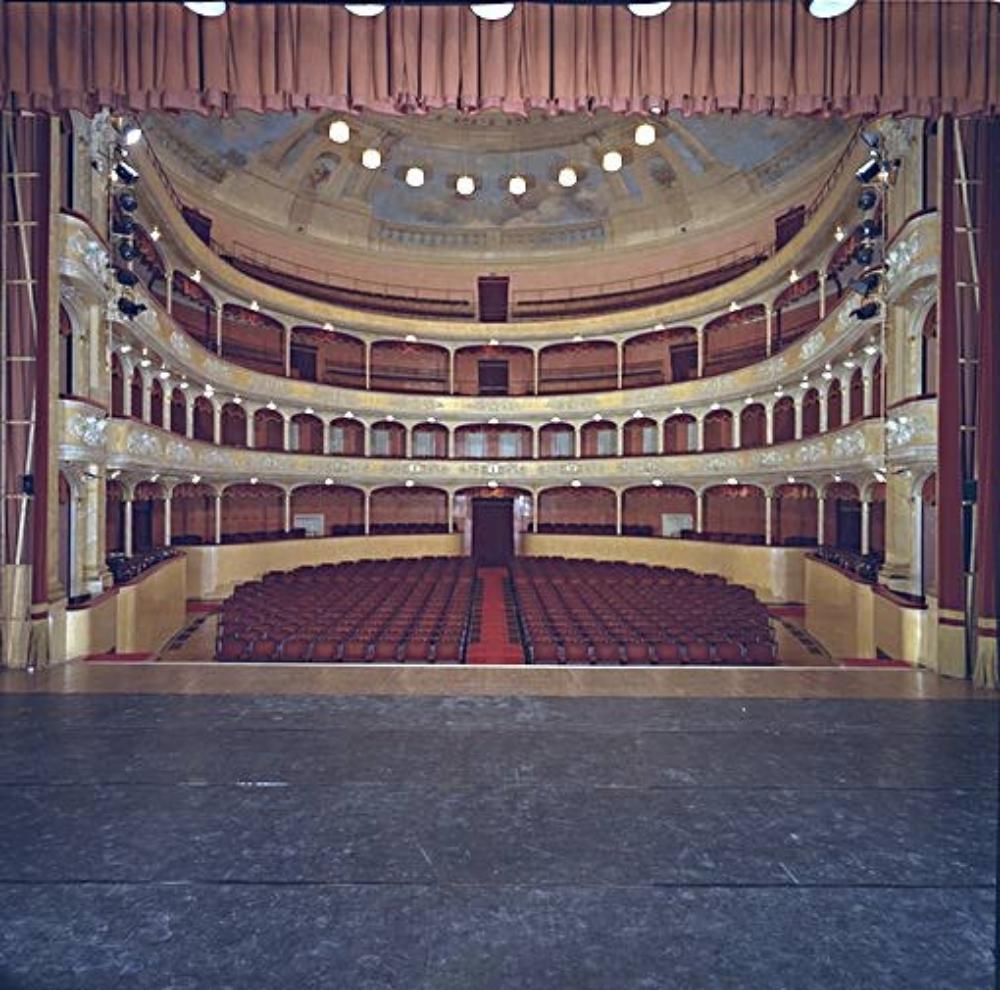
At the time of the inauguration, which took place on the evening of March 24, 1889 with the opera Le donne curiose by E. Usiglio, the theater featured a horseshoe-shaped stalls accessible from an atrium with cast iron columns and a gallery with an iron balustrade and wooden steps. The hall displayed the barrel-shaped ceiling painted by Fermo Forti from Carpi (with the help of Giuseppe Migliorini) which, with light tones and allegorical images, depicted the apotheosis of Gioachino Rossini and Carlo Goldoni. From the second tier stairs, one accessed the foyer connecting with the terraces; service and residential rooms were on the upper floor, the café on the ground floor, behind the stage the dressing rooms for the actors and below, stables for the horses of equestrian shows, for which the stalls’ floor was mobile.
Before the opening, surveys revealed some cracks in the east and west facades. In 1893, besides the reoccurrence of the same problems, vault subsidence was found which, together with poor acoustics and stage “joints,” led to a radical restructuring entrusted the following year to engineer Luigi Sfondrini of Milan, already the author of the Costanzi Theater in Rome and Verdi Theater in Padua. He handled the roof replacement, a slight modification of the hall’s curvature, and the construction (1895) of the second loggia on the west facade (A.St.C. Modena, Administrative Acts, 1892, f. 298, theaters file, Storchi Theater and Charitable Institution).
In the following years, almost continuous interventions were recorded on the roofs; in 1929 the exterior was restored with repairs to plasters and cornices, under the direction of engineer Francesco Benvenuti Messerotti, and in 1931 the radical intervention by architect Mario Baciocchi of Milan reduced the hall to its current state. The works – supervised by engineer Zeno Carani, known builder of the Sassuolo theater – involved moving back the balustrades flush with the boxes, thus enlarging the stalls (whose floor was redone) which further expanded with the creation of the mystery gulf partially placed under the stage, also redone along with the grids. A glass and iron frame was placed in the skylight of the ceiling (made by Sfondrini), and the hall’s decoration and lighting system were redone, then offices, café, and remaining rooms were restored for a cost of 350,000 lire (A.ST.C. Modena, Opera Pia Storchi, 1927-31, f. IX, fs. 1929, 31).
Taken under the management of the Municipality of Modena in 1981, it underwent restorations completed in 1986; since that year it resumed intense activity.
Information about Storchi Theater
Largo Garibaldi, 15,
41121 Modena (Modena)
Source: MIBACT



