


Naples Underground has centuries of fascinating history—let’s explore it together.
The History of Naples Underground
In 1787, during his journey through Italy, Goethe wrote of Naples: “… beneath the purest sky, the most unstable ground,” referencing the mighty Vesuvius to the east and the constant eruption activity of the Phlegraean Fields to the west. Had he ventured below, he might have described Naples as a true “swiss cheese”—a city riddled with underground tunnels, ancient aqueducts, vast cisterns, and countless tuff quarries.
- Naples Underground has centuries of fascinating history—let’s explore it together.
- The History of Naples Underground
- From World War II to Today
- Tuff Extraction in Naples Underground
- Naples Underground: Route and Tips
- Naples Underground Opening Hours
- Timetables and Booking for Naples Underground School Group Visits
- Useful Contacts: Naples Underground Ticket Prices
- Naples Underground Opening Times and Prices
- Naples Underground Prices
In 1889, Naples city engineer Guglielmo Melisurgo traversed the cavities used for the city’s aqueduct system and counted over five thousand caves and two thousand wells. Yet, even today, less than half of Naples’ underground—a staggering 638,000 square meters of quarries, channels, tanks and conduits from Greek and Roman times—has been fully explored.
The origins of these cavities remain uncertain, though early accounts trace them back to the Cimmerians—skilled miners from the Caucasus who settled the region in the 8th century BC. Ancient authors, including Pliny the Elder, described how these people lived around Lake Avernus, near Naples, dwelling in underground homes called argillae and making a living from mining. The geographer Strabo attributes the mining activity to another people, the Eumelids, who also operated in Neapolis and their tombs.
All the cavities of Naples Underground date back to ancient times, dug primarily for the extraction of “Neapolitan yellow tuff”—an excellent building stone. Over the centuries, many tunnels became catacombs, pagan shrines, or aqueducts, while enormous chambers served as cisterns and grain stores.
From World War II to Today
During World War II, Naples Underground became a vast and effective air-raid shelter, complete with restrooms and electric lighting. For 3,000 years—right up until the advent of reinforced concrete—tuff was the primary building material in Naples. The Greeks may have chosen this site for ancient Neapolis precisely because of the yellow rocks of Mount Echia, a dormant volcano just behind today’s Piazza Plebiscito. Archaeologists believe the tuff used to build the citadel on Megaride island was extracted here.
By the end of 1897, there were 69 active quarries with nearly 2,000 workers in Naples. As the city expanded above ground, an equally vast network of cavities grew below. Today, Naples’ iconic architecture reflects this tradition: the Castel dell’Ovo on Megaride, Castel Sant’Elmo overlooking San Martino, and the 17th-century Palazzo di Donn’Anna in Posillipo were all built from this local tuff. Many historical buildings are being restored, and there’s a renewed interest in this distinctive stone.
In 1997, Jean-Nöel Schifano, director of the French Institute Grenoble, hosted a grand celebration for the completion of his tuff-façade restoration, pairing the stone with Naples’ famous babà dessert in the “Babà-Tufo Festival,” an imaginative tribute to two pillars of Neapolitan culture.
Naples is built with the very stone it sits upon, creating a “geological continuity” unique worldwide: many palazzi are founded directly atop the tuff below. Some believe this has made the city more “elastic” and helped absorb shocks from the earthquakes that have struck through the centuries. The network of cavities is thought to help further dissipate seismic energy.
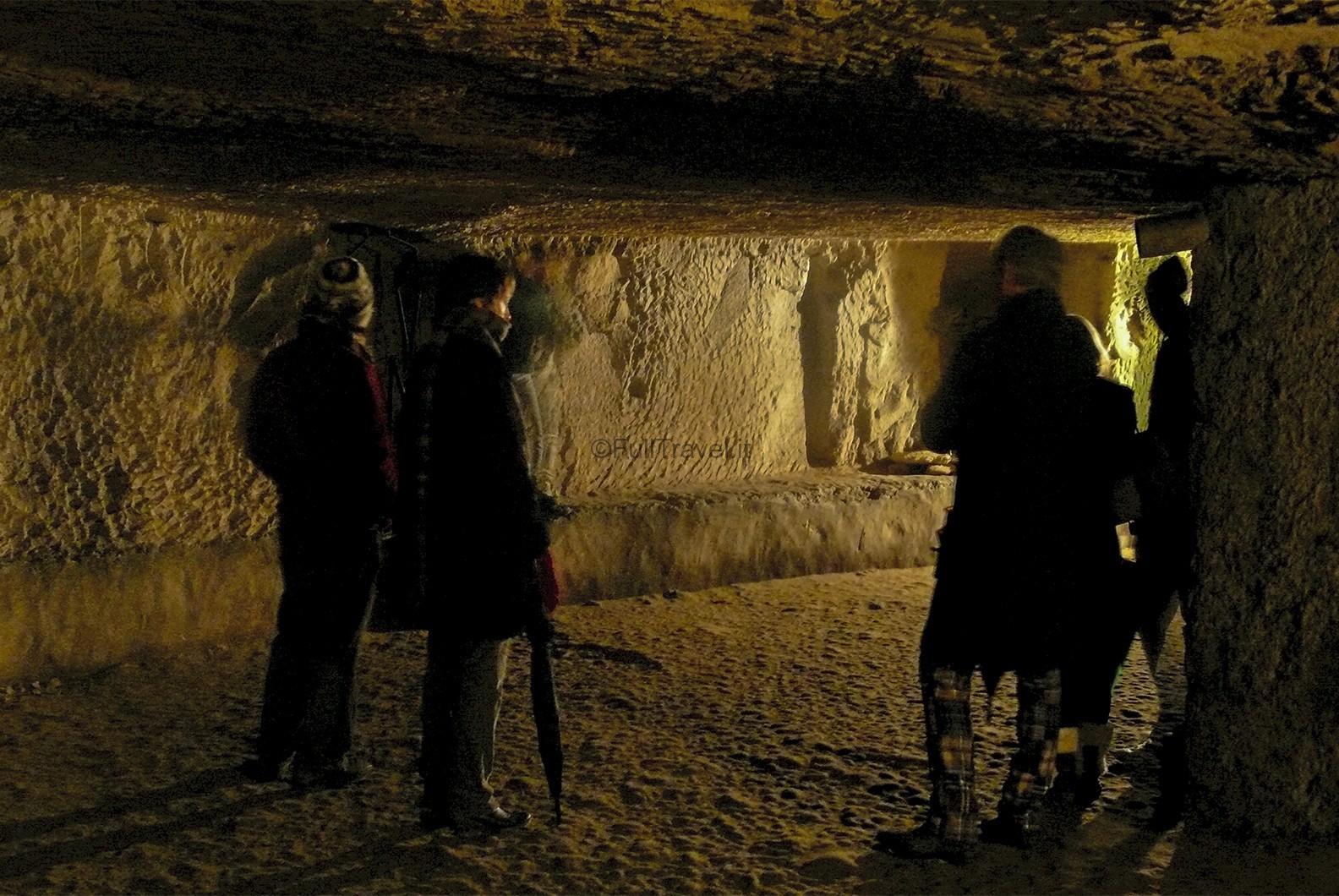
Tuff Extraction in Naples Underground
Over the past few centuries, quarry architecture has evolved: the oldest, considered the safest, have an isosceles trapezoid shape, while those from the 1800s are elliptical. This new design made them less stable—partial collapses occurred more often—but allowed for more material to be extracted.
The actual tuff extraction technique has changed little over three thousand years, though advancements in metallurgy introduced new tools. The basic tools—straight-edged pickaxes for isolating blocks, iron rods and wedges to detach stone, hatchet-like hammers for breaking it into regular pieces—remain much the same.
In the city, 75% of quarries were underground, reached by stairs or wells to reach tuff banks beneath. Workers would dig three to four meters, reinforcing the tunnel sides before hollowing out the first chamber. From there, gallery tunnels branched out to other deposits, creating a web of passages and vast chambers supplying building material. Examining the vertical tuff walls, you’ll see rows of small holes, spaced 20 centimeters apart: these are “grappiate”—footholds chiseled by quarrymen, enabling them to scale heights of 20 meters or more, even on overhangs. These were the ancient “free-climbers” responsible for manually creating over 8 million cubic meters of cavities now explored—making possible, first for Greeks, then Romans, the vast underground aqueducts Bolla and Claudio. The latter was even pressurized—a sophisticated network that supplied water to the city for some 2,300 years, until 1883.
Naples Underground: Route and Tips
Visiting Naples Underground means embarking on a 2,400-year journey through history—from Greek times to the modern era—descending 40 meters below ground to travel among tunnels and cisterns. On the tour, you’ll see remnants of the ancient Greco-Roman aqueduct, World War II air raid shelters, and sites like the War Museum, Hypogean Gardens, and the “Arianna” Seismic Station. You can also visit the ruins of the ancient Greco-Roman Theater (free of charge), accessible via a private property.
Wear comfortable shoes and bring a light sweatshirt, especially in summer months. Exploring narrow tunnels is optional for visitors.
Naples Underground Opening Hours
Several options are available for experiencing Naples Underground, but the main entrance is at Piazza San Gaetano 68 (near Via dei Tribunali, right in central Naples). The standard guided tour lasts about two hours, led by experienced multilingual guides who know Naples’ underground inside out.
Tours in Italian:
10:00, 11:00, 12:00, 13:00, 14:00, 15:00, 16:00, 17:00, 18:00
(Thursdays at 21:00 only upon reservation with a minimum of 10 participants)
Tours in English:
10:00, 12:00, 14:00, 16:00, 18:00
(Thursdays at 21:00 by reservation only with at least 10 people)
Groups of fewer than 10 do not need to book. Tours in other languages, for larger groups, or outside regular hours are available by reservation.
Timetables and Booking for Naples Underground School Group Visits
Schools can arrange guided tours outside standard times by emailing info@napolisotterranea.org or by contacting (+39) 081 296944; (+39) 081 0190933; (+39) 333 5849479; (+39) 349 1046436. By emailing or calling, you can coordinate with staff to organize school tours, introductory lessons before the visit if desired, and educational workshops.
Useful Contacts: Naples Underground Ticket Prices
Phone: (+39) 081 296944
Mobile: (+39) 333 5849479 – Mobile: (+39) 334 3662841 – Mobile: (+39) 392 1733828 – Mobile: (+39) 340 4606045 – Mobile: (+39) 349 1046436
Email: info@napolisotterranea.org
Naples Underground Opening Times and Prices
Naples Underground Prices
Entrance fees: Full price: €9.30; Reduced: €8.00; Students and teachers: €6.00; for children aged 5–10 years; discount with artecard; 10% discount.