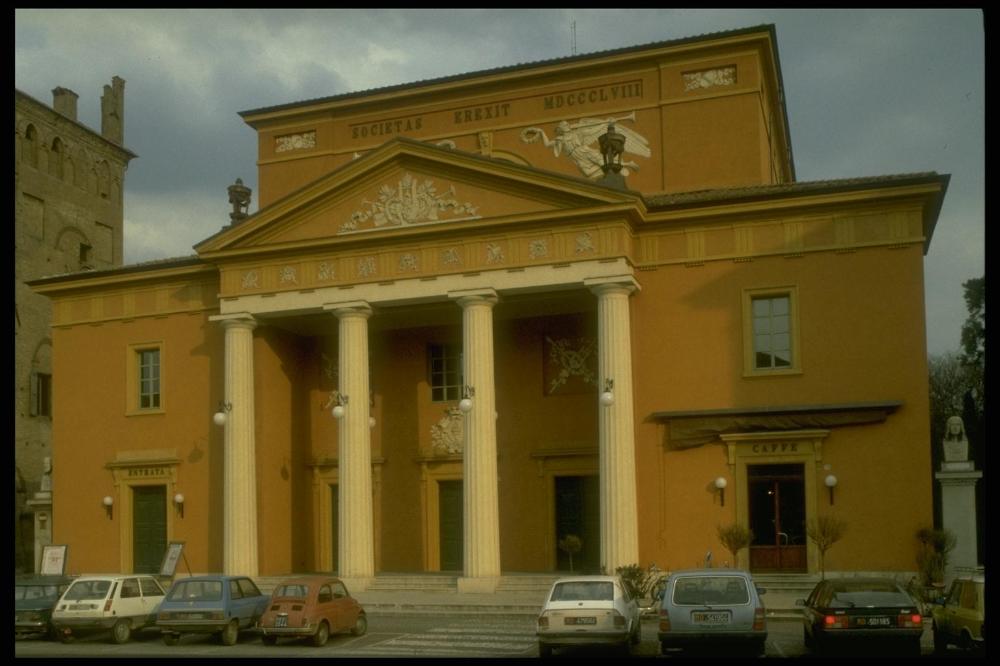


The box seat holders of the Old Theater formed a society in 1848 in order to raise the sum, which the central government had repeatedly refused to grant, necessary for the construction of a new theater. The Society, which by deed of 1856 had undertaken to bear the expenses, commissioned Claudio Rossi, a professor at the drawing school and a representative, along with Cesare Costa, of the Modenese neoclassical movement. Rossi presented two designs. The commission chose the more traditional project “in line with the temple-theater style usual at the beginning of the nineteenth century (consider the Regio of Parma)” (Bondoni in Theaters, 1982, p. 203). The more experimental eclectic design with a neo-Renaissance taste was rejected. For the construction of the new building, the old site was not to be altered, so the free area located between the Pio castle where the Old Theater stood and Palazzo Sacchetti, the Town Hall seat, was preferred. In March 1857 the works began and ended four years later with the inauguration on August 11, 1861. A porch projecting over stone steps, resting on four Doric columns and crowned by a wide pediment, strongly characterizes the facade of the new theater. Above it, corresponding to the auditorium, set back, rises a ‘sub-pediment’ with a semicircular window decorated in relief with the allegorical figure of Music and Dramatic Art. In 1860, when construction costs became unsustainable, the Society ceded the rights to the Municipal Administration which acquired ownership. However, the commitment of the box holders’ Society was still remembered on the facade where it reads “Societas erexit MDCCCLVIII.” A garden behind the theater and a series of busts with important city figures delimit the theater space and enhance its role in the cityscape. From the elliptical internal foyer decorated with gilded stuccoes, you access the ticket office, cloakroom, bar, and the performance hall. The layout of the stalls is horseshoe-shaped with 22 boxes on the first tier, 22 on the second, and 24 on the third (once equipped with backstage), one royal box, and a gallery. The stalls, with a recently renewed wooden floor, accommodate about 500 people. The Society of Box Holders was also remembered in the decorations by Ferdinando Manzini who portrayed the features of the members in the medallions of the box railings. Of Giuseppe Ugolini, who decorated the ceiling of the stalls with figures of Music, Poetry, Prose, and Dance, a decorative project with nine Muses similar to the decoration he executed for the second atrium of the Municipal Theater of Reggio is also preserved. Also the curtain decorated by Ugolini with Orpheus urging Nature. Unfortunately, the load-bearing structure of the stage, of considerable size, equipped with a proscenium arch and clock, has been redone in concrete. Numerous service rooms include a room for set designers and seventeen dressing rooms for actors. Albano Lugli decorated the overdoors of the foyer located above the entrance hall, with copies taken from Correggio’s female figures. In an adjoining small room with a fireplace, the ‘Casino Society’ met to organize exhibitions, conferences, and cultural meetings. A first restoration was carried out in 1939, and between 1978-1981 the Municipality oversaw an important restructuring and consolidation project. (Caterina Spada)
Information about the Municipal Theater of Carpi
Piazza dei Martiri,
41012 Carpi (Modena)
Source: MIBACT