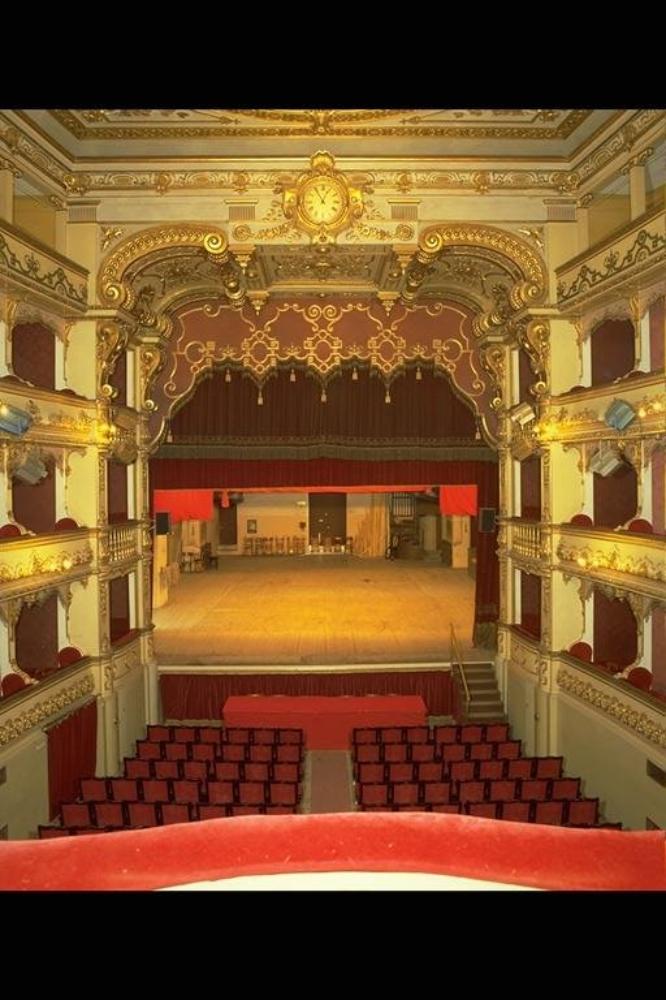
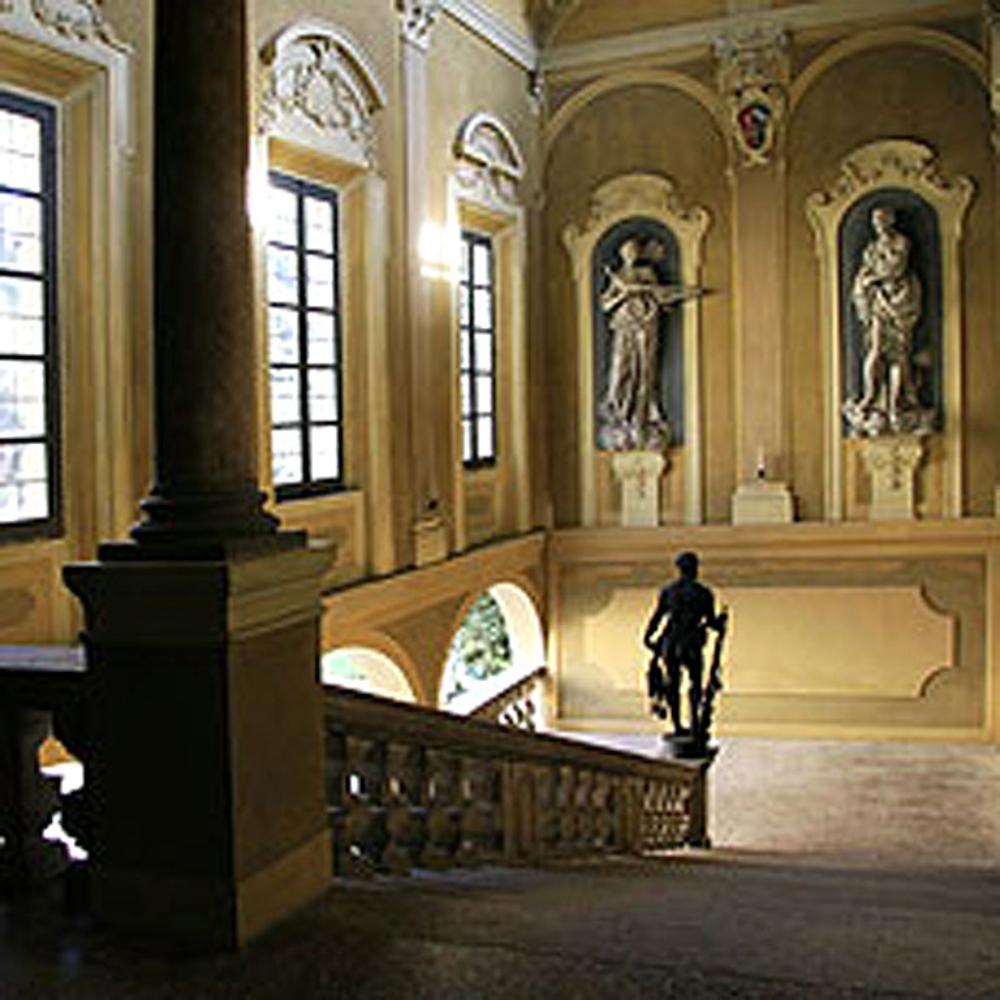
This theater stands in San Lorenzo on the site once occupied by the Theater of the Academy of the Intrepid, then by the Obizzi Theater, designed by Carlo Pasetti and inaugurated in 1660 on the occasion of the arrival in Ferrara of Cardinal Frasone, the new Legate, with the Dafne by Pio Enea degli Obizzi. The old Obizzi Theater, after 1674 following the death of Pio Enea, remained inactive for several years and was destroyed by a fire in June 1679. The ruins remained in place until the first decade of the 19th century, when they were removed to complete the San Paolo bridge. The area thus freed gave rise to the New Square, later dedicated to Giuseppe Verdi, on which the Tosi Borghi Arena was built. Since 1855 the Ferrara Community Council had discussed the possibility of providing the city with a stable daytime arena or theater, as until then only provisional locations had been used for this purpose. The following year, the construction project for an arena for daytime public entertainment presented by Giulio Tosi Borghi, chief machinist of the Municipal Theater who had previously created a temporary arena, was approved. On June 14, 1857, with a performance by the Chiari Dramatic Company, this arena was inaugurated, uncovered with a circular stalls protected by a railing and a loggia. The following year it was covered with a awning, later with a true roof and equipped with a second loggia supported by wooden columns. However, the first radical restoration took place only in 1871, when the wooden columns were replaced with cast-iron ones, and two years later it was fitted with a new curtain painted by Giuseppe Migliari. In 1912 the Arena was acquired through a public auction by new owners who entrusted engineers Faust Finzi and Antonio Mazza with transforming the structure into a true theater. The stage (equipped with spacious dressing rooms) and the hall were expanded, and with the traditional railing removed, boxes and balcony seats were erected. The first gallery was cantilevered with a bulging parapet while the second was made deeper. The new blue and gold awning matched the upholstery; in addition, a “advertising curtain” was introduced. The skylight’s realization was entrusted to Polish artist Guido Marussig, the white and gold stucco decorations (now no longer present) were the work of Venetian Lina Zanetti and Ferrarese Cleonte Chianarelli; from the foyer one accessed a new café and an elegant smoking room. The new theater was dedicated to Giuseppe Verdi, on the centenary of his birth, and inaugurated with a performance of Aida on May 13, 1913. Very active until World War II, it then inexorably fell into disuse until permanent closure after being used for some time as a cinema and for vaudeville. In the 1990s the Municipality of Ferrara purchased it and started a complex restoration project in order to convert it into an auditorium, based on suggestions from maestro Claudio Abbado. Structural consolidation has now been completed. (Lidia Bortolotti)
Information about Giuseppe Verdi Theater of Ferrara
Via Castelnuovo, 6,
44121 Ferrara (Ferrara)
Source: MIBACT