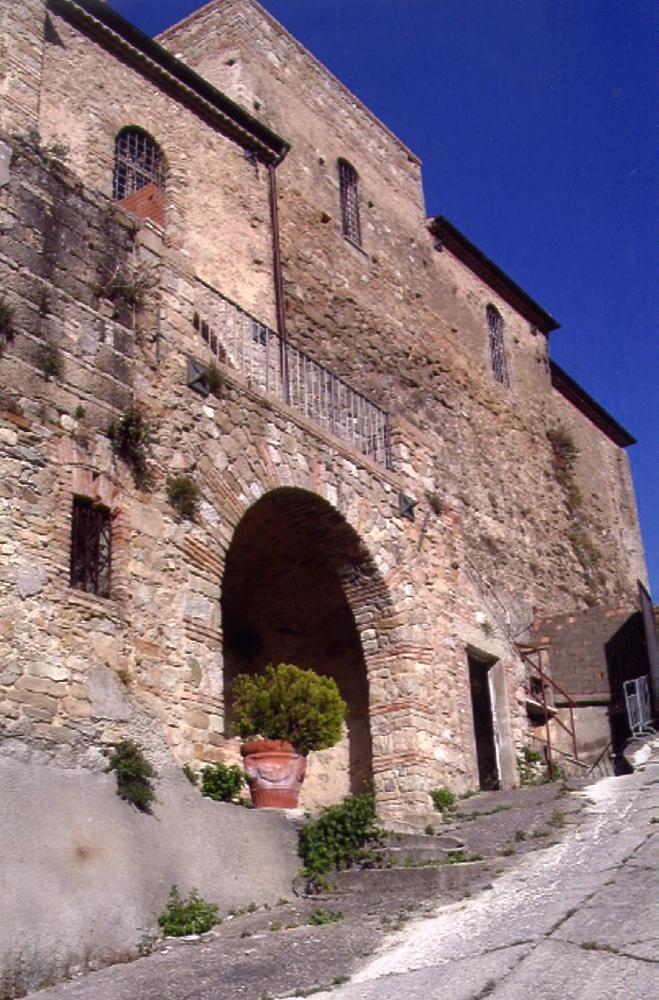


As shown in the engraving published by Pacichelli in the famous “Il Regno di Napoli in prospettiva” (1703), before the violent earthquake of September 8, 1694, which completely destroyed it, the Calitri castle was an imposing structure with four large corner towers, buttresses, and other fortification works. The engraving also reveals that the main entrance was located on the southeast side of one of the hills overlooking the Ofanto and Cortino valleys. The entire north facade, articulated in two massive protruding curtain walls, was built on a steep cliff of layered sandstones over seventy meters high. A detailed description of the fortified building from 1691 still speaks of “a very famous castle loaded with dwellings, about 300 rooms, which can comfortably house five noble courts, well equipped with two drawbridges with beautiful bastions, considering that said castle is located on a mountain and garnished with all conveniences and more.” It was the final period of the Gesualdo family, who had acquired it in 1304 and held possession for over three centuries, expanding it with significant and repeated restructuring interventions and transforming it into a sumptuous residence fitting for princes and prelates. Already damaged by the shocks of previous years, in 1694 the manor collapsed onto the houses below, causing a series of chain collapses. It was never rebuilt, the stones were resold in lots to citizens who reused them in new constructions, while the most valuable spoliated material was used by the feudal lord to renovate “a small palace of said land (…) in the square, commonly called the house of Gatta”, to be used as the Baron’s residence “after the ruin of the Castle due to the earthquake.” On the eve of November 23, 1980, before almost completely collapsing, the entire area where the ancient castle stood was already covered by a dense urban fabric, a consequence of the long series of building and urban planning renovations layered from the 18th century onwards. All these changes had largely altered the typological layout of the ancient building itself, transforming it into a village, making its identification, delimitation, and volumetric consistency problematic. The intervention completed in 2008 restored the entire upper part of Calitri’s historic center for public use. It included the restoration of building blocks, urban planning arrangement, and exhibition setups for the entire area between Via Castello, Via Madonna delle Grazie, and Le Ripe. The restored spaces house the “Ceramics Museum,” comprising historical sections and exhibition spaces for current artisanal production and contemporary artistic majolica, with workshops and restoration studios as well as essential services and dedicated educational spaces.
Information about the Ceramics Museum of Borgo Castello
Via Castello snc,
83045 Calitri (Avellino)
https://www.calitri.net/Itinerari_museo.asp
Source: MIBACT