


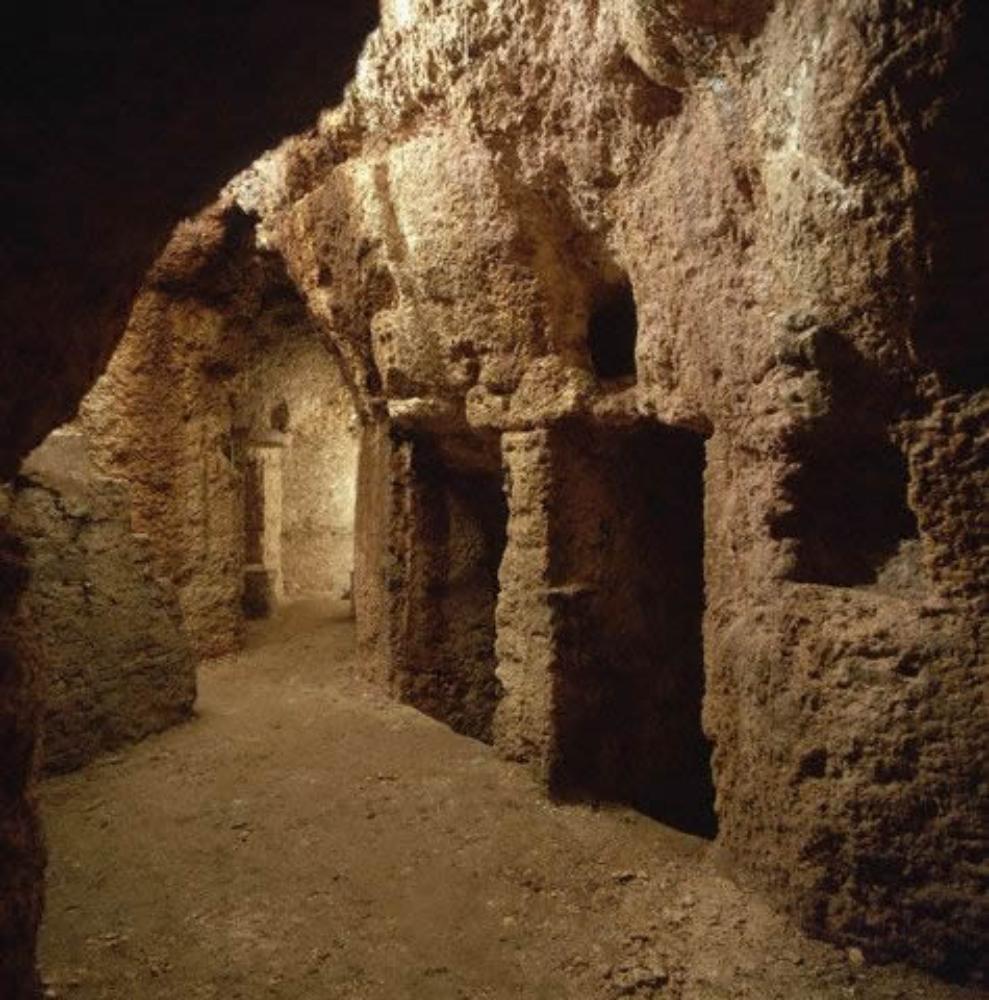


Just a few steps from Via Monastero Maggiore, at no. 2, is the Celtic Hypogeum. It consists of various underground chambers, excavated in the rock with primitive technique, developed at different levels, branching approximately in the shape of a K.
A steep ladder leads to the central chamber, from which three corridors depart. On the walls, there are niches and rough benches, but the greatest mystery is represented by three crude masks.
The original function of this very particular monument, which has no parallel in Friuli, remains an unsolved question. Aside from imaginative interpretations blended with legend, it has been hypothesized that the hypogeum had a funerary use in the Celtic period, while other scholars believe the premises were prisons during the Roman or Lombard periods. The hypogeum seems to have been carved out from a natural cavity along the right rocky bank of the Natisone River, which flows below. Of pre-Roman, possibly Celtic, age, its function at the time remains unknown. Given the closure of the natural opening towards the river, it may have served as a water cistern and was certainly reused later, although the reason is unknown. Connecting steps were carved in the rock, as well as stone seats and benches, pillars, and, most intriguingly, two roughly carved faces that seem like millennial sentinels guarding ancient cults. The presence of water, which wets the floor surfaces and filters through the porous rocks, could be indicative, hinting at possible rituals whose details are unknown. On the left, two stone seats can be seen, which necessarily narrow the passage: here two people could sit, perhaps for ritual purposes.
Information about the Celtic Hypogeum
Via Monastero Maggiore, 2
33043 Cividale del Friuli (Udine)
0432710422
[email protected]
https://www.cividale.net
Source: MIBACT