


Composed of four islands – Mallorca, Menorca, Ibiza, and Formentera – located in the heart of the Mediterranean, the Balearic Islands are an idyllic paradise of stunning beauty, with protected parks, crystal-clear coastlines, and unique landscapes. But there’s more: the Balearics are also the ideal destination for anyone looking to enjoy an active break. There are over 400 hiking and coastal trails perfect for outdoor enthusiasts.
Thanks to the introduction of the ITS–Sustainable Tourism Tax, the Balearic Islands’ Government is committed to preserving this natural beauty. The survival of these landscapes also allows AETIB–the Balearic Islands Tourism Strategy Agency–to promote the archipelago as the perfect destination for lovers of outdoor sports.
Balearic Islands and sustainability
The Balearic Islands are strongly committed to sustainability, shown by the implementation of the Sustainable Tourism Tax (ITS). Since 2016, this tax—applied to anyone staying in tourist accommodations on any of the four islands—has funded environmental, cultural, research, and sustainability projects, all aimed at creating a better environment and services for both tourists and residents.
To date, this tax has financed over 170 projects across the archipelago, with more than 260 million euros invested in 6 key areas: education and employment, social housing, research, historical heritage conservation, sustainable and year-round tourism, and the preservation of the natural environment.

Balearic Islands: travel tips
Not many know that the Balearic Islands are a top destination for trekking lovers. If you want a truly unique way to admire the islands’ breathtaking scenery, hiking one of the many trails is by far the best choice. Among them, don’t miss the route through the Albufereta Natural Park on Mallorca—an itinerary best explored by bike.
This protected area is of great ecological significance: chosen by hundreds of birds as a migratory stopover, it’s located in the Bay of Pollença on Mallorca’s northern coast, and is fed by four streams: Can Xanet, del Rec, de la Font del Mal Any, and de Can Roig.
Declared a Nature Reserve in 2001, it’s one of the main attractions in the Bay of Pollença, standing out for its extraordinary landscape and high botanical and ornithological value. Within the park, a mosaic of natural and semi-natural habitats unfolds—shaped by centuries of human interaction with nature—including lakes, meadows, streams, canals, farmland, dunes, and beaches. The water running through two ponds and several canals eventually flows into the sea beneath the road bridge connecting Alcúdia and Port de Pollença.
On Menorca, the Albufera des Grau is the island’s most important natural park, and an unmissable destination for wonder-filled walks under the open sky. Spanning over 5,000 hectares full of plant species and home to hundreds of animals—both water birds (such as ducks, herons, cormorants) and raptors (including ospreys and booted eagles)—the area offers a truly diverse ecosystem.
In 1993, Menorca was declared a UNESCO Biosphere Reserve, and the Albufera des Grau is a key part of this network, which includes: one park, five nature reserves, one marine reserve, and nineteen ANEI–Special Interest Natural Areas.
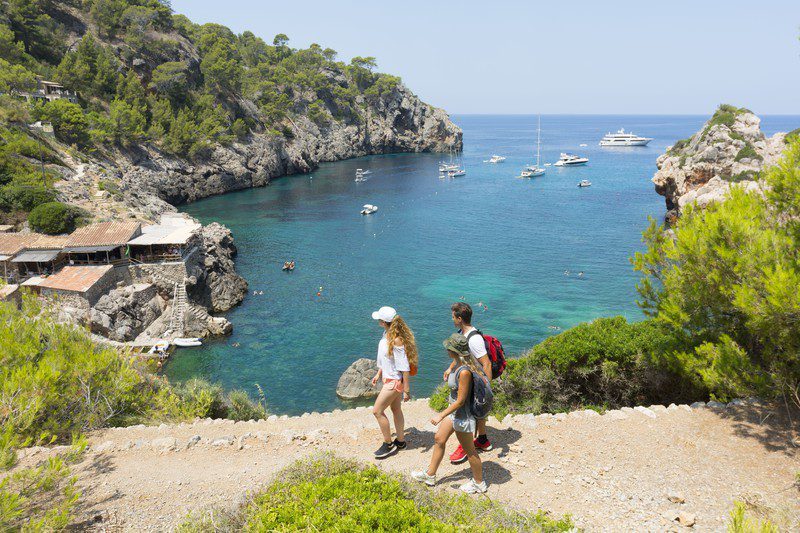
In the Balearics: so much more than trekking
In Ibiza, for example, just across from the islets of Es Caragoler, En Morellener, Illa de Santa Eularia, Illa Gran, and Illa Rodona, you’ll find Cala Martina, a lovely beach that’s a favorite among fans of water sports like dinghy sailing, paddle surfing, and kayaking. It’s the perfect stretch of coastline for these activities, and if you enjoy diving, there’s a local school offering excursions to the nearby islets—famous for their marine caves.
Cala Martina beach is about 250 meters long, with soft, light-colored sand that gently slopes into the sea. The seabed is a mix of sand, rocks, and seagrass; don’t forget your snorkel!
Finally, on Formentera, at the heart of the island’s northern coast, lies the Costa des Carnatge or Platja de Tramuntana, a stretch of coastline that’s 2 km long and 30 meters wide. This low, rocky zone is ideal for walking with suitable shoes, offering exceptional Mediterranean views. It’s one of Formentera’s most peaceful spots—perfect for those who appreciate solitude and the open landscape. Tramuntana’s coastline is bordered by the small peninsulas of Prima and sa Creu. In addition to Costa des Carnatge, the area includes beaches like Es Picatxo, Es Quintalar, Racó des Cans, Cala d’en Baster, and Punta de sa Palmera.