


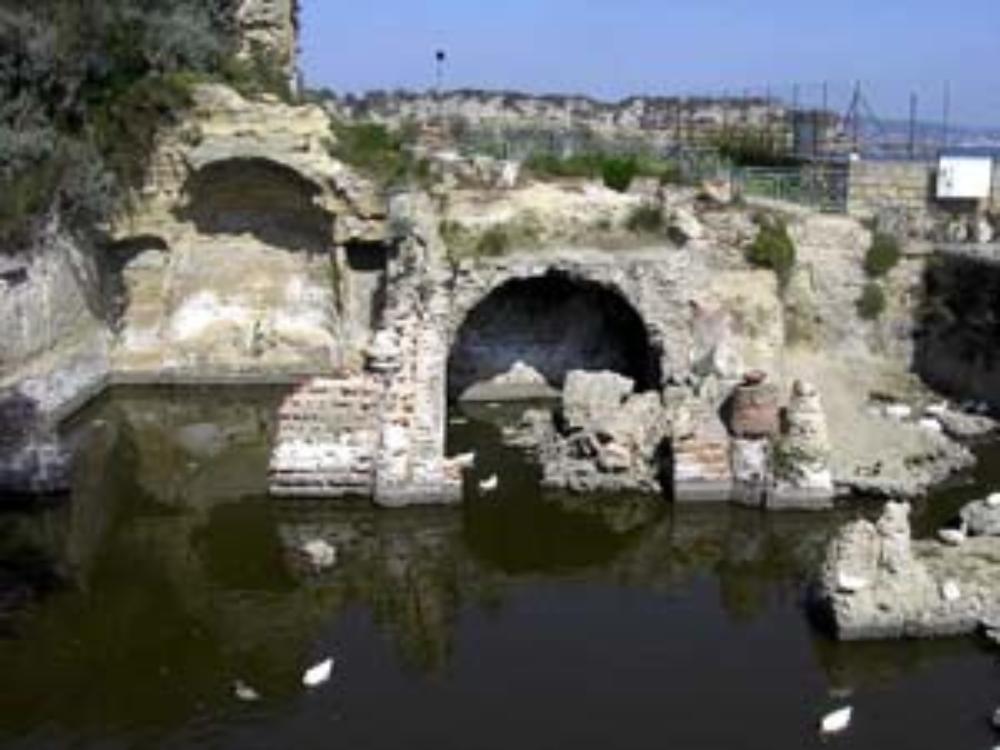


The monumental complex, located a short distance from the theater, built during the Julio-Claudian era and dedicated to the cult of Emperor Augustus, in its current form dates back to the Antonine age arrangements (mid-2nd century AD), commissioned by Cassia Victoria in honor of her husband L. Laecanius Primitivus, an Augustal priest from the time of Marcus Aurelius. However, the building was destroyed at the end of the 2nd century AD probably due to seismic events. At the time of its discovery in 1967, statues of Vespasian, Nerva, Titus, Abundance, and several deities including Asclepius, Apollo, and Venus were found, one of the type of the Small Herculaneum and another on a dolphin, then removed and now displayed in the dedicated room inside the Archaeological Museum of the Phlegraean Fields. Semi-submerged due to bradyseism, the sanctuary consists of three adjacent rooms, partly constructed in masonry and partly carved from the rock, which forms the lateral and rear walls. The central building, the true shrine, consists of a small podium-temple of rectangular plan in front of which the altar is located. By means of a marble staircase, flanked by two masonry podiums originally covered with marble slabs and surmounted by statues, one reaches the tetrastyle pronaos with cipollino columns featuring Pergamene-style capitals, above whose epistyle, bearing the dedicatory inscription, was the pediment decorated with reliefs. Beyond this vestibule, paved with a mosaic carpet of white tesserae and a black tesserae border, and crossing the marble threshold, one enters inside the shrine. This is built in opus reticulatum with tufelli bonding, while its walls would have been covered with marble slabs. On the rear wall, an apse with a podium, flanked by two rectangular niches, is plastered and painted red on the upper part of the front, while the apse vault features stucco decoration with marine-themed reliefs. The floor, made of cocciopesto with white tesserae arranged to form squares, contains a central band in polychrome marble repeating the same geometric motif. The room to the right of the shrine, built in opus reticulatum, was decorated with stucco and painted plaster coverings on the walls and on the barrel and groin vaults. In the one on the left, the bronze equestrian statue of Nerva (originally Domitian) was found, now in the Archaeological Museum of the Phlegraean Fields.
Information about Augustali Shrine
Via Miseno
80070 Bacoli (Naples)
0815235035 – 0818040430
[email protected]
https://www.archeona.beniculturali.it
Source: MIBACT